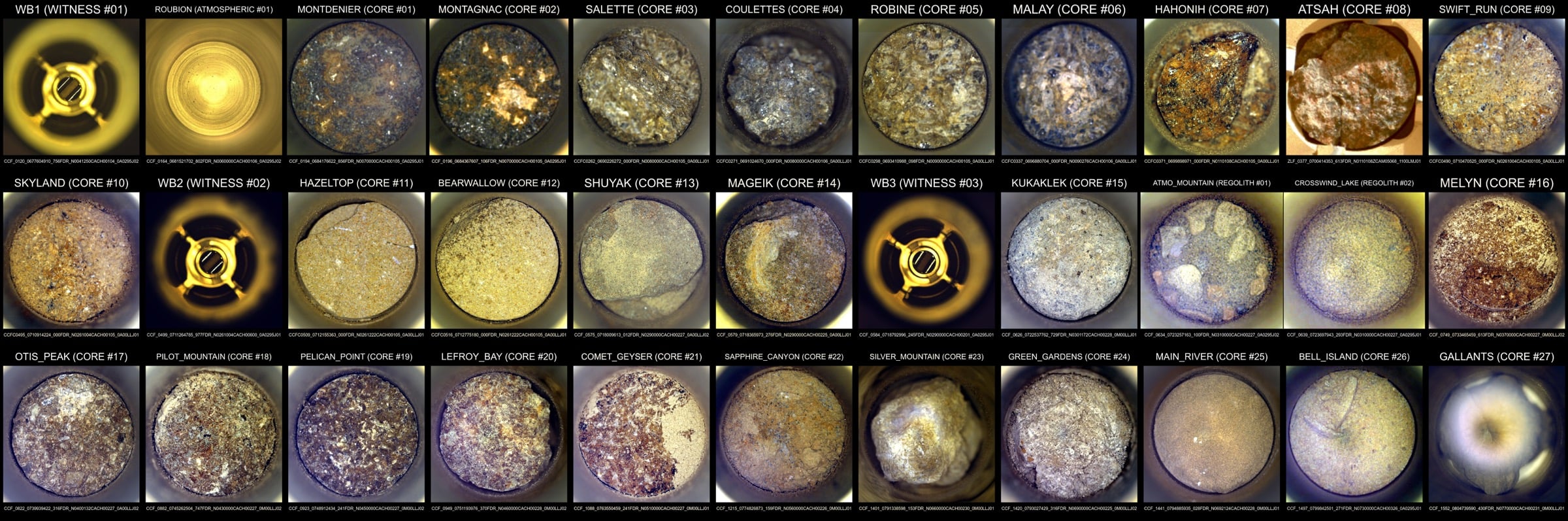
Congress ended the existing Mars Sample Return programme in January 2026 by giving it no money in NASA’s final fiscal-year budget. The decision did not stop Perseverance. The rover remains active in Jezero Crater, drilling, sealing and cataloguing pieces of Mars for a return mission that no longer exists in approved form.
The distinction matters. Lawmakers did not order the samples abandoned forever, and a later Congress could fund a different architecture. But as things stand, no authorised lander, Mars ascent rocket or Earth-return spacecraft is coming to collect them.
That leaves one of the most deliberately assembled geological collections in exploration history split between a titanium-tube depot on the Martian surface and the belly of a working rover.
What Congress actually cancelled
The decisive language appears in the joint explanatory statement for the 2026 appropriations agreement: “the agreement does not support the existing Mars Sample Return (MSR) program.” Congress approved roughly US$24.4 billion for NASA overall, rejecting most of the administration’s proposed agency-wide cuts, but accepted the White House’s decision to end MSR in its existing form.
The agreement provided US$110 million for “Mars Future Missions”. That money preserves work on capabilities such as radar, spectroscopy, entry, descent and landing. It is not an appropriation for retrieving Perseverance’s cache.
Cancellation is therefore the fair description of the programme NASA and the European Space Agency had been designing. It is not the same as a legal prohibition on ever returning a Mars sample. There is simply no approved mission, schedule or complete budget that connects the tubes in Jezero Crater with a laboratory on Earth.
Five years of selection are sealed inside the tubes
Perseverance landed on 18 February 2021 with a sampling system built to unusually strict contamination standards. Its team does not merely drill the nearest convenient rock. Scientists first study each site with cameras and spectrometers, reconstruct its geological setting, abrade selected surfaces and decide which cores best represent Jezero’s volcanic, river, lake and groundwater history.
NASA’s current sample inventory records 30 collected samples in 38 available sampling tubes, alongside three sealed witness tubes used to track possible contamination. The collection includes igneous and sedimentary rock cores, regolith and Martian atmosphere.
Ten tubes were deposited at a backup cache called Three Forks in early 2023. Most of the remaining collection stays aboard Perseverance. The surface depot was created so a future retrieval mission would still have something to collect if the rover could no longer deliver its onboard tubes directly.
Among them is Sapphire Canyon, the core from Cheyava Falls. As Space Daily has reported in detail, that rock contains mineral and organic associations described as potential biosignatures. That phrase does not mean life was discovered. It means the sample deserves tests that Perseverance cannot perform.
Why the laboratories have to come to the samples, or the samples to Earth
A rover carries instruments selected years before launch, constrained by mass, power, temperature and the need to survive landing. Earth laboratories can use multiple generations of equipment, repeat measurements, prepare slices thinner than a hair and let independent teams test competing explanations.
Returned material could be examined with electron microscopes, synchrotrons, high-precision isotope instruments and organic chemistry methods too large or delicate to place on Mars. Researchers could study individual mineral grains and their boundaries, then preserve much of the collection for techniques not yet invented.
This is why sample return was never an elaborate courier service. Perseverance’s job was to provide geological context and make the selection. The deepest analysis was always meant to happen later on Earth.
How an eleven-billion-dollar programme lost its path
The planned retrieval chain was exceptionally complicated. A lander would carry a small rocket to Mars. Samples transferred from Perseverance, or collected from the depot, would be loaded into that Mars Ascent Vehicle and launched into orbit. An ESA Earth Return Orbiter would capture the sealed container and bring it home under strict planetary-protection controls.
NASA’s 2023 independent review concluded that the architecture faced unrealistic cost and schedule assumptions. Estimates rose towards US$8 billion to US$11 billion, with return slipping as late as 2040. NASA responded by restructuring the programme and soliciting lower-cost designs.
In January 2025, the agency narrowed the work to two landing approaches, both still estimated at roughly US$6 billion to US$7 billion. NASA said it would choose an architecture in the second half of 2026. Congress removed support before that decision could become a funded mission.
The samples are waiting, not wasted
The cancellation does not erase the rover’s science. Every core has already sharpened the geological record of Jezero because the sampling work is accompanied by images, chemical maps and observations of the surrounding rock. Perseverance is also still collecting data and remains capable of carrying its onboard tubes.
Nor are the tubes approaching a simple expiry date. They were designed to preserve their contents for years on Mars. Their precise locations are mapped, and the depot offers redundancy if the rover eventually fails.
What I find difficult to ignore is the asymmetry. Humanity completed the part that required landing a nuclear-powered laboratory on Mars, driving it through an ancient lake basin and choosing individual centimetres of rock. The missing part is a political and engineering commitment to finish the trip.
A new return architecture may eventually be approved, perhaps using technologies Congress is still funding. Until then, the mission’s most consequential cargo remains exactly where Perseverance placed it: sealed, documented and beyond the reach of every laboratory built to understand it.