
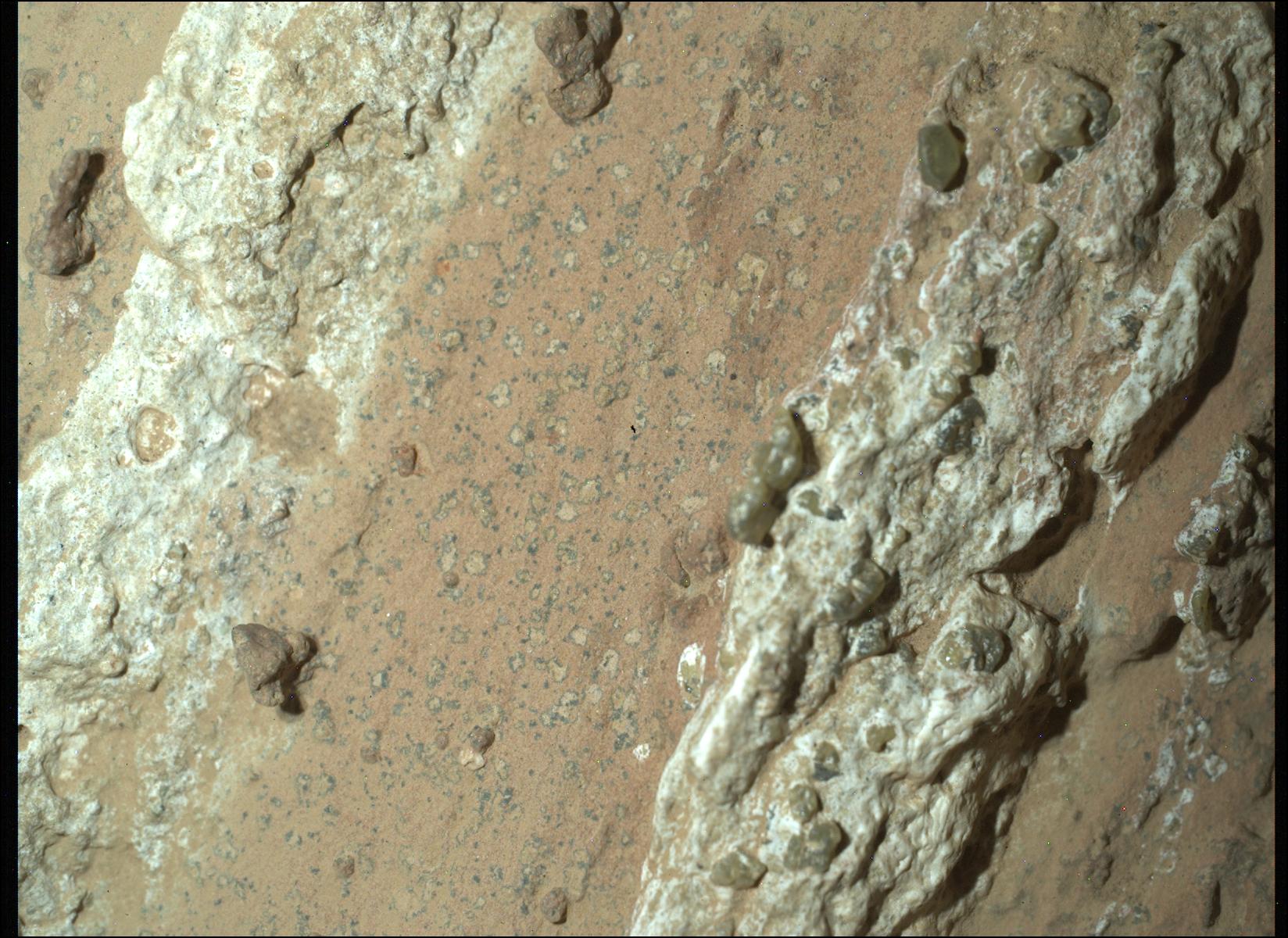
NASA’s September 2025 announcement about the Perseverance rover did not say that life had been found on Mars. It said something more careful, and in some ways more interesting: a sample taken from a rock called Cheyava Falls contains a potential biosignature.
The sample, named Sapphire Canyon, came from the Bright Angel formation in Neretva Vallis, a dried-up river valley that once carried water into Jezero Crater. According to NASA’s 10 September 2025 release, the rock preserves evidence of ancient water, organic carbon, and chemical reactions that could have provided energy for microbial metabolisms.
The central word is potential. A potential biosignature is not proof of life. It is a substance, structure, texture, or pattern that might have a biological origin, but still needs further evidence before biology can be separated from non-biological chemistry.
What Perseverance found at Bright Angel
Perseverance encountered Cheyava Falls in July 2024 while exploring the Bright Angel outcrops along Neretva Vallis. The rover’s instruments, including PIXL and SHERLOC, examined an arrowhead-shaped rock about 1 metre by 0.6 metres and later collected the Sapphire Canyon core.
The rock is sedimentary. NASA said the formation’s rocks are composed of clay and silt, materials that on Earth can preserve traces of past microbial life. The same rocks are rich in organic carbon, sulfur, oxidised iron and phosphorus.
Those ingredients matter because they sit at the intersection of habitability and preservation. Organic carbon is not life by itself. Water-shaped sediments are not life by themselves. Iron and sulfur chemistry is not life by itself. But a place where all of them overlap is exactly the kind of setting astrobiologists pay attention to.
The leopard spots carry the signal
The feature that raised the level of interest was a pattern of small spots and reaction fronts, described by the mission team as leopard spots. In higher-resolution data, those spots carried signatures of two iron-rich minerals: vivianite, a hydrated iron phosphate, and greigite, an iron sulfide.
On Earth, NASA noted, vivianite is often found in sediments, peat bogs, and around decaying organic matter. Certain microbial life can also produce greigite. The Nature paper behind the announcement, “Redox-driven mineral and organic associations in Jezero Crater, Mars”, was led by Joel A. Hurowitz and published on 10 September 2025.
The paper interprets the mineral patterns as evidence of electron-transfer reactions between sediment and organic matter. That is why the finding is astrobiologically interesting: microbial life can use such redox reactions to obtain energy for growth.
It is also why the result must be handled cautiously. Chemistry that can feed life is not the same as chemistry made by life.
Why this is not a life detection
NASA’s own release is careful on this point. The minerals could have formed without biology, through processes involving sustained high temperatures, acidic conditions, or reactions helped along by organic compounds. The Bright Angel rocks do not appear to show evidence of high-temperature or acidic alteration, which makes those explanations less straightforward, but not impossible.
Katie Stack Morgan, Perseverance project scientist at NASA’s Jet Propulsion Laboratory, put the caution plainly in the release: abiotic explanations are less likely under the paper’s findings, but they cannot be ruled out. That is the difference between an intriguing signal and a confirmed biological origin.
This matters because Mars has a history of life-shaped hopes that later proved more complicated. The scientific standard is not whether a feature can be explained by biology. It is whether non-biological explanations can be excluded strongly enough to make biology the best remaining account.
Cheyava Falls is not there yet.
The sample’s setting makes it harder to dismiss
The reason the finding is being treated seriously is the geological context. Neretva Vallis was carved by water flowing into Jezero Crater. Jezero itself was selected for Perseverance because it once hosted a lake and delta environment, the kind of setting that could have concentrated sediments and preserved chemical traces from early Mars.
The Sapphire Canyon sample was taken from clay- and silt-rich rocks in that ancient river system. If Mars ever hosted microbial life, fine-grained water-laid sediments are among the places where evidence might survive.
The surprise in the NASA release is that the rock belongs to some of the younger sedimentary material Perseverance has examined. One earlier assumption was that potential traces of ancient life would be most likely in older rocks. If the Bright Angel result holds up, it could suggest either that habitable conditions lasted longer than expected or that younger rocks can preserve clearer signals than anticipated.
That is a geological implication, not a declaration of biology.
Why Earth laboratories still matter
Perseverance can do a great deal from the surface of Mars. It can image textures, map chemistry, detect organic signatures, and choose samples. It cannot perform every laboratory test that would be needed to settle the origin of the Cheyava Falls features.
That is why the Sapphire Canyon core matters as a cached sample. The strongest tests would involve bringing the material to Earth, where laboratories could examine isotopes, mineral structures, organic molecules, microscopic textures, and possible formation pathways with instruments too large or specialised to fly on a rover.
This is the uncomfortable position Mars science now occupies. Perseverance may already have collected one of the most scientifically important rocks in the search for ancient life, but the interpretation remains limited by what can be done remotely.
The announcement therefore strengthens the case for sample return, even as Mars Sample Return has faced cost, schedule, and political pressure.
The careful reading
The Cheyava Falls result is one of the strongest potential biosignature claims from Mars because several pieces line up: an ancient water-shaped setting, organic carbon, redox-active chemistry, iron phosphate and iron sulfide minerals, and textures that resemble reaction fronts.
None of those pieces alone establishes life. Together, they justify the attention.
The next question is not whether the announcement should be exciting or dismissed. It is whether the same features can be produced without biology under plausible Martian conditions. Until that question is answered, Sapphire Canyon sits in the most interesting category Mars science has: not evidence of life, but evidence that deserves the full machinery of life-detection science.
