

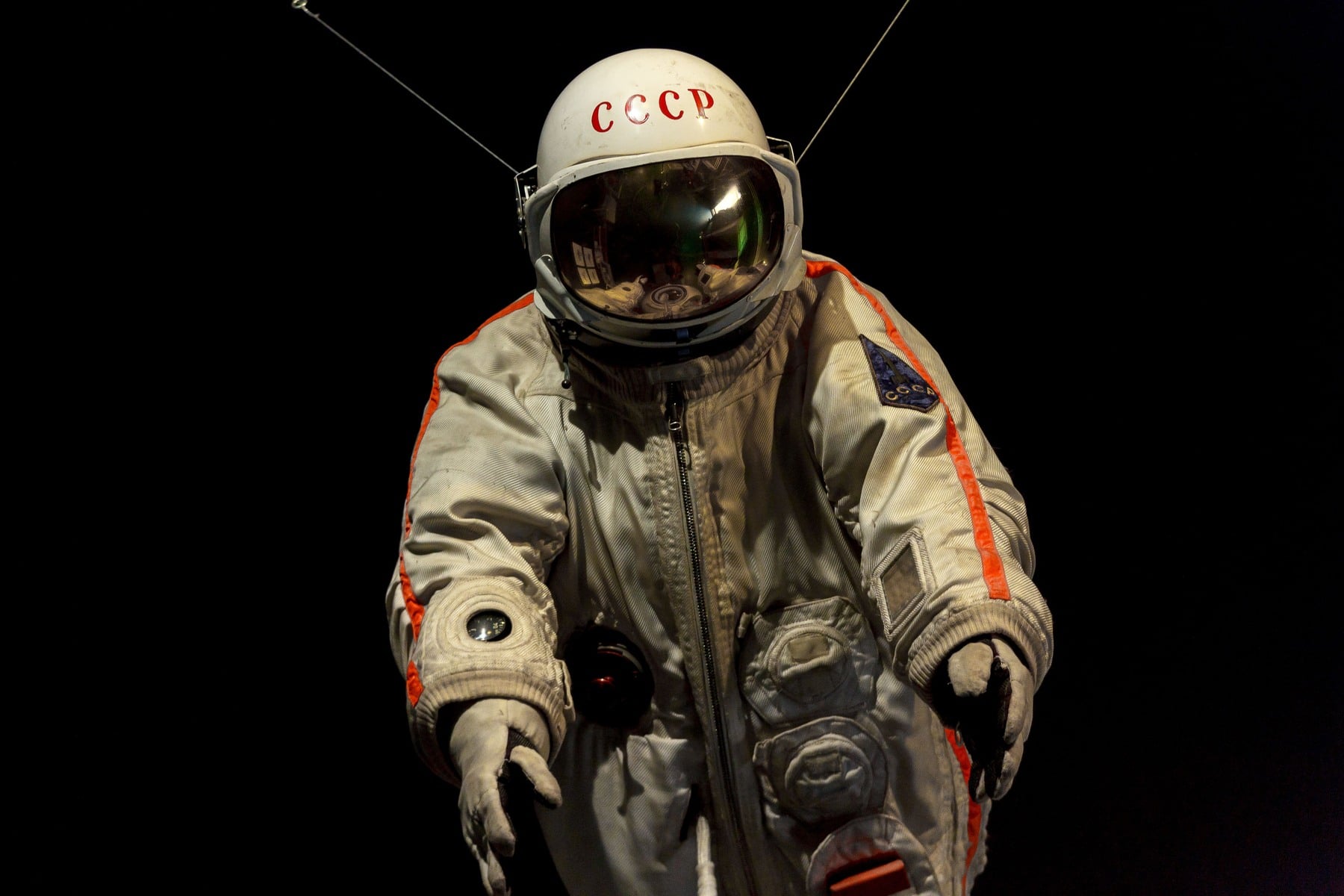
When the Soyuz TM-20 capsule landed in Kazakhstan on 22 March 1995, Valeri Polyakov had been away from Earth for fourteen and a half months. He had launched on 8 January 1994, lived aboard the Russian space station Mir through three expedition crews and spent 437 consecutive days in orbit.
The calendar alone is difficult to absorb. The New Mexico Museum of Space History records 7,075 circuits of Earth and a distance of 186,887,000 miles. That is accumulated travel around the planet, not a straight-line journey 187 million miles away, but it captures the repetition: another orbit roughly every 90 minutes, day after day, for well over a year.
Polyakov’s goal was not to collect a dramatic number. He was a physician-cosmonaut who wanted to test whether a person could remain physically and psychologically effective across a duration relevant to Mars. NASA later described the 14-month flight as long enough for a round trip to Mars, although an actual mission’s duration depends on its trajectory and time at the planet.
More than three decades later, his record for one uninterrupted spaceflight remains intact. Other people have accumulated far more time across several missions. Several have stayed in orbit for about a year. No one has remained on a single flight longer than Polyakov.
A record counted in one uninterrupted line
Spaceflight records become confusing because two different clocks are often mixed together. One measures a person’s total career time across every mission. The other measures the length of one continuous flight from launch to landing.
Polyakov logged 678 days across two Mir missions. That career total has been overtaken many times. Oleg Kononenko, for example, passed 1,000 cumulative days across multiple flights. It does not alter Polyakov’s separate single-flight record.
The current Guinness record gives his flight as 437 days, 17 hours, 58 minutes and 31 seconds. Some historical NASA pages differ by minutes, a reminder that archived summaries are not always internally consistent. The undisputed fact is the span from 8 January 1994 to 22 March 1995 and a stay just short of 438 days.
NASA’s current American benchmark belongs to physician-astronaut Frank Rubio, whose unexpectedly extended ISS mission lasted 371 days. The agency’s station record table places Mark Vande Hei at 355 days and Scott Kelly at 340. All are extraordinary flights. All remain well below Polyakov’s.
Mir was a laboratory assembled around him
Mir had been launched in 1986 as the first modular space station. New sections arrived over time, producing a complex of laboratories, living areas, solar arrays, docked Soyuz capsules and visiting Progress cargo ships. It was cramped and increasingly worn, but it allowed crews to live continuously in orbit and investigators to extend human spaceflight from months towards years.
Polyakov already knew the station. His first mission, beginning in August 1988, lasted 240 days. He had flown partly to monitor Vladimir Titov and Musa Manarov near the end of their one-year mission and to help prepare them for re-entry. That experience made him unusually qualified to become both the medical observer and the long-duration subject.
He was 51 when Soyuz TM-18 carried him back to Mir with Viktor Afanasyev and Yuri Usachev. Rather than returning with that crew, he stayed as personnel rotated around him. NASA’s history of Mir places him across Expeditions 15, 16 and 17. In the final days, he overlapped with NASA physician Norman Thagard, the first American assigned to a long-duration Mir stay.
This continuity made the experiment valuable. Space agencies had abundant evidence about the opening months of weightlessness. They had much less evidence about whether changes would stabilise, compound or take an unexpected turn after a year.
The physician became his own subject
Polyakov did not simply endure the mission and receive an examination at the end. He performed medical and physiological investigations on himself and on other crew members. The programme followed cardiovascular function, blood and fluid regulation, muscle strength, bone mineral loss and work capacity.
That design had an obvious strength: the subject was a trained doctor who understood the measurements and could notice clinically meaningful changes. It also had an equally obvious limit. A sample of one cannot reveal how a diverse Mars crew would respond, and a person who volunteers to spend more than a year in orbit is unlikely to represent the general population.
The flight nevertheless answered a basic question. A highly selected and well-supported person could continue doing useful work after the six-month point, after one year and through month fourteen. Duration did not automatically produce a sudden collapse in health or performance.
That conclusion was important in the 1990s, but it is not the same as saying that time becomes harmless once someone adapts. The measurements showed costs, and later research has revealed biological changes that Mir-era instruments could not examine in the same detail.
His mental performance stabilised after a difficult opening
A 1998 study co-authored by Polyakov analysed 29 sets of measurements taken before, during and after the 438-day flight. The tasks tested reasoning, memory search, unstable tracking and the ability to combine tracking with a second mental task. Researchers also collected ratings of mood and workload.
Basic cognitive functions were not impaired during the mission. Mood, perceived workload, tracking and divided-attention performance did worsen during the first three weeks in orbit. From the second month through the fourteenth, mood and performance returned towards preflight levels and remained impressively stable.
The difficult transition appeared again after landing. Tracking and time-sharing performance were disturbed during the first two weeks back on Earth, but follow-up testing found no lasting performance deficit six months later.
It is an encouraging pattern: adaptation rather than continuous psychological deterioration. It is also one man’s pattern. A crew of several people can develop conflicts, incompatible sleep schedules or unequal responses that cannot appear in a single-person performance record.
That difference emerged clearly in the later ground analogue covered by SpaceDaily. During 520 days inside the Mars500 habitat, six men showed declining activity and increasingly divergent sleep behaviour. Polyakov experienced real microgravity but remained near Earth; Mars500 reproduced isolation and mission duration without reproducing spaceflight. Neither study contained the whole Mars problem.
His body adapted, but it did not escape microgravity
A technical report by Polyakov and Anatoly Grigoriev described the medical findings from the 438-day flight. Strength declined mainly in the muscles that extend the legs. Mineral losses appeared in the upper femur and lumbar vertebrae. The researchers also reported lower hydration and blood volume and a meaningful increase in the estimated risk of kidney stones.
Exercise and other countermeasures helped him remain functional, but adaptation was not immunity. In microgravity, bones no longer bear ordinary loads, postural muscles have less work to do and fluids redistribute towards the upper body. The cardiovascular system changes because it no longer needs to pump against a constant downward pull.
During the Soyuz descent, Polyakov experienced the familiar consequences of returning from prolonged weightlessness: a powerful sense of body pressure, difficult breathing and speech, faster heart and breathing rates, and vestibular reactions. A medical analysis of his re-entry found no new kind of physiological response absent from shorter flights, supporting the countermeasures used. It did not claim that re-entry was easy.
This distinction matters for Mars. Survival during the cruise is only one requirement. Crew members may need to leave a capsule, manage equipment and respond to danger shortly after reaching a planet where gravity is about 38 per cent of Earth’s.
SpaceDaily’s earlier review of bone loss on a nine-month Mars transit explained why a fixed percentage cannot simply be multiplied by the number of months. Loss rates vary among people and over time, depend on exercise and nutrition, and may partly plateau. Polyakov supplied the longest real human data point, not a universal curve.
A 437-day Mir flight was not a Mars mission
The duration comparison is useful, but the environmental comparison breaks down quickly. Mir orbited only a few hundred kilometres above Earth. It remained inside the planet’s magnetosphere, which supplies substantial protection from the deep-space radiation environment.
A Mars-bound spacecraft would spend most of its journey beyond that protection. NASA identifies five interacting hazards for human exploration: space radiation, isolation and confinement, distance from Earth, changing gravity fields, and a hostile closed environment. Polyakov experienced important parts of three. He did not experience the full radiation or distance hazards.
Mir also received visiting crews and cargo vehicles. Ground controllers could communicate with it with little delay, medical experts were nearby in conversational terms, and a Soyuz was available for return. A Mars crew may wait many minutes for each message, cannot receive an emergency delivery and cannot turn around for a quick journey home.
The station was still a severe environment. It was noisy, confined and dependent on machinery. Polyakov lived through long separation from family and a relentless work programme. Yet the distinction matters precisely because his achievement was real. It should not be burdened with proving conditions he never encountered.
Why nobody has simply stayed longer
The endurance record is sometimes treated as if later crews repeatedly tried and failed to beat it. That is not how station missions are designed. Flight length is chosen around research goals, vehicle schedules, crew rotation, medical exposure, training and cost. A record is not valuable enough by itself to justify several extra months in orbit.
Modern six-month expeditions already provide large bodies of repeatable data. Carefully selected year-long flights extend the curve and allow comparisons between people, while newer instruments measure genetics, immunity, vision, microbiomes and cognition in ways unavailable during Polyakov’s mission.
Frank Rubio’s 371-day flight illustrates the operational side. It was originally planned for six months and extended after a coolant leak made his crew’s Soyuz unsafe for the scheduled return. NASA gained useful long-duration observations, but the added time arose from a spacecraft problem rather than a planned attempt at Polyakov’s record.
A 438-day ISS experiment could be designed, but it would still reproduce low Earth orbit. Agencies can often learn more by combining several long flights, ground analogues, radiation experiments and partial-gravity research than by asking one person to add another day to a number set in 1995.
What the record proves, and what it cannot
Polyakov demonstrated that a human being can live and work in microgravity for longer than many proposed Mars transit plans. He retained basic cognitive function, adapted after a difficult opening period and returned without a previously unseen medical syndrome. Those are substantial findings.
He also lost bone mineral and muscle strength, experienced fluid and cardiovascular changes, and required time to readapt to gravity. His flight did not test deep-space radiation, Martian surface operations, delayed medical support or the dynamics of a small crew isolated beyond any realistic rescue.
The fairest reading lies between triumphalism and dismissal. One exceptional physician aboard one well-supported station could not certify that a crewed Mars expedition is safe. He did show that mission-length exposure to weightlessness and confinement need not destroy a person’s capacity to think, work and return.
That is why the record still matters even if it is eventually broken. The 7,075 orbits were not just fourteen months of waiting. They converted a question about human endurance from speculation into lived evidence, while leaving the harder Mars questions clearly visible beyond Mir’s windows.