

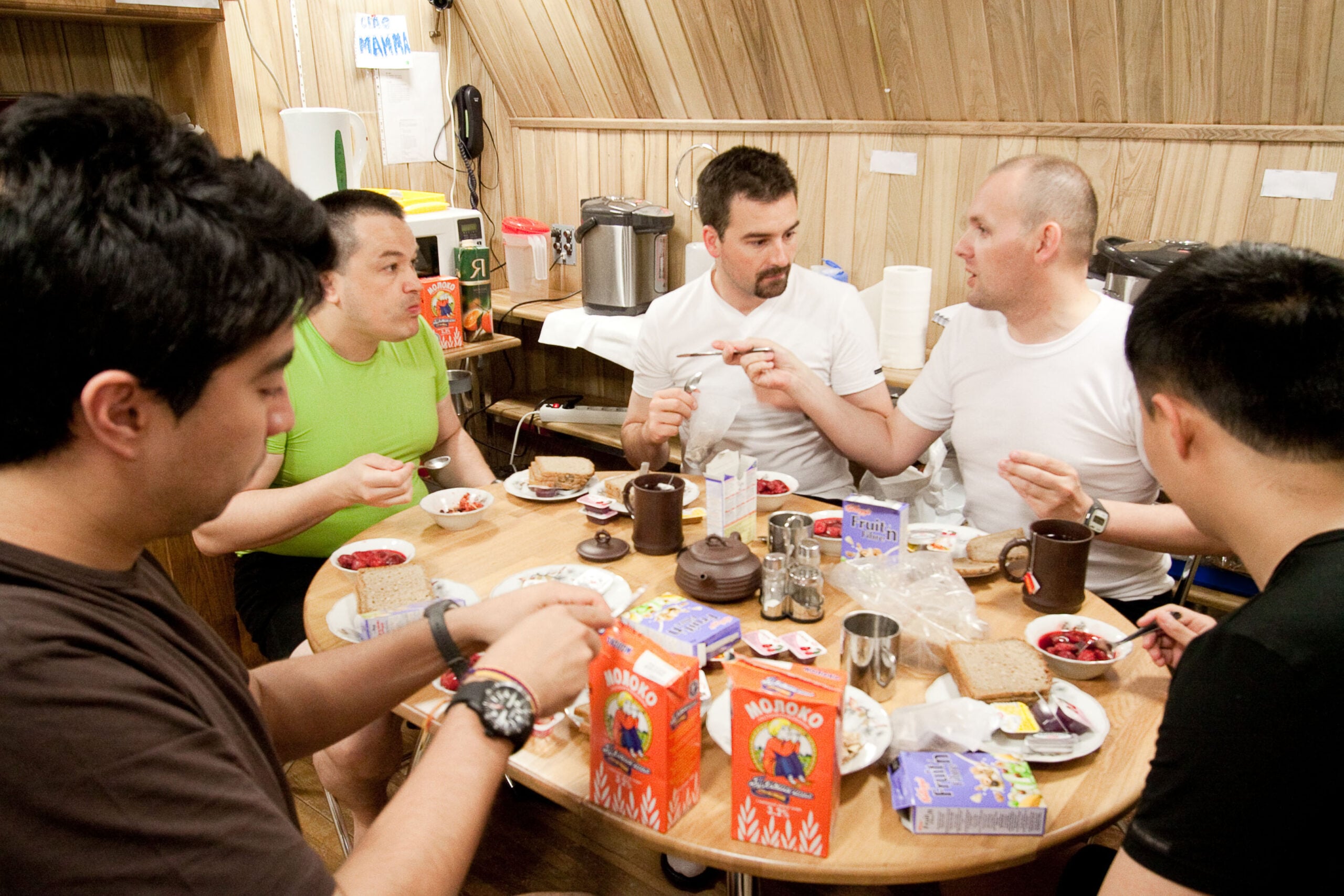
Six men sealed inside a simulated Mars spacecraft became progressively less active across 520 days. From the first 130-day mission quarter to the last, active waking fell by 7 percent, equivalent to 1.12 fewer hours per person each day, while sleep and quiet waking rest increased.
Mathias Basner and colleagues reported the pattern in a peer-reviewed PNAS paper published in 2013. They called the reduction in movement hypokinesis and described the broader slide towards sleep and rest as “behavioural torpor”.
We are writers, not clinicians. This is reporting about an extreme-environment experiment, not medical or sleep advice.
This is one simulation with six participants, not settled consensus about what happens on a real flight to Mars. The average trend was clear, but the six men did not respond in the same way.
The spacecraft was a sealed facility in Moscow
Mars500 began on 3 June 2010 at the Institute for Biomedical Problems of the Russian Academy of Sciences. The hatch reopened on 4 November 2011, after 520 consecutive days. The crew included three Russians, two men selected by the European Space Agency and one selected by the China National Space Administration.
They were healthy male volunteers aged 27 to 38, with an average age of 32. Their backgrounds in engineering, medicine, the military and space training broadly resembled those of working astronauts and cosmonauts.
The “spacecraft” was a 550-cubic-metre pressurised complex of interconnected modules. It reproduced a long outbound flight, Mars orbit, a surface phase for half the crew, and the return journey. Maintenance, scientific work, exercise, emergency drills and delays in communication with mission control supplied the operational rhythm.
An ESA overview of Mars500 makes the central limitation equally plain: the mission never left Moscow. Confinement, isolation and routine were real. Microgravity, radiation, launch risk and the impossibility of emergency return were not.
Speaking of extreme space journeys: if this kind of thing fascinates you, the video here is worth your time. Voyager 1 has been drifting through interstellar space for nearly 50 years, and its power is finally running out — NASA is shutting its instruments down one by one. But before it goes silent for good, it picked up something nobody expected: a faint, steady tone coming from the empty space between the stars.
Four million minutes showed a slow withdrawal from activity
Each man continuously wore a wrist actigraph, a watch-sized device that recorded movement and light exposure once a minute. The instruments produced 4,396,333 usable minutes of data, covering 98 percent of the entire mission.
A validated algorithm classified each minute as active wakefulness, sleep or waking rest. The investigators also collected weekly ratings of tiredness, sleep quality and workload, and tested alertness with a three-minute psychomotor vigilance task.
Active waking dropped steeply during the first three months, then declined more gradually over the following 13 months. Comparing the first and fourth 130-day quarters, active wakefulness fell 7 percent. Sleep increased 8.4 percent, or 0.59 hours per person each day, and waking rest rose 50.4 percent, or 0.54 hours.
Average actigraphic sleep climbed from 7.12 hours a day in the first quarter to 7.71 hours in the fourth. Added together, the crew slept 673 more hours in the second half of confinement than in the first.
The final 20 days were an exception. Active waking and movement intensity rose sharply, while sleep and rest fell. Scheduled workload and the men’s own workload ratings did not rise with them. Mission managers attributed the change to anticipation that the hatch was finally about to open.
“Behavioural torpor” did not mean human hibernation
The word torpor can imply something more dramatic than the researchers measured. In animals, physiological torpor usually involves controlled reductions in metabolism and body temperature. Mars500 did not show that.
The men remained awake, completed work, exercised and finished the mission. Here, “behavioural torpor” was an analogy for sedentariness: progressively less active waking, more sleep and more quiet rest during prolonged confinement.
It was not necessarily a simple decline in function. Across the crew, vigilance performance did not worsen cumulatively. In the second half, when the men slept more, their average normal response speed improved and an already low rate of attention lapses fell.
The early mission showed the other side of the balance. During the first 40 days, average sleep was below 6.78 hours, when workload was high. Sleep briefly dipped again around the simulated Mars surface phase. The problem for mission planners is therefore not that sleep or rest is undesirable. It is that workload, alertness, movement and circadian timing can drift out of balance over a journey measured in years.
Dim light was plausible, but not isolated as the cause
The crew controlled its habitat lighting. For 90 percent of waking mission time, the wrist monitors measured light below 177 lux. Mean exposure while actively awake fell by 25.6 percent across the four quarters, from 104.8 lux to 78.0 lux.
Those levels are dim beside outdoor daylight. Light is also one of the main timing signals for the circadian system, which coordinates sleep and waking with the 24-hour day. The researchers therefore considered low illumination a plausible contributor to altered sleep timing and reduced activity.
But Mars500 did not randomly assign the men to bright and dim habitats. Workload ratings were highest in the first quarter and lower afterwards. The mission also became more familiar and repetitive. Confinement, monotony, fewer demands, access to private unmonitored quarters and falling light exposure changed together, so the paper could not identify one cause.
Later work has tested lighting more directly. A 45-day space-analogue experiment using dynamic lighting compared scheduled changes in light with standard lighting under repeated sleep restriction. It was a different task and population, but it reflects the practical direction that follows from Mars500: make the timing environment part of habitat design rather than treat light as decoration.
The crew average concealed six different missions
SpaceDaily’s earlier account of Mars500 focused on the sleep schedules pulling apart. A companion PLOS One analysis of the same crew showed how much the group average concealed.
Four of the six experienced at least one problem involving sleep timing, sleep quality or vigilance. One developed a roughly 25-hour “free-running” rhythm. Another increasingly divided sleep between a main night period and daytime naps. A third developed worsening sleep-onset insomnia and was the only crew member whose sleep duration declined across the mission.
Two men showed no changes in sleep duration, timing or quality and no reported psychological distress. One of them was 1.85 times more active while awake than the rest of the crew, yet also recorded the second-longest average sleep.
That is a useful warning against treating “the crew” as one nervous system. A shared environment can produce a group-level trend while affecting individuals differently, even in a crew selected for health, competence and tolerance of confinement.
What Mars500 can and cannot tell a real Mars programme
Mars500 had no control crew living outside the chamber on the same schedule. Its sample was six men, all carefully selected, in one facility. Wrist movement estimates sleep rather than measuring brain activity, and the authors noted that the actigraph algorithm may have overestimated average sleep by about 26 minutes a day.
The simulation also omitted stresses that may pull behaviour in another direction. Real astronauts would face microgravity, radiation, equipment risk and the knowledge that help could be months away. A Mars vehicle may be smaller, busier or more automated. Its crew may be mixed-gender and selected using lessons that did not exist in 2010.
For persistent sleep difficulties in ordinary life, a clinician can assess causes that a sealed-spacecraft experiment cannot. Mars500 is evidence about an unusual operational environment, not a way to diagnose an individual reader.
The enduring result is quieter than human hibernation. Remove natural daylight, novelty and ordinary social variation, and a highly capable crew may still conserve movement without consciously deciding to do so. The risk is not a cinematic collapse. It is a slow rearrangement of the day, visible only because six wrist monitors kept counting every minute.