
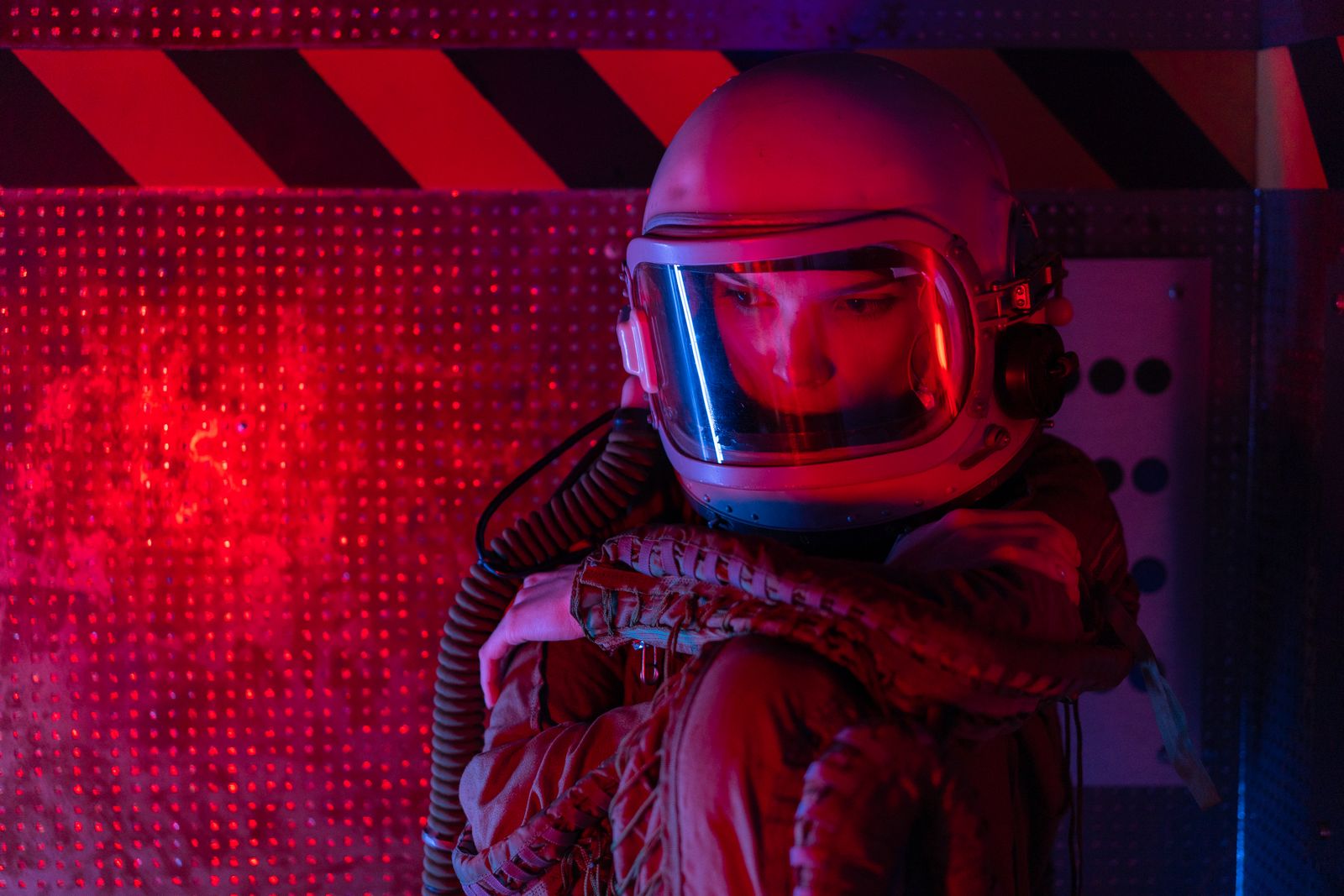
On 3 June 2010, six men climbed into a windowless mock spacecraft in a Moscow research institute, and the hatch was sealed behind them. They did not come out for 520 days. The craft never moved. The mission, called Mars-500, was a full-length simulation of a round trip to Mars, and the most telling thing it produced was not about engines or orbits. It was about sleep.
By the end, the crew’s daily rhythms had pulled apart. At least one man was settling into a day noticeably longer than 24 hours, so his waking and sleeping hours slid steadily out of step with everyone else’s. For stretches, some of the crew were asleep while the others were up. That drift is exactly the kind of problem the scientists were watching for.
This is one simulation with six participants, not settled consensus about what happens on a real flight. The finding is worth taking seriously, but it should be read as a result from this study, not a rule about every crew.
What the experiment was for
Mars-500 was run by the Institute for Bio-Medical Problems of the Russian Academy of Sciences in Moscow, with the European Space Agency taking part. The six volunteers, three Russians, a Frenchman, an Italian, and a crew member from China, lived in a sealed habitat for 17 months, the length of a conservative Mars mission with the planet at a workable distance.
The point was never the hardware. With no way to leave and little to break the monotony, the experiment was built to study the part of spaceflight that engineering cannot fix: how people hold up, psychologically and physically, when they are shut in together with the same faces for a year and a half.
A team from the University of Pennsylvania, led by David Dinges and Mathias Basner, tracked the crew the whole way. Using wristwatch-like devices that recorded movement and light exposure, they gathered about 4.396 million minutes of data, and ran twice-weekly tests of alertness and fatigue. The results were published in the Proceedings of the National Academy of Sciences.
What happened to their sleep
The headline number is small and stark.
Of the six, only two kept what the researchers would call normal sleep across the whole mission.
“Only two out of the six had fairly normal, stable, well-timed, high-quality, adequate duration sleep periods,” Dinges said, “and the other four had some sort of disturbance.” One man’s body settled onto a day of roughly 25 hours, which is enough to walk his clock right around until he was awake at the wrong times relative to the crew. Another broke his sleep into two separate stretches inside each day. A third was simply not getting enough.
The drift was not a late wobble. Most of the disturbances appeared inside the first 180 days and then stayed. As the months wore on, the crew also became less active when awake, resting and sleeping more, a slide the researchers called hypokinesis.
It helps to be precise about what was and was not happening here. The crew kept to a 24-hour clock with a scheduled nightly sleep period. What they did not have was the thing that normally holds a human clock to 24 hours, the natural cycle of daylight and dark. Inside a sealed box, with the lighting under their own control, the body’s own slightly-longer-than-a-day rhythm had room to assert itself.
Why being out of sync is the dangerous part
A tired crew is one problem. A crew that is no longer awake at the same time is a different and arguably worse one.
On a real mission, the hours when everyone is alert together are the hours when the crew can handle an emergency as a team. As individual rhythms drift apart, that shared window shrinks. The person who has wandered onto a 25-hour day might be at his lowest when an alarm sounds, and the colleague who could help is asleep. The sedentary slide compounds it, because a crew that moves less stays less fit for the moment when fitness suddenly matters.
Dinges put the underlying risk plainly. “Just being in a chamber for 17 months, you can easily begin to drift in terms of your self-discipline or what activities are fun,” he said. “That we can’t have, because a crew has got to stay mentally and physically fit and capable of dealing with any emergency or event that might occur.” The crew did sharpen up around the simulated Mars landing and again near the end. It was the long, featureless middle that did the damage.
What the simulation could not reproduce
The limits here are real and worth stating, because they are the difference between a suggestive result and a settled one.
Six people is a very small group, and they were all men. More importantly, this was a chamber in Moscow, not a spacecraft. The crew faced no microgravity, no radiation, no genuine danger, and, whatever their discipline, some part of them knew the door could open in a true emergency. A real crew, three years from home with none of those reassurances, might fare better under the pressure or considerably worse. The simulation isolated confinement and routine while leaving out most of what makes deep space frightening.
What it shows cleanly is narrower, and still useful: shut capable, screened, motivated people in a box on a fixed schedule for 17 months, take away the sky, and their sleep starts to come apart in ways that would matter on a real flight.
The habitat as a home
The constructive finding is about design. If the natural light cycle is what keeps the human clock honest, then a spacecraft has to supply a convincing substitute, lighting that brightens and dims like an Earth day, alongside a schedule people actually keep.
Dinges framed it as a shift in what a spacecraft is for. “The habitat is going to have to be more than just a nice engineering environment,” he said. “It’s actually going to have to be a psychological, physiological, and behavioral home, and be like Earth in order to ensure they stay capable all the way to Mars and back.”
That is the open question a real mission will have to answer. A ship can be built to survive the trip to Mars. Whether it can be built to keep six people awake at the same time for three years is a harder thing to know, and Mars-500 is the closest look we have had at how quickly that can slip.
