

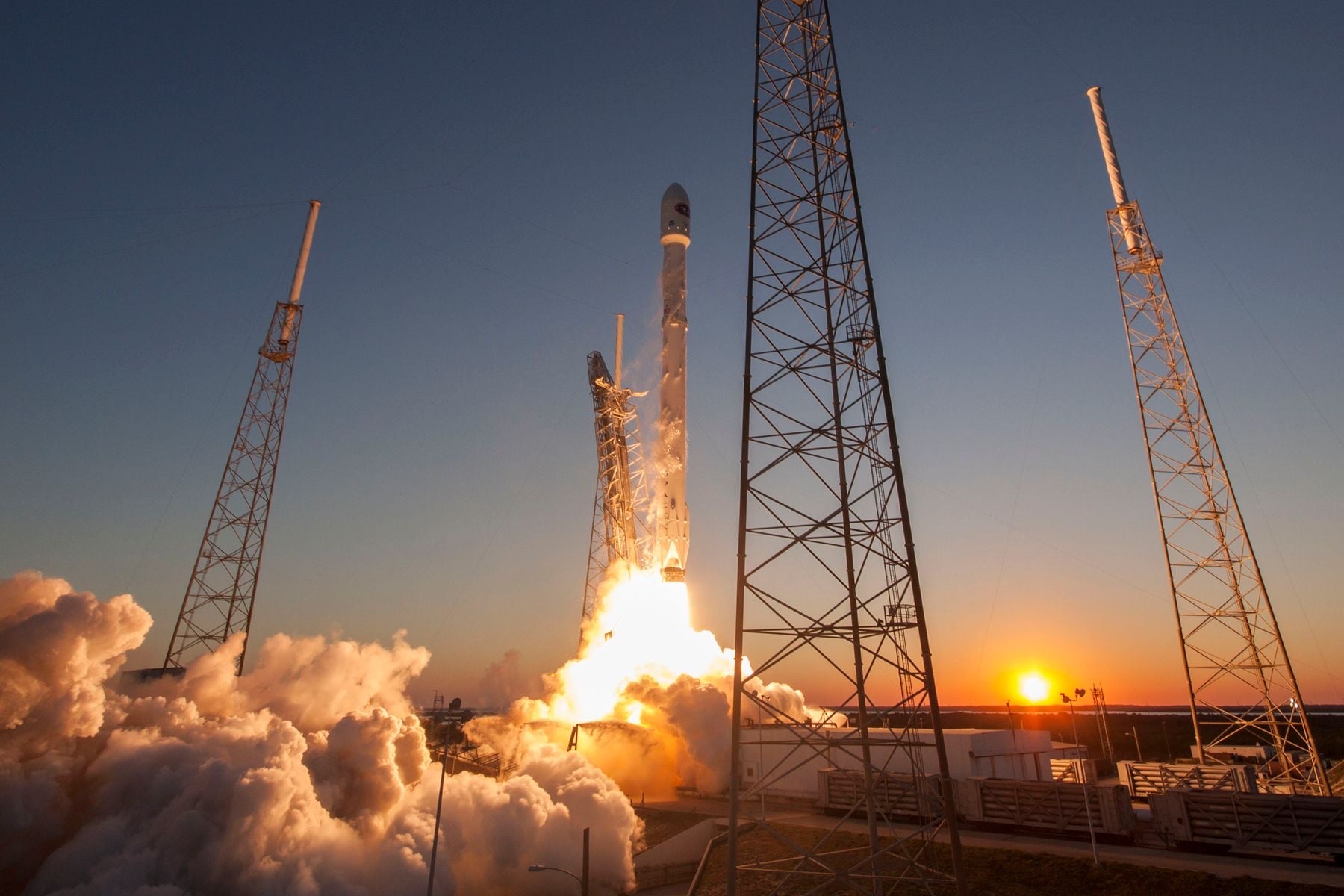
President Donald Trump issued a new National Space Transportation Policy on August 20, directing American space transportation ranges to grow capable of supporting more than 1,000 launches and reentries a year by 2030.
The target works out to more than 2.74 operations a day. Set beside the 178 US launches reported for 2025, it looks like a fivefold expansion in little more than four years. That comparison captures the intended scale, but the figures do not count precisely the same events.
The policy, formally National Security Presidential Memorandum 17, replaces guidance issued in 2013. It establishes a capacity goal and assigns deadlines across government. It does not schedule 1,000 missions, provide a dedicated construction budget, or guarantee enough reliable vehicles and paying customers will emerge to use the capacity.
The baseline changes when the definition changes
The 178 figure is a calendar-year count of launches attributed to the United States. The Federal Aviation Administration measures a different pool. Its latest aerospace forecast recorded 204 FAA-licensed commercial launch and reentry operations in fiscal 2025, the busiest year in the regulator’s history.
That total comprised 195 launches and nine reentries. Fifteen launches took place at Rocket Lab’s Mahia site in New Zealand, because the FAA licenses launches by US companies outside American territory. At the same time, the FAA total excludes missions the US government conducts for itself. Calendar and fiscal years differ as well.
The new policy is broader in one direction and narrower in another. It covers government and non-government users at federal and commercial ranges, but its headline target concerns launches and reentries on American soil. The 178 and 204 figures are therefore useful reference points, not an apples-to-apples denominator for the 1,000-operation goal.
One fact remains clear through every counting system: SpaceX supplied most of the existing cadence. As SpaceDaily reported in July, Falcon 9 alone flew 165 missions in 2025, one every 2.2 days. A national capacity target built on that base is also a bet that high-frequency operations will spread beyond a single rocket family and company.
The memorandum orders capacity, not a flight manifest
The official policy text says American ranges “must grow to support” more than 1,000 operations each year. The verb is important. A range can possess the pad, tracking, safety and airspace capacity for a mission that no operator ultimately books.
NASA and the Department of War are told to operate federal ranges transparently for government and non-government users. Relevant agencies must look for opportunities to improve infrastructure, facilitate commercial access and encourage leases, private investment and public-private partnerships for capital work on federal property.
Within 180 days, the government must identify possible locations for additional launch facilities and targeted upgrades to existing infrastructure. It must also publish federal range-scheduling criteria intended to make more efficient use of tracking, safety, communications and ground-support resources while preserving priority for government missions.
The policy reaches into industrial capacity too. A separate strategy, also due within 180 days, is meant to address competition, domestic supply chains and workforce development. Range concrete is only one part of cadence. Engines, stages, avionics, propellant, inspectors and trained crews all have to arrive at the same pace.
Reentry is not a footnote to the 1,000 target
The White House goal is frequently shortened to “1,000 launches”. The policy consistently says launches and reentries. A returning crew or cargo capsule, reusable upper stage, spaceplane or other recoverable craft may require its own safety case, protected airspace and ground response.
The memorandum gives the Interior Department 90 days to identify federal land for an additional designated reentry site. Transportation then has 180 days to evaluate safety criteria, while Commerce has 240 days to produce a development plan covering infrastructure, commercial access and co-development.
That sequence suggests the administration expects a higher-cadence system to include more vehicles returning intact, not merely more expendable rockets leaving the ground. Reentry capacity would matter for cargo from future commercial stations, reusable transport stages, lunar sample logistics and vehicles carrying manufactured material back from orbit.
It also carries environmental questions distinct from those around a launch pad. Previous SpaceDaily coverage of mass launch and reentry examined what a much larger flow of rockets and spacecraft could place in the upper atmosphere. Building transport capacity does not resolve how cumulative emissions, debris and recovery corridors should be assessed.
Airspace and licensing may become the shared bottlenecks
Rockets briefly cross airspace used by thousands of aircraft. A three-operation daily average would make coordination an ordinary transport task rather than an occasional exception. The policy directs Transportation to integrate launch and reentry management into air-traffic-control modernisation and designate priority airspace for critical launch corridors.
The FAA already uses live vehicle data to narrow hazard areas and reopen routes more quickly after a rocket clears them. Scaling from hundreds of annual operations toward four figures will test how well that system handles simultaneous missions, weather delays, holds and failures without imposing widening disruption on conventional aviation.
Permitting is the other major lever. The memorandum reinforces Trump’s 2025 commercial space executive order, which directed agencies to accelerate launch and reentry licensing and environmental review. SpaceDaily has previously examined the FAA proposal to waive specified requirements under 13 environmental laws.
Faster review can remove duplicate paperwork. It cannot remove sound, blast overpressure, road closures, wildlife disturbance or the consequences of an accident. The policy repeatedly qualifies implementation as subject to existing law and available appropriations, leaving future budgets and agency rules to determine how its speed and safety aims are reconciled.
The 2030 number is a policy target, not a forecast
The FAA’s current commercial forecast reaches roughly 507 licensed operations in 2036 at its upper end. The administration’s call for capacity above 1,000 six years earlier is not a modest extension of that baseline. It assumes more demand, more reusable vehicles, additional recovery activity and infrastructure capable of turning around much faster than today’s ranges.
The memorandum also seeks multiple launch options for government payloads, standard interfaces that allow spacecraft to move between rockets, and responsive launches within 48 hours when civil or national-security needs demand it. Those provisions are about resilience as much as volume. A thousand flights dominated by one vehicle would meet a traffic count without necessarily meeting the policy’s competition and redundancy goals.
More than 1,000 annual launches and reentries would make spaceflight a daily part of American transport management. NSPM-17 supplies agencies with deadlines and a capacity number. Reaching it will depend on congressional funding, range construction, airspace integration, environmental decisions, vehicle reliability and sustained demand that a presidential memorandum cannot create on its own.