

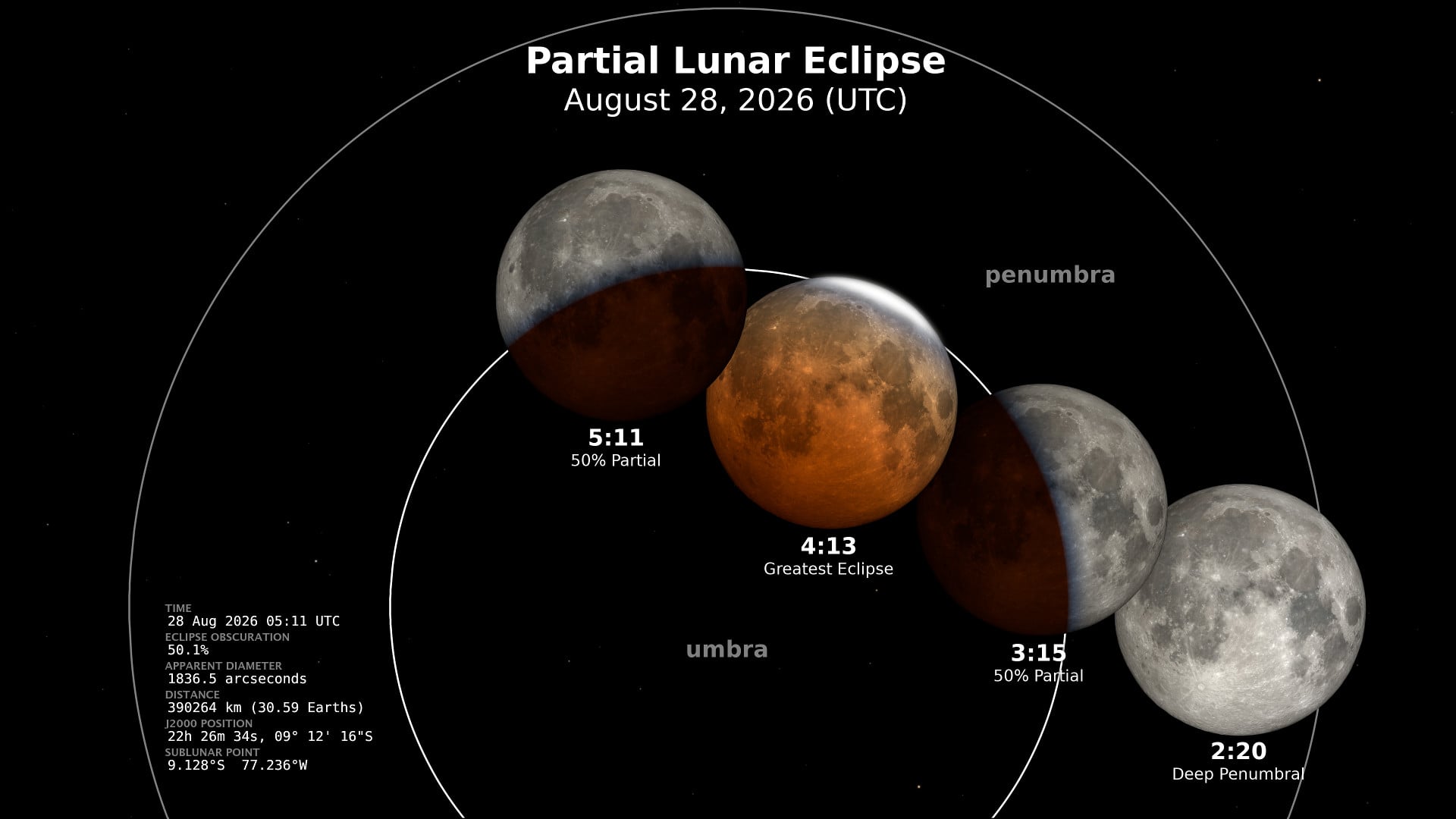
Tonight’s full Moon will cross so deeply into Earth’s shadow that the difference between “partial” and “total” becomes a thin, brilliant sliver.
At 4:13 am UTC on 28 August, equivalent to 12:13 am Eastern time and 9:13 pm Pacific on the night of the 27th, 96.3 percent of the Moon’s visible disk will be inside the umbra. This is the central region of Earth’s shadow where the planet completely blocks the Sun.
Maximum eclipse will be visible from almost all of the continental United States, provided clouds and the local horizon cooperate. Eastern viewers get the full event high in the night sky. Western viewers get an earlier clock but need to pay more attention to moonrise.
The eclipse will not look identical everywhere, or even through two cameras standing beside one another. The shadowed Moon could glow copper, deepen to reddish brown or become so dark that much of it seems ashen grey. A narrow uneclipsed rim will remain far brighter than everything beside it.
That uncertainty is not a weakness in the prediction. The orbital geometry is known to the second. The colour depends on what sunlight encounters while skimming through Earth’s atmosphere tonight.
The four times that matter across the United States
The first penumbral contact occurs at 1:23 am UTC, but the early effect is difficult to see. Earth is then covering only part of the Sun as viewed from the Moon, producing a gentle loss of brightness rather than an obvious bite.
The unmistakable partial phase begins when the Moon touches the umbra at 2:34 am UTC. From there, Earth’s curved shadow advances for one hour and 39 minutes before maximum.
Here is the useful timetable for the four main continental time zones:
- Eastern: partial phase begins 10:34 pm Thursday, maximum 12:13 am Friday, partial phase ends 1:52 am.
- Central: partial phase begins 9:34 pm Thursday, maximum 11:13 pm, partial phase ends 12:52 am Friday.
- Mountain: partial phase begins 8:34 pm Thursday, maximum 10:13 pm, partial phase ends 11:52 pm.
- Pacific: partial phase begins 7:34 pm Thursday, maximum 9:13 pm, partial phase ends 10:52 pm.
The umbral phase lasts three hours and 18 minutes. Faint penumbral shading continues after it, ending at about 3:02 am Eastern, 2:02 am Central, 1:02 am Mountain and 12:02 am Pacific.
NASA’s current visualization gives 4:13 UTC as greatest eclipse and 96.3 percent as the fraction of the disk inside the umbra. The timing differs by a minute from some rounded public tables, but not enough to affect any viewing plan.
The 96 percent and 93 percent figures are both correct
Two eclipse numbers are circulating, and they describe different measurements.
Umbral magnitude measures the fraction of the Moon’s diameter covered by the umbra. Tonight’s magnitude is about 0.932, so roughly 93 percent of the lunar width enters Earth’s central shadow.
Obscuration measures area. Because only a narrow cap remains outside the umbra, 96.3 percent of the circular disk is shadowed. Area better matches the everyday question of how much of the Moon appears covered.
SpaceDaily’s earlier look at the difference between 93 percent of the width and 96 percent of the area also highlighted the severe brightness contrast created by the surviving edge.
The eclipse remains partial because part of the Moon never enters the umbra. A total eclipse requires every point on the lunar disk to cross that boundary. Near enough does not create a short total phase.
Almost the whole continental United States gets maximum eclipse
The Americas have the best placement for this event. At maximum, the Moon is above the horizon throughout the contiguous United States. Weather is the main nationwide uncertainty, with one geographic complication along the Pacific side.
From the Eastern, Central and much of the Mountain time zones, the full Moon is comfortably above the horizon before the dark partial phase starts. Any open patch of sky with a clear view of the Moon will work.
Along the West Coast, particularly at northern latitudes, moonrise falls near or after the beginning of the partial phase. Some viewers will first see the Moon already carrying Earth’s shadow as it clears the eastern or southeastern horizon.
An unobstructed horizon matters there. A beach, open field, hilltop or east-facing upper floor may be more useful than driving far from city lights. The full Moon is bright enough to overpower normal urban skyglow, and the partly eclipsed Moon remains easy to see once it is above buildings and terrain.
Timeanddate’s state-by-state United States eclipse table adjusts moonrise and visibility for local position. Alaska and Hawaii have more restricted circumstances, which is why “almost everyone across the continental United States” is the accurate claim.
Earth makes a pale shadow and a dark shadow
Earth’s shadow is not one uniform cone. The broad outer penumbra is a region where Earth blocks only part of the solar disk. The inner umbra is the region where Earth hides the whole Sun.
The penumbral phase begins gradually. At first, the Moon may look unchanged. Later, one side can seem dirty or bruised as less sunlight reaches it. There is no sharp line because different points in the penumbra see different fractions of the Sun.
The umbra has the boundary people recognise as an eclipse. As the Moon enters it, a dark curved arc moves across craters and maria. The curve is Earth’s shadow, one of the oldest direct observations that the planet is round.
Tonight, most of the Moon travels through the umbra while a thin northern cap remains in the penumbra. That cap still receives some direct sunlight and may remain hundreds of times brighter than the darkest shadow nearby.
This contrast is why the eclipse may look like a dark bite rather than a uniformly red “blood moon.” It is also why colour can become easier to see after the eye has spent several minutes outside instead of looking once and returning indoors.
The copper light is every sunrise and sunset around Earth
If Earth had no atmosphere, the Moon inside the umbra would receive almost no sunlight. It would become extremely difficult to see.
Earth’s atmosphere changes that. Sunlight grazing the rim of the planet passes through a long path of air. Molecules scatter shorter blue wavelengths more efficiently, while red and orange wavelengths are more likely to continue. Refraction bends some of that surviving light into the umbra.
From the lunar surface, the eclipse would reverse the familiar view. A dark Earth would cover the Sun, surrounded by a narrow luminous ring made from the planet’s dawn and dusk zones.
The Moon reflects that filtered light back. Copper and brick tones are not colour produced by the lunar surface. They are a projection of Earth’s atmosphere.
SpaceDaily’s earlier explanation of why sunsets are red and the daytime sky is blue followed the same scattering physics. A lunar eclipse places that atmospheric filter between the Sun and an enormous grey screen.
Dust, smoke and volcanic aerosols decide how much light survives
The atmosphere is not optically identical from one eclipse to the next. Volcanic eruptions can inject sulphate aerosols into the stratosphere. Wildfires lift smoke, dry regions supply mineral dust, and weather systems distribute clouds around Earth’s limb.
These particles scatter and absorb light in ways that depend on their size, composition and altitude. A relatively clear stratosphere tends to allow a brighter orange or copper eclipse. A heavy aerosol load can produce dark red, chocolate brown or grey.
The relevant atmosphere is global. Sunlight enters the umbra after passing through a ring around the edge of Earth. A major aerosol layer thousands of kilometres from an observer can affect the colour reaching the Moon.
Local smoke, haze and thin cloud also change what reaches the observer’s eye, but that is an additional filter. The first filter lies along the sunlight’s route past Earth before it reaches the lunar surface.
No responsible forecast can promise a particular shade. It is possible to calculate the shadow’s position precisely while remaining uncertain about its brightness. The atmosphere evolves faster and in more detail than the orbital alignment.
A deep partial eclipse does not photograph like a total one
The remaining four percent of area creates an extreme exposure problem. A camera setting that preserves detail in the bright cap may render the umbra nearly black. An exposure that reveals a copper shadow may turn the cap into a white glare.
Human vision faces a related challenge. The bright edge keeps the pupil and visual system from adapting as completely as they would during totality. Looking away from phones and streetlights for several minutes can help subtle colour emerge.
Binoculars reveal the shadow boundary crossing named craters and dark volcanic plains. A telescope is optional. Low magnification is usually better than a narrow view because the shape of the whole Moon is the event.
For a camera, use a tripod if available, turn off the flash and bracket several exposures. Phone users can steady the device against a railing or wall, reduce exposure to keep the bright edge from blowing out, and take images at intervals rather than relying on digital zoom.
The NASA visualization intentionally raises the apparent exposure near maximum to imitate dark adaptation. It is a scientifically based preview, not a guarantee that the unaided eye or an automatic phone exposure will reproduce the same orange.
No eclipse glasses or dark observing site are required
Lunar eclipses are safe to watch directly. The Moon never becomes brighter than an ordinary full Moon and spends the event becoming dimmer. Solar-eclipse glasses are unnecessary and would block most of the view.
Ordinary eyeglasses are fine. Binoculars and telescopes are safe without solar filters because they are pointed at the Moon at night, not at the Sun.
Light pollution is not a serious obstacle. A clear view through breaks in cloud is more important than a rural sky. Even a short opening around maximum can reveal the thin bright cap and the enormous dark curve across the rest of the disk.
The simplest observing plan is to look at least three times: near the beginning of the partial phase, halfway to maximum and at maximum. The movement is too slow to notice easily from second to second but obvious across 20 or 30 minutes.
Anyone staying outside for only one window should aim for roughly 30 minutes either side of maximum. That is 11:43 pm to 12:43 am Eastern, 10:43 to 11:43 pm Central, 9:43 to 10:43 pm Mountain, and 8:43 to 9:43 pm Pacific.
No deeper lunar eclipse occurs until New Year’s Eve 2028
The next lunar eclipse in January 2028 is partial, but shallow. Only a small section of the Moon enters the umbra. It does not approach tonight’s 96.3 percent obscuration.
The next eclipse anywhere on Earth to carry more of the Moon into Earth’s central shadow is the total lunar eclipse of 31 December 2028. Its umbral magnitude exceeds one, meaning the whole disk will enter the umbra with room to spare.
“Deepest until 2028” describes the geometry, not who can see each later eclipse. Visibility depends on which half of Earth faces the Moon at the time. A future total eclipse may occur below the horizon for a particular country even while it is total elsewhere.
Tonight’s event also follows the 12 August total solar eclipse by just over two weeks. SpaceDaily’s advance map of that narrow path across Greenland, Iceland and Spain showed how selective a solar eclipse can be. A lunar eclipse is far more democratic: anyone on Earth’s night side with the Moon above the horizon shares the same event.
The timing is certain and the appearance is not
At 12:13 am Eastern, the shadow reaches its deepest point exactly as predicted. The remaining northern cap stays outside the umbra, preventing totality. Those facts are geometry.
Whether the rest glows like polished copper, darkens toward chocolate or nearly disappears into grey depends on the atmosphere, local sky, eyesight and exposure. Those are observations that cannot be replaced by the timetable.
That is why two lunar eclipses with similar magnitude need not resemble one another. Earth supplies a different atmospheric filter each time, and a partial eclipse adds a bright edge that changes how every shade is perceived.
Go outside before maximum, give the eye time to adjust and look more than once. The Moon will miss totality by a sliver. Everything else about its appearance remains for tonight to decide.