
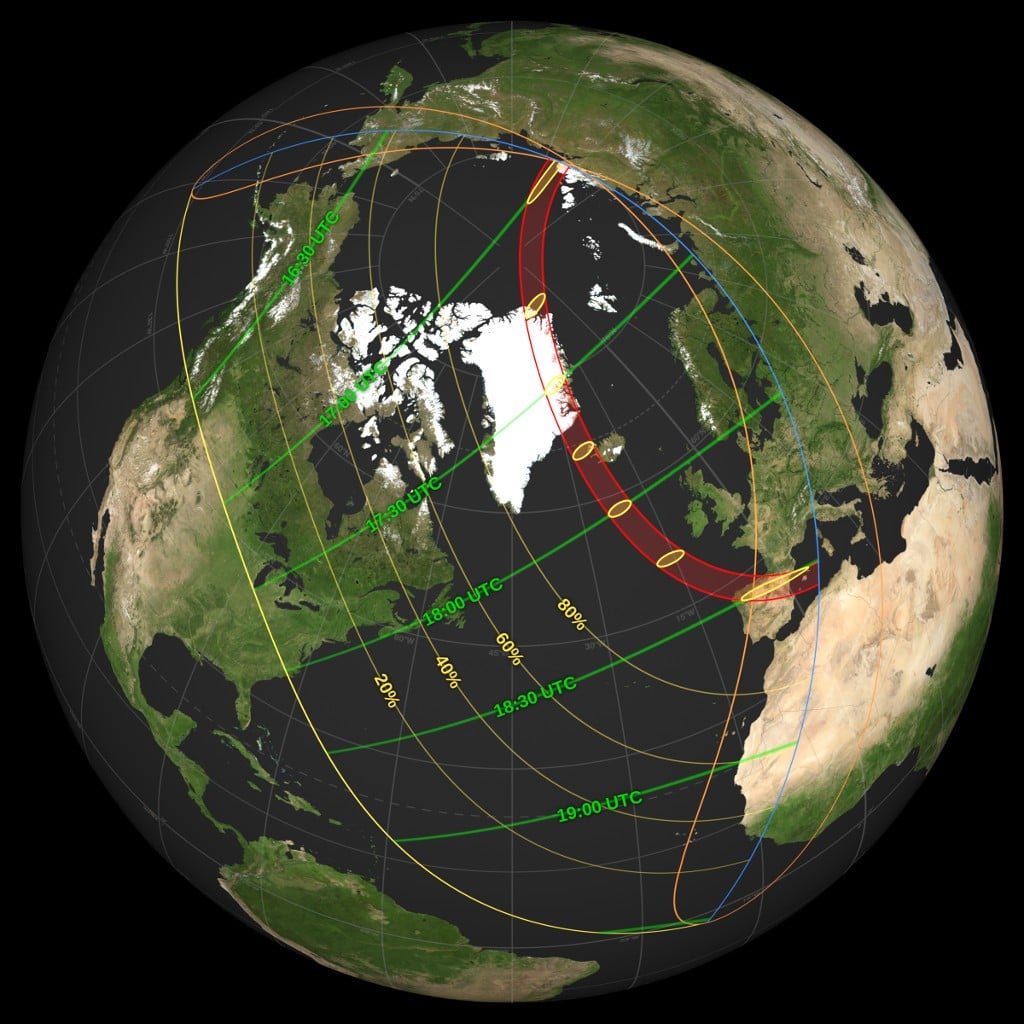
On Wednesday, 12 August 2026, the Moon’s darkest shadow will touch Earth in the high Arctic and sweep across Greenland, western Iceland and the North Atlantic before reaching the Iberian Peninsula near sunset. Inside that moving band, the Sun’s bright surface will disappear completely for seconds or minutes.
The total phase will cross northern Spain from Galicia to the Mediterranean and continue over the Balearic Islands. A small corner of northeastern Portugal and a remote part of northern Russia also lie in the path. Far beyond it, a partial eclipse will be visible across much of Europe, Canada, northwestern Africa and parts of the northern United States.
From 14 July, the event is 29 days away. The astronomical geometry has been calculated in enough detail to give local contact times to the second. That precision does not make every viewing place equally good, particularly in Spain, where the eclipsed Sun will hang low over the western horizon.
A narrow shadow creates the total eclipse
A solar eclipse occurs when the new Moon passes between Earth and the Sun. The Moon casts a broad outer shadow, the penumbra, within which observers see part of the Sun covered. Nested inside it is the much narrower umbra. Only observers reached by that central shadow see the solar surface completely blocked.
NASA’s 2026 eclipse overview traces the umbra across northern Russia, Greenland, Iceland, the Atlantic, Spain and a small part of Portugal. The red strip on the agency’s map is the path of totality. Moving only a short distance beyond its northern or southern edge changes the event from total to partial.
At greatest eclipse, southwest of Iceland, the path will be about 294 kilometres wide. Maximum totality will last 2 minutes 18.2 seconds. Most inhabited places along the route receive less than two minutes, and locations near the path edge receive much less.
The change during totality is not simply a dimmer version of daylight. The last exposed arc of the Sun breaks into bright points as sunlight passes through valleys along the Moon’s edge. The solar corona appears around the black lunar disc, the sky darkens and the horizon can remain lit beyond the comparatively small shadow. The sequence then reverses as the umbra moves on.
Greenland and Iceland see the shadow before Spain
The track begins in a sparsely inhabited part of northern Russia and passes across the Arctic Ocean. It crosses eastern Greenland, where the centre line offers totality close to the event’s maximum duration, then clips western Iceland. In those regions the Sun will be higher than it is later in Spain, though weather and access are serious constraints.
After crossing the North Atlantic, the shadow reaches Galicia and travels eastward across the northern half of Spain. Spain’s National Geographic Institute lists A Coruña, Oviedo, León, Bilbao, Zaragoza, València and Palma among the provincial capitals in or near the totality corridor. Its official eclipse guide says almost all of the northern half of mainland Spain will experience totality, while the south will see a partial eclipse.
In A Coruña, the partial phase begins at about 7:31 p.m. local summer time and totality occurs near 8:28 p.m. It lasts about 76 seconds with the Sun roughly 12 degrees above the horizon. In Burgos, totality lasts about 104 seconds, but the Sun is only around eight degrees high. These are calculated circumstances for the cities, not a promise of an unobstructed view.
The low Sun is the central practical issue in Spain. A hill, building, tree line or distant cloud bank to the west can hide an eclipse that is astronomically visible from the coordinates. A site inside the path still needs a clear western horizon. Near the Mediterranean end of the route, sunset is close enough that the remaining partial phase continues as the Sun descends.
Spain’s century-long wait has a 1912 footnote
The European Space Agency describes 12 August as the first total solar eclipse visible from mainland Spain since 1905. That 1905 eclipse crossed a substantial part of the country and delivered several minutes of totality. ESA is organising a webcast from the Javalambre Astrophysical Observatory in Teruel and public activities in León, both inside the 2026 path. Its event announcement uses the 1905 comparison.
Spain’s National Geographic Institute gives 1912 as the peninsula’s most recent total eclipse. The apparent disagreement concerns the hybrid eclipse of 17 April 1912. It changed between annular and total along its route, and the total portion over the northwest of the peninsula was extraordinarily narrow and lasted only seconds. The institute’s history of the 1912 observing campaign describes the uncertainty that astronomers faced in determining whether particular sites would see totality at all.
Both ways of stating the history support the broader claim. Mainland Spain has not experienced a broadly visible total solar eclipse for more than a century. The 2026 path is hundreds of kilometres wide rather than the knife-edge total zone associated with the 1912 hybrid event.
How an eclipse can be mapped before it happens
The prediction begins with the measured orbits and apparent sizes of the Sun and Moon. Astronomers calculate the axis and dimensions of the lunar shadow as it passes Earth, then combine that geometry with Earth’s rotation and shape. A standard set of coefficients called Besselian elements allows the shadow’s position to be calculated for any moment during the event.
NASA’s Goddard eclipse tables give the instant of greatest eclipse as 17:45:53.8 Universal Time at 65 degrees 13.5 minutes north and 25 degrees 13.7 minutes west. The published Besselian elements encode how the shadow axis and its edges move over the reference plane. Mapping software uses those values to calculate the beginning and end of totality for a chosen latitude and longitude.
The associated NASA path table lists the northern limit, southern limit and centre line at two-minute intervals, together with the Sun’s altitude, path width and central duration. Modern interactive maps interpolate from the same underlying geometry, which is why dropping a pin can produce contact times displayed to the nearest second.
Displayed precision is not identical to perfect certainty. NASA notes that its standard table does not include every mountain and valley along the Moon’s limb. Those irregularities can shift the practical path edge by roughly one to three kilometres and alter the duration by one to three seconds. The uncertainty matters most for observers who choose a site close to the limit of totality.
It is also possible to map the shadow exactly and still see nothing because of cloud. The eclipse path can tell an observer where the alignment occurs, but no astronomical calculation made weeks ahead can guarantee local weather.
The wider eclipse reaches far beyond totality
Most people who see the event will experience a partial eclipse. NASA says the partial phase extends from Alaska and northern Canada across much of Europe and into northwestern Africa. The Moon may cover a large fraction of the Sun, but even a thin remaining crescent is bright enough to injure an unprotected eye.
Proper eclipse glasses or a handheld solar viewer are required throughout every partial phase. Ordinary sunglasses are not sufficient. Cameras, binoculars and telescopes need purpose-built solar filters mounted over the front of their optics. Looking through an unfiltered optical instrument while wearing eclipse glasses is dangerous because the instrument concentrates sunlight before it reaches the glasses.
Only observers inside the path of totality may remove eye protection, and only after the Sun’s bright face has been completely covered. The glasses must go back on as soon as the first bright point reappears. Outside that path, there is no safe naked-eye phase at any time.
The next month will be filled with maps, weather forecasts and attempts to optimise a viewing site. The celestial part of the event is already constrained: the centre line, contact times and duration can be calculated with extraordinary precision. The earthly part remains less obedient. A clear horizon, a safe viewing method and a gap in the clouds will decide who actually watches daylight disappear.
