
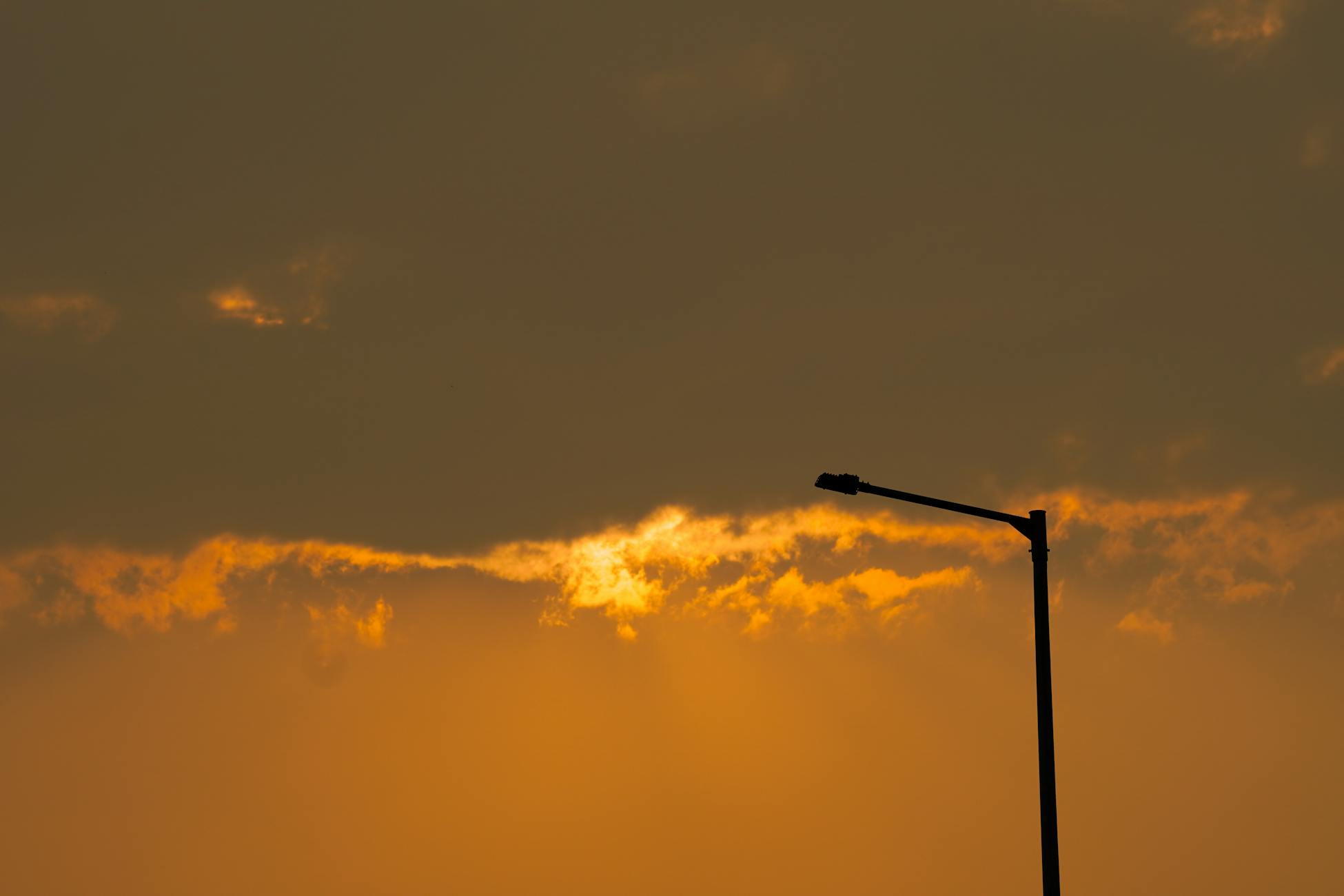
Lord Rayleigh showed that when sunlight passes through a gas, the gas molecules scatter shorter wavelengths much more efficiently than longer ones — by a factor of roughly the inverse fourth power of the wavelength. Blue light, sitting near 450 nanometres, gets scattered around ten times more strongly than red light sitting near 650 nanometres. That single ratio is the entire story. The blue sky overhead at noon and the red sun sinking at the horizon are the same physical process viewed from two different geometries.
The popular framing treats sunset as the sun doing something — turning orange, going red, putting on a show. That framing is approximately right in its emotional effect and badly incomplete in its mechanics. The sun is emitting the same broadband white light it emits at noon. Nothing about the source has changed. What has changed is the length of the atmospheric column the light has to traverse to reach the eye of the observer.
The same physics, two different geometries
At noon, sunlight enters the atmosphere from roughly overhead and passes through what atmospheric scientists call one air mass — the shortest possible path through the gas layer wrapping the planet. In that geometry, blue wavelengths get scattered out of the direct beam in every direction, including sideways and downward. When you look up at a patch of sky that is not the sun itself, what reaches your eye is scattered light, dominated by the wavelengths that scatter most efficiently. That is why the sky is blue. You are not seeing the sun. You are seeing the air, lit from the side, glowing in the wavelengths it preferentially redirects.
The part worth slowing down on is what happens at the horizon. When the sun drops to within a few degrees of the horizon, the path length through the atmosphere is no longer one air mass. The light is now travelling through a column of gas many times thicker than it traversed at noon, and the consequences are unforgiving.
Over that long path, the scattering does not stop at blue. Once the blue has been almost entirely removed from the direct beam, green starts to go. Then yellow. The wavelengths that survive the trip and reach your eye in a straight line from the sun are the ones that scatter least — the oranges and reds at the long end of the visible spectrum. As PBS Nova summarises the standard explanation, the colour of a sunset is essentially a subtraction problem. The sun does not become red. The air strips out everything that is not red before the light reaches you.
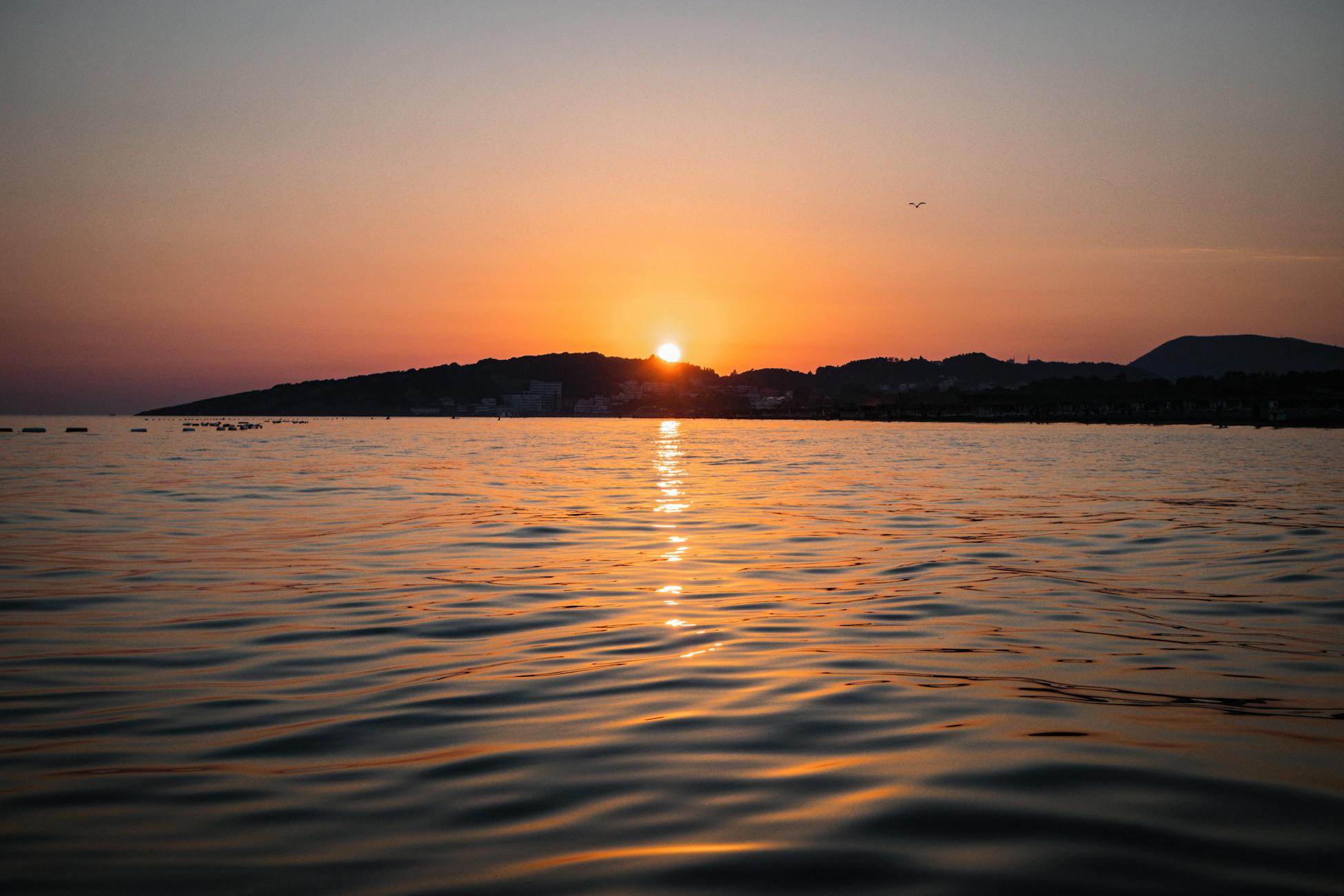
Why the inverse fourth power matters
Rayleigh scattering scales as one over the wavelength to the fourth power. Plug in the numbers. Blue at 450 nanometres versus red at 650 nanometres gives a ratio of roughly (650/450) to the fourth, which lands near 4.4. Adjust for the full visible band and the effective scattering ratio between the blue and red ends is closer to a factor of ten. That factor is why a thin column of air looks transparent, a slightly thicker column looks faintly blue, and an extremely thick column — the one your line of sight crosses when the sun is near the horizon — looks orange-red from the perspective of the receiver.
You can verify the principle yourself with a glass of water and a flashlight in a dark room. Stir in a few drops of milk. Shine the flashlight through the side of the glass and look at it perpendicular to the beam — the scattered light has a faint bluish tint. Now look down the barrel of the beam itself, through the milky water, at the bulb. The bulb looks yellow or orange. Same liquid. Same light source. Two different geometries. Two different colours. It is the canonical classroom demonstration of Rayleigh scattering, and physicist Charles Hakes walks through a version of it in a Durango Herald column on the same physics.
Where aerosols enter the picture
The picture so far is Rayleigh scattering by gas molecules — nitrogen and oxygen, mostly, the bulk of dry air. It explains the blue sky and the red sun. It does not, on its own, explain why some sunsets are spectacular and others are flat. That part of the story involves aerosols: the suspension of fine solid or liquid particles in the air, ranging from dust to sea salt to combustion products to volcanic sulphates.
Aerosols scatter light too, but they do not follow the inverse fourth power law. Particles that are comparable in size to the wavelength of visible light — roughly half a micrometre — scatter more uniformly across the spectrum, a regime physicists call Mie scattering. As a Nature index summary on atmospheric aerosol optics describes, the way aerosols absorb, scatter and polarise light is governed by their size distribution, chemical composition, morphology and mixing state. Larger particles redden sunsets further by removing more of the remaining yellow. Some particles absorb selectively, deepening the reds and pinks. Very fine particles in the stratosphere — the kind injected by major volcanic eruptions — can produce vivid sunsets that linger for months after the eruption.
More recent work is sharpening the picture. A 2025 collaboration led by groups at the Hong Kong University of Science and Technology and Southern University of Science and Technology found that nitrogen-containing compounds play a dominant role in how organic aerosols absorb light, which has consequences for both climate modelling and the specific tint a polluted sunset takes on. Satellite observations from missions like EarthCARE are now mapping these particles in three dimensions across the atmosphere, resolving vertical aerosol distributions in ways that ground-based instruments cannot. The particles doing the headline work in climate modelling and air-quality science are the same particles doing the secondary colouring work at sunset.
The smoke event of 2023 and a useful natural experiment
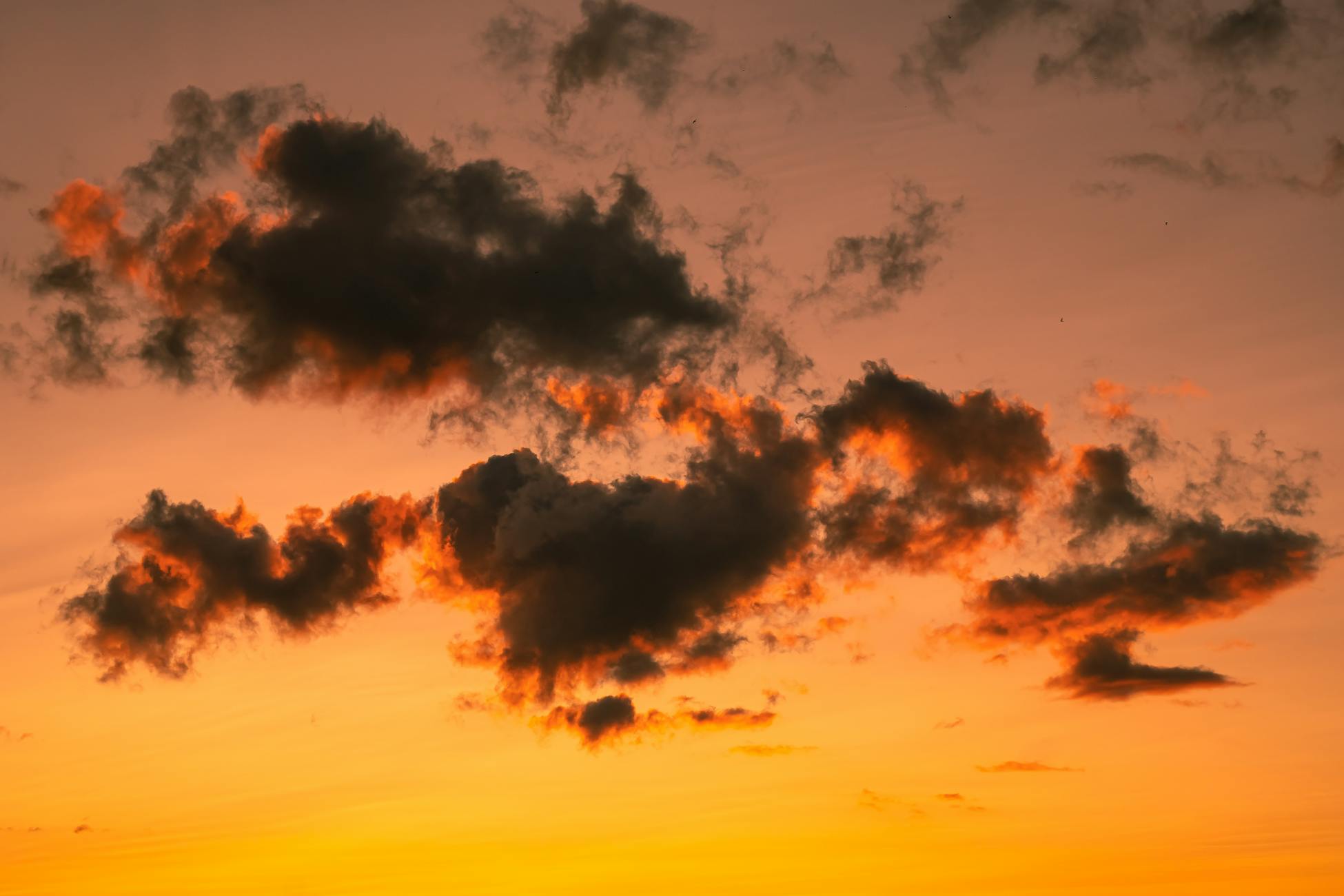
The Canadian wildfire season of 2023 gave a continent-scale demonstration of how aerosol loading transforms sunsets. Smoke plumes drifted south into the US and east across the Atlantic, and as authorities issued air quality warnings stretching all the way to Europe, sunsets appeared unusually red, unusually long-lasting, and unusually saturated. The mechanism was straightforward. The smoke added a second layer of scattering — Mie scattering by combustion particulates — on top of the baseline Rayleigh scattering by gas molecules. The path length through the atmosphere had not changed. What changed was the optical density of that path.
This is also why sunsets look different from different altitudes, and why pilots and mountaineers describe the experience of dawn at 10,000 metres as visibly bluer and less reddened than dawn at sea level. The path length above them is shorter. There is less air, and less aerosol, between their eye and the sun.
Why other worlds get this wrong from our perspective
The most useful sanity check on the Rayleigh-plus-Mie picture is what sunsets look like elsewhere. Mars has an atmosphere roughly 1% as dense as Earth’s, loaded with fine reddish dust. The dust scatters red light forward and blue light less aggressively in the forward direction, which inverts the colour balance near the sun’s disk: Martian sunsets are blue, with a reddish sky surrounding them. The Moon has essentially no atmosphere at all, which is why images of lunar sunsets returned by private landers show the sun simply switching off against a black sky — no reddening, no gradient, no glow. The colour is in the air, not the sun.
Total lunar eclipses make the same point from another direction. When the Moon passes through Earth’s shadow, the only light reaching it is sunlight that has been bent and filtered through the edge of Earth’s atmosphere — every wavelength except the long reds scattered away during the trip. The Moon glows the colour of every sunset on Earth happening at once. That is the entire physical content of the so-called blood moon. It is sunsets, projected.
The proverb the sailors got right
The old weather adage — red sky at night, sailor’s delight; red sky at morning, sailor take warning — has a real basis in the same physics, as a column on Rayleigh scattering in the Durango Herald works through. In mid-latitudes, weather systems move generally west to east. A vivid red sunset means the air to the west, where the sun is, contains enough aerosols and dry particles to redden the light without clouds blocking it — usually a sign of high pressure and clear conditions arriving. A red sunrise means the same aerosol-loaded clear air has already moved east, with whatever follows it — often a low-pressure system carrying weather — about to arrive. The sailors were doing aerosol optics without the vocabulary.
What is worth noticing is how much of the visible world runs on the same small piece of physics. The blue overhead, the red at the horizon, the orange tint of a smoky afternoon, the copper colour of an eclipsed moon, the blue glow at the edge of a Martian dawn — all of it is one equation about how light interacts with particles smaller than its own wavelength, applied to different geometries and different densities. The sun is doing nothing unusual at sunset. The atmosphere is doing what it always does. The only thing that has changed is how much of it the light had to cross to find you.
