
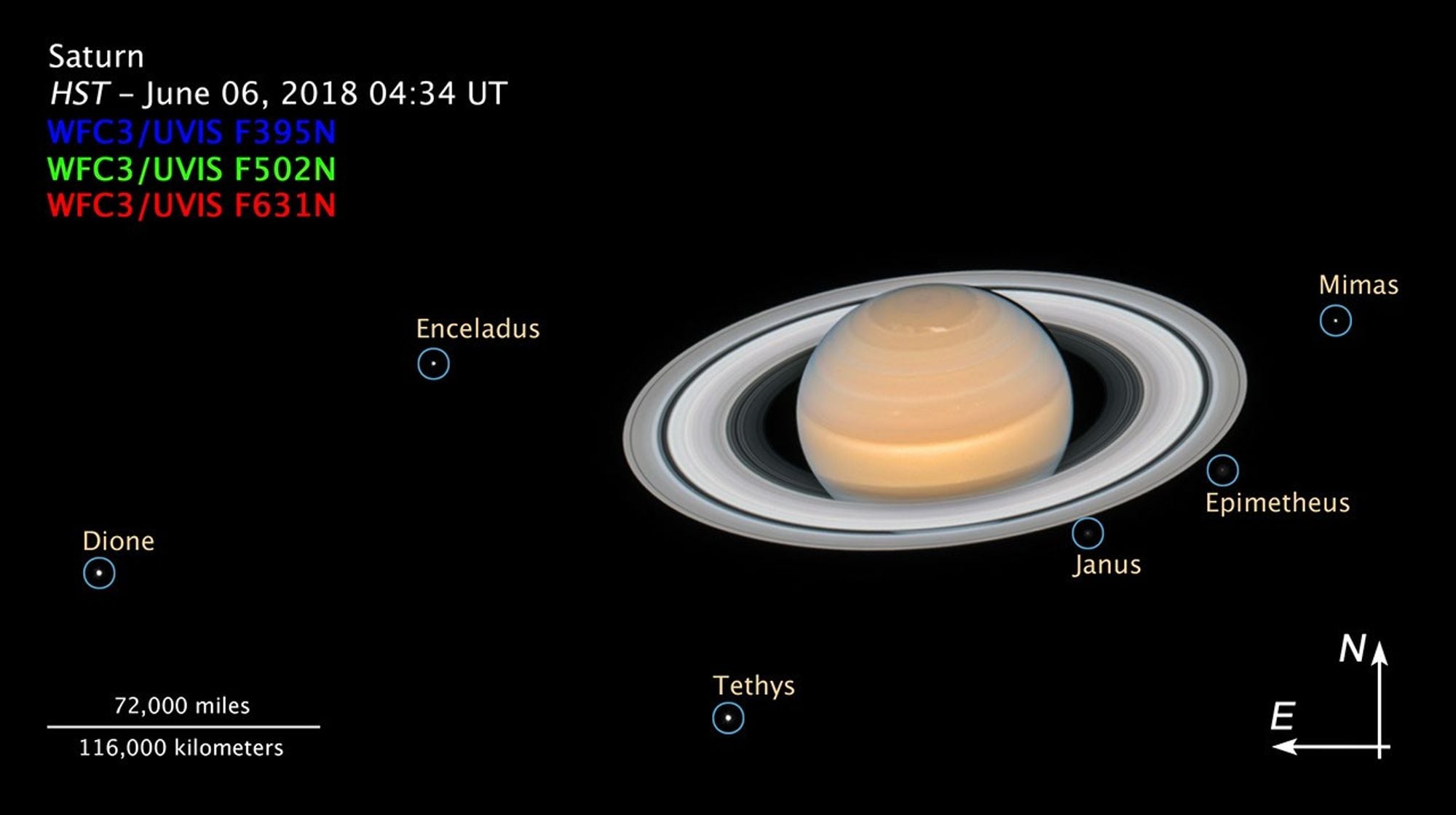
Saturn has 285 confirmed moons. The International Astronomical Union raised the total from 274 on 26 March 2026, when its Minor Planet Center recognised 11 more small satellites around the planet.
That came barely a year after a much larger change. On 11 March 2025, 128 objects were recognised at once, taking Saturn from 146 confirmed moons to 274. Any older textbook that gave a precise total is now out of date, although it was not necessarily mistaken when it went to press. The catalogue changed because the observations improved.
The number may move again. “285” is a count of objects whose orbits have been confirmed well enough for official recognition, not a claim that astronomers have found every natural satellite around Saturn.
The 2025 increase took years to earn
The March 2025 announcement was sudden. The work behind it was not. According to the University of British Columbia’s account of the observing campaign, the team repeatedly surveyed the sky around Saturn with the Canada-France-Hawaii Telescope between 2019 and 2021. It combined multiple images to strengthen the signal from objects too faint to stand out reliably in one exposure.
That first campaign produced dozens of confirmed moons and many more candidates. Astronomers returned to the same fields for three consecutive months in 2023, gathering the repeated positions needed to connect faint points of light into plausible Saturn-centred orbits.
All 128 additions were irregular moons, generally only a few kilometres across. Unlike Titan, Enceladus and Saturn’s other large regular moons, these small bodies travel far from the planet on tilted and often elongated paths. Many are probably fragments of larger captured objects broken apart in ancient collisions.
Space Daily’s earlier report on the 128-moon recognition examined those fragment families and the image-stacking work in detail. The useful point here is procedural: a candidate does not become an official moon merely because it appears in a telescope image.
Recognition requires an orbit, not a close-up
The Minor Planet Center acts as the international clearinghouse for measurements of small bodies, including irregular planetary satellites. Before it confirms a moon, it checks that the detections do not belong to an object already catalogued. Astronomers then calculate whether a planetocentric orbit, one around Saturn, fits the observations better than a heliocentric orbit around the Sun.
This is why discovery dates and announcement dates can look oddly disconnected. Several of the 11 moons announced in 2026 carry provisional designations beginning S/2020, while the others begin S/2023. The year records the discovery observations used in the designation, not the day the object finally entered the official total.
The letter S identifies Saturn. The last number distinguishes satellites assigned within the same discovery year. Names from Norse, Gallic or Inuit mythology can come later, once an orbit is sufficiently secure and the formal naming process advances. For tiny satellites, the catalogue number often matters long before a familiar name does.
The latest 11 are closer to fragments than worlds
In its 26 March 2026 announcement, the IAU said the 11 additional Saturnian moons are probably about one to two kilometres wide. They are roughly 100 million times fainter than an object visible to the unaided eye. The international discovery team was led by Edward Ashton of Academia Sinica’s Institute of Astronomy and Astrophysics.
Calling all 285 objects “moons” is formally correct, but the shared word conceals an extreme range. Titan is 5,150 kilometres across, has a dense atmosphere and carries rivers and seas of liquid hydrocarbons. The newest entries may be kilometre-scale remnants seen only as moving points. They share a host planet, not a common geological character.
Saturn’s rings contain countless particles that are not counted as moons. The practical boundary depends on whether an object is distinct, can be tracked and follows a confirmed orbit. Better instruments and longer observing campaigns keep pushing that boundary towards smaller and fainter bodies.
Even online reference pages can lag the catalogue
Printed books make the lag obvious because their pages cannot update. Websites are not automatically current either. NASA’s Saturn moons catalogue still lists 274 confirmed moons and describes the March 2025 additions, while the IAU’s later count is 285. That is not a scientific dispute. It is a difference in update timing between two reference systems.
Moon totals therefore need a date and a source. “Saturn has 285 confirmed moons as of March 2026” is more precise than treating 285 as an enduring physical property like the planet’s approximate diameter. Saturn did not acquire 139 moons during those two March announcements. Astronomers acquired enough evidence to recognise them.
The next revision will come from better tracking
The current inventory reaches close to what existing surveys can reliably detect around Saturn, but it is not necessarily complete. More sensitive telescopes, longer observational arcs and improved searches through archived images may add objects or reconnect new detections with candidates that were previously lost.
The number to watch is 285, qualified by “confirmed” and dated to March 2026. The next change will arrive when the Minor Planet Center accepts another orbit, and every fixed list will begin ageing again.
