
For a long time, the solar system’s moon counts sounded almost settled at the human scale. Jupiter and Saturn traded the lead now and then as telescopes improved, but the numbers moved in steps, not leaps.
Then, on March 11, 2025, Saturn’s official count changed by 128 moons in a single day.
The change did not mean astronomers had looked at Saturn one night and suddenly seen 128 new worlds. It meant the International Astronomical Union had recognised a large set of tiny, faint objects as Saturnian moons after enough observations had been gathered to show that they were really orbiting the planet. The University of British Columbia announcement described the result plainly: 128 new moons of Saturn had been recognised by the IAU, discovered by astronomers from Taiwan, Canada, the United States and France.
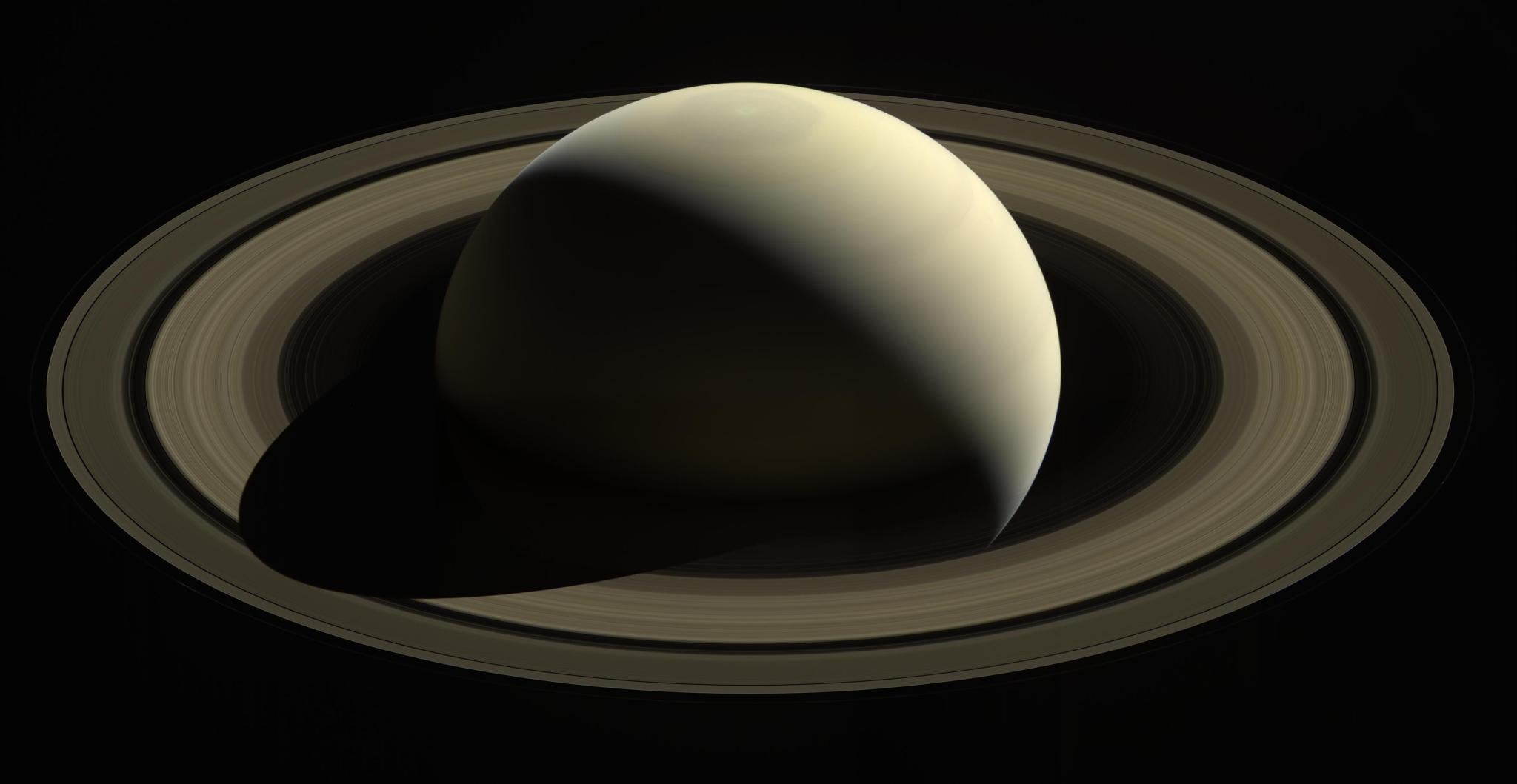
That was enough to push Saturn’s tally from 146 confirmed moons to 274. At that point, Saturn had more moons than every other planet in the solar system combined.
A moon count is not as simple as it sounds
The word “moon” can make the result feel larger, rounder and more familiar than it is. Most of the 128 additions are not Titan-like bodies with atmospheres, seas or obvious surfaces. They are small irregular satellites, only a few kilometres across, moving on distant, tilted orbits around Saturn.
NASA’s Saturn moons page describes the current Saturn system as ranging from planet-sized Titan to small bodies no larger than a sports arena, and notes that astronomers confirmed 128 small moons around Saturn in March 2025. That scale is part of why the count changed so dramatically. Modern surveys are not only finding the obvious moons. They are beginning to inventory the faint debris of planetary history.
In the 2025 work, the team used the Canada-France-Hawaii Telescope to monitor fields around Saturn, then combined multiple images so that faint moving objects could be pulled out of the background. This technique is often called shift-and-stack: instead of looking for a moon in a single exposure, astronomers align a series of images according to the expected motion of a distant object, strengthening its signal while the background noise averages down.
That matters because the smallest moons are close to invisible in ordinary viewing. They are not bright dots waiting beside Saturn. They are extremely faint points that have to be tracked across time, then linked to orbits convincingly enough for the Minor Planet Center and the IAU process to accept them as natural satellites.
The discovery was years in the making
The March 2025 confirmation was sudden on paper, but not in practice. The same observing campaign had already helped add dozens of moons to Saturn’s count earlier in the decade. UBC says the team monitored the sky around Saturn between 2019 and 2021, combining images to strengthen the signal from faint objects; that initial work produced 64 moons and left many other candidates that could not yet be designated.
The team then returned to the same fields for three consecutive months in 2023. That second look supplied the tracking needed to confirm a much larger population.
In a short paper in Research Notes of the American Astronomical Society, Edward Ashton and colleagues wrote that they were highlighting the IAU Minor Planet Center’s announcement of 128 new irregular moons of Saturn discovered in CFHT imaging acquired in 2023. The paper also notes that 83 of those moons could be linked to detections from the team’s earlier 2019-2021 study.
That is the quiet labour behind the headline number. A small object has to be seen, found again, linked across images and assigned an orbit. Until then, it may be a candidate, not an official moon.
Why Saturn has so many small moons
The new count says something about Saturn, but it also says something about what we are now able to detect.
Saturn’s famous moons include Titan, Enceladus, Rhea, Iapetus, Dione and Mimas. These are worlds that spacecraft can image as landscapes. Some are geologically active. Some may have subsurface oceans. Titan is larger than Mercury. Enceladus throws material into space from fractures near its south pole.
The 128 new moons belong to a different category. They are irregular satellites, meaning their orbits tend to be distant, inclined and often eccentric compared with the large regular moons. Many are thought to be fragments of earlier bodies, captured or broken apart during the long dynamical history of the Saturn system.
That fragmentation is part of the scientific interest. A high number of small moons clustered in related orbital groups can point to old collisions. Instead of one neat family of moons forming in place, Saturn’s outer satellite system may preserve a record of bodies being captured, disrupted and scattered over immense spans of time.
Ashton and colleagues reported that many of the newly recognised moons fall into known dynamical groupings, including a large fraction associated with the Mundilfari subgroup. They argued that this pattern is consistent with the idea that some parts of Saturn’s irregular moon population were produced by collisional breakup rather than by isolated captures one by one.
That does not mean every moon has the same origin story. Saturn’s satellite system is a mixture: large regular moons, ring-related moonlets, small irregular satellites and fragments whose histories are inferred from orbits more than from photographs. The 2025 announcement made the population larger, but it also made the family tree more complicated.
The number has already moved again
There is one awkward feature of writing about moon counts: they do not stay still.
The title number, 274, was the important March 2025 total. It was also the basis for the striking comparison that Saturn then had more moons than every other planet combined. But by March 2026, the count had changed again. The IAU announced that its Minor Planet Center had confirmed 11 additional moons around Saturn, raising the known total to 285, while Jupiter’s known total rose to 101.
That later update does not make the 2025 result less important. If anything, it reinforces the lesson. The outer solar system is still being counted. Not explored in the old sense of seeing a new continent or a bright planet through a telescope, but counted through faint motions, repeated exposures and orbital bookkeeping.
Saturn’s moon lead is therefore both a planetary fact and an observational one. The planet really does have a large retinue of small satellites. But the number we give it also depends on how deep surveys go, how long objects are tracked and where astronomers draw the practical line between a moon, a fragment and an object too uncertain to name.
The March 2025 announcement stands out because of its scale. A single administrative day nearly doubled Saturn’s official moon count, but the work behind it stretched over years. It was a reminder that even in our own solar system, the inventory is not finished. Around a planet that spacecraft have already visited and photographed in detail, there were still more than a hundred moons waiting to become official.