

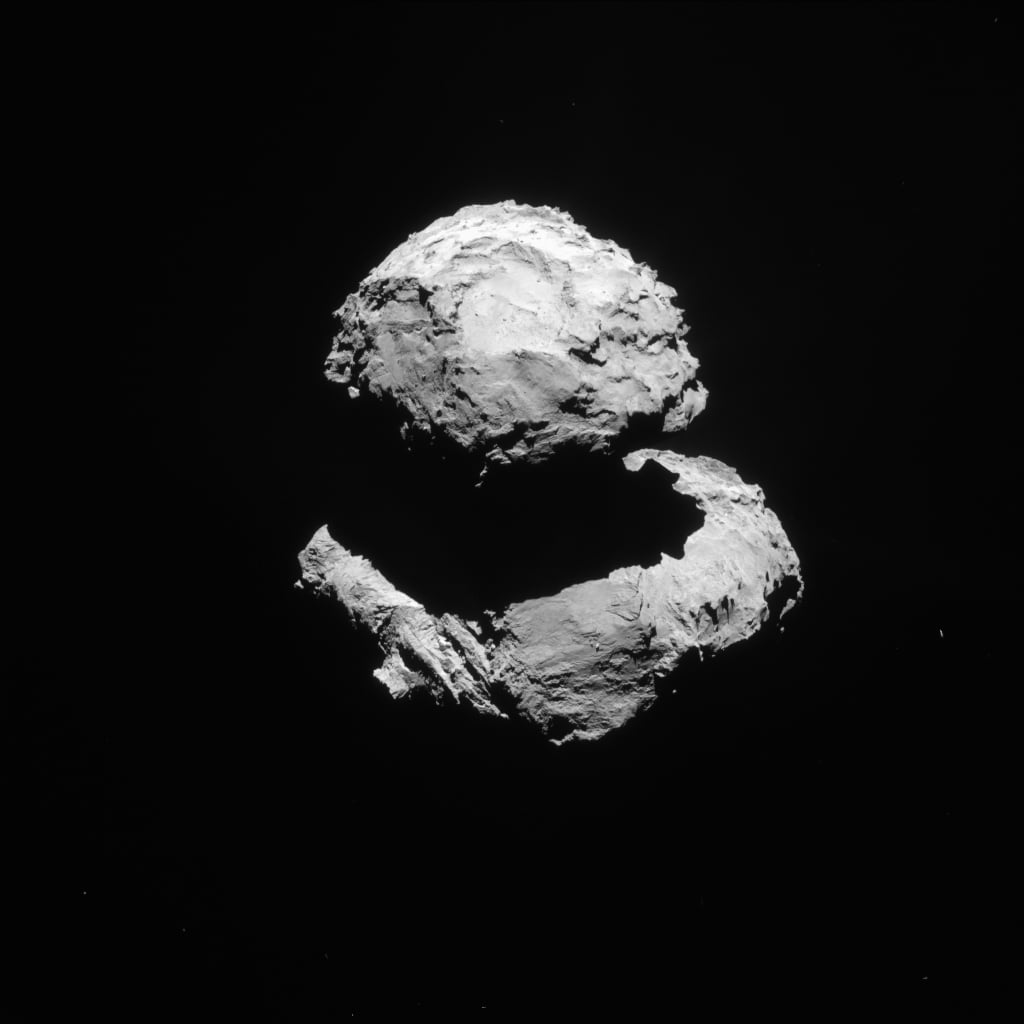
On 28 March 2015, ESA’s Rosetta spacecraft passed about 14 kilometres above the surface of Comet 67P/Churyumov–Gerasimenko. That close view brought it into a denser part of the comet’s coma, where gas released by warming ice was carrying dust away from the nucleus.
The dust did not need to strike Rosetta to cause trouble. Sunlight reflecting from nearby grains made them appear as bright points in the spacecraft’s star-tracker cameras. Onboard software that was meant to recognise the fixed geometry of the sky instead registered hundreds of plausible but false stars.
ESA’s 1 April status report records the consequences: almost a day without dependable star tracking, a high-gain antenna drifting away from Earth, a sharp decline in radio signal and, after the error returned, an automatic safe-mode response that shut down the scientific instruments.
The headline compresses a sequence that unfolded over the flyby and the following day. Rosetta was not instantly knocked into safe mode by one grain. Its attitude estimate first degraded, tracking was recovered, false-star errors continued and the protective mode followed during an onboard reconfiguration. That distinction is central to understanding what went wrong.
Star trackers tell a spacecraft which way it faces
A star tracker is a small optical navigation system. It photographs a patch of sky, extracts points of light and compares their relative positions with an onboard star catalogue. A successful pattern match gives the spacecraft a precise attitude, meaning its orientation in three dimensions.
Attitude is different from position. Rosetta could be on the correct trajectory around 67P and still face the wrong way. Its solar arrays needed sunlight, its instruments needed to look at selected regions of the comet, and its high-gain antenna needed to point towards Earth. All three depended on an accurate orientation solution.
When a tracker lost its match, gyroscopes could propagate the last known attitude for a time. Gyros measure rotation rather than an absolute direction, however, so small errors accumulate. ESA noted that the drift was especially relevant when Rosetta was slewing between observing attitudes.
Against an ordinary deep-space background, stars are distant, effectively fixed reference points. Near an active comet, a camera can also see sunlit fragments close to the spacecraft. A dust grain is not fixed against the sky, but for an individual exposure it can be compact and bright enough to enter the list of candidate stars. When hundreds appear, pattern recognition becomes much harder.
A February flyby had already exposed the weakness
The March safe mode was not the first warning. On 14 February, Rosetta flew only six kilometres above the surface over Imhotep, a broad region on the comet’s large lobe. The geometry placed the spacecraft towards the sunlit side, where the comet was more active.
ESA’s account of that earlier pass says the primary tracker began losing enough recognisable stars about two hours before closest approach and sometimes locked on to false ones. Rosetta switched to backup units, including its second star tracker, but the backup also struggled.
The vehicle avoided safe mode in February. Rosetta spacecraft operations manager Sylvain Lodiot said it had done so with considerable luck. Had the protective response occurred at the closest point, the science payload would have switched off and might not have returned to work until the spacecraft had moved well beyond the most valuable part of the pass.
Close flight offered measurements that could not be collected from farther away. It also exposed Rosetta to denser gas and dust. Its two long solar wings presented a large area to the outflow, producing drag, while the attitude cameras faced a moving field of reflected light. The same environment was both the subject of the science and a threat to the machinery performing it.
Hundreds of false stars and a fading signal
The 28 March pass came within 16 kilometres of the comet’s centre, about 14 kilometres from the surface. Rosetta again crossed above the large lobe. Its navigation camera still returned detailed images, but the primary star tracker began having trouble while the spacecraft was approaching closest passage.
Attempts to restore tracking encountered heavy optical background noise from comet activity. ESA reported hundreds of false stars and said almost 24 hours passed before the system again tracked correctly. During that interval, attitude error built up.
The high-gain antenna consequently moved away from its Earth-pointing direction. Ground stations recorded a substantial drop in signal strength. Once the tracker recovered, the spacecraft automatically corrected the pointing error and the full radio signal returned.
The trouble was not over. False-star detections persisted, and comparisons between the star trackers and other navigation measurements produced inconsistent results. During an attempt to reconfigure onboard systems, the same error occurred again. This time Rosetta entered safe mode on Sunday 29 March.
Safe mode is deliberately conservative. When monitored values or system relationships move outside permitted limits, the spacecraft protects power, thermal control and communications while disabling activities that could make recovery harder. Rosetta’s science instruments were switched off. Controllers worked from Sunday into Monday to return the vehicle to normal status.
Earth was more than 400 million kilometres away
There was no joystick response available from mission control. On 13 March, two weeks before the encounter, ESA placed Rosetta and the comet 457 million kilometres from Earth. The distance was still comfortably above 400 million kilometres during the flyby.
A radio signal over that separation takes roughly two dozen minutes in one direction. A command sent from Earth cannot be judged until the spacecraft has received it and telemetry has crossed the same distance back. Each diagnostic cycle therefore takes close to an hour before time for analysis is included.
That delay is why autonomous fault protection exists. It can also make an autonomous sensor error consequential. Rosetta had to decide whether its attitude solutions agreed and whether its pointing remained safe long before an operations team could inspect every frame and respond.
The star tracker was not behaving irrationally. It was applying its recognition logic in an environment with far more transient points of light than an ordinary star field. To the computer, the problem was not obvious debris against an obvious sky. It was an excess of candidates and no sufficiently trustworthy pattern.
The retreat changed Rosetta’s flight plan
The safe-mode sequence placed Rosetta on an escape trajectory that carried it to about 400 kilometres from 67P. A correction on 1 April began the return. A second manoeuvre followed on 4 April, and the spacecraft reached a target distance of 140 kilometres on 8 April.
The team did not simply restore the previous close-pass schedule. ESA described a complete replanning of upcoming flybys, beginning with cautious pyramid-shaped arcs and weekly decisions about whether the spacecraft could move closer.
Later operations generally kept Rosetta around 100 to 200 kilometres out and favoured a terminator trajectory near the division between comet day and night. That geometry could reduce the effect of the dusty outflow on the trackers and solar arrays, but distance always had a scientific cost.
The trade-off became especially clear when the Philae lander briefly woke in June 2015. A closer orbiter could provide a stronger communications link, yet the mission’s Philae status report said the star trackers were again showing dust interference as Rosetta approached roughly 165 kilometres. The best geometry for hearing the lander was not necessarily the safest place for the orbiter.
Space Daily’s account of Philae’s bouncing landing and short primary mission describes how dependent the lander was on Rosetta as a relay. The false-star problem therefore affected more than the orbiter’s own observations.
An optical hazard, not evidence of a destructive dust storm
It would be easy to turn the event into a story about Rosetta being battered by a storm. That is not what ESA’s status report established. The hundreds counted by the tracker were optical detections labelled as false stars, not a scientific census of hundreds of damaging impacts on the spacecraft.
Dust around a comet can create physical risks, including momentum transfer, contamination and damage to exposed surfaces. In this episode, the documented chain began with reflected light entering an attitude sensor. A small particle could matter because it looked like a navigation reference, even if it never touched Rosetta.
A 2022 review in Acta Astronautica used Rosetta among its operational examples and concluded that near-nucleus comet environments can be manageable with suitable design and planning. The authors recommended avoiding active jets, protecting sensitive surfaces and using newer star trackers with stronger rejection of transient false positives.
That conclusion does not minimise the March event. It puts the failure mode in proportion. The environment was not generally unsurvivable, but one sensor class was vulnerable to the particular way sunlit grains appeared in its field of view.
The problem returned near the mission’s end
On 28 May 2016, Rosetta encountered the same class of problem while flying about five kilometres above the surface. ESA reported that a tracker had probably locked on to a false star, producing pointing errors and safe mode. Contact was lost for nearly 24 hours.
Controllers sent commands without immediate telemetry confirmation to release a tracker stuck in a particular sub-mode. The commands worked, Rosetta returned to three-axis stabilised safe mode and the operations team regained contact. The episode confirmed that the earlier event had not been an isolated software oddity.
For the final descent, ESA planned to remove the star trackers from the attitude-control loop so that the same interference would not disrupt the sequence. Rosetta completed its controlled descent onto 67P on 30 September 2016.
By then the mission had orbited a comet, delivered the first lander to one and sampled its changing gas and dust for more than two years. Space Daily has previously examined the unusual chemistry Rosetta measured in 67P’s coma. The false-star episode shows the engineering cost of reaching that material closely enough to study it.
The grains were scientifically valuable and operationally deceptive at the same time. Hundreds of points of reflected sunlight were enough to obscure Rosetta’s fixed celestial references and redraw months of flight planning. At a comet, even knowing which lights are stars can become part of the mission.