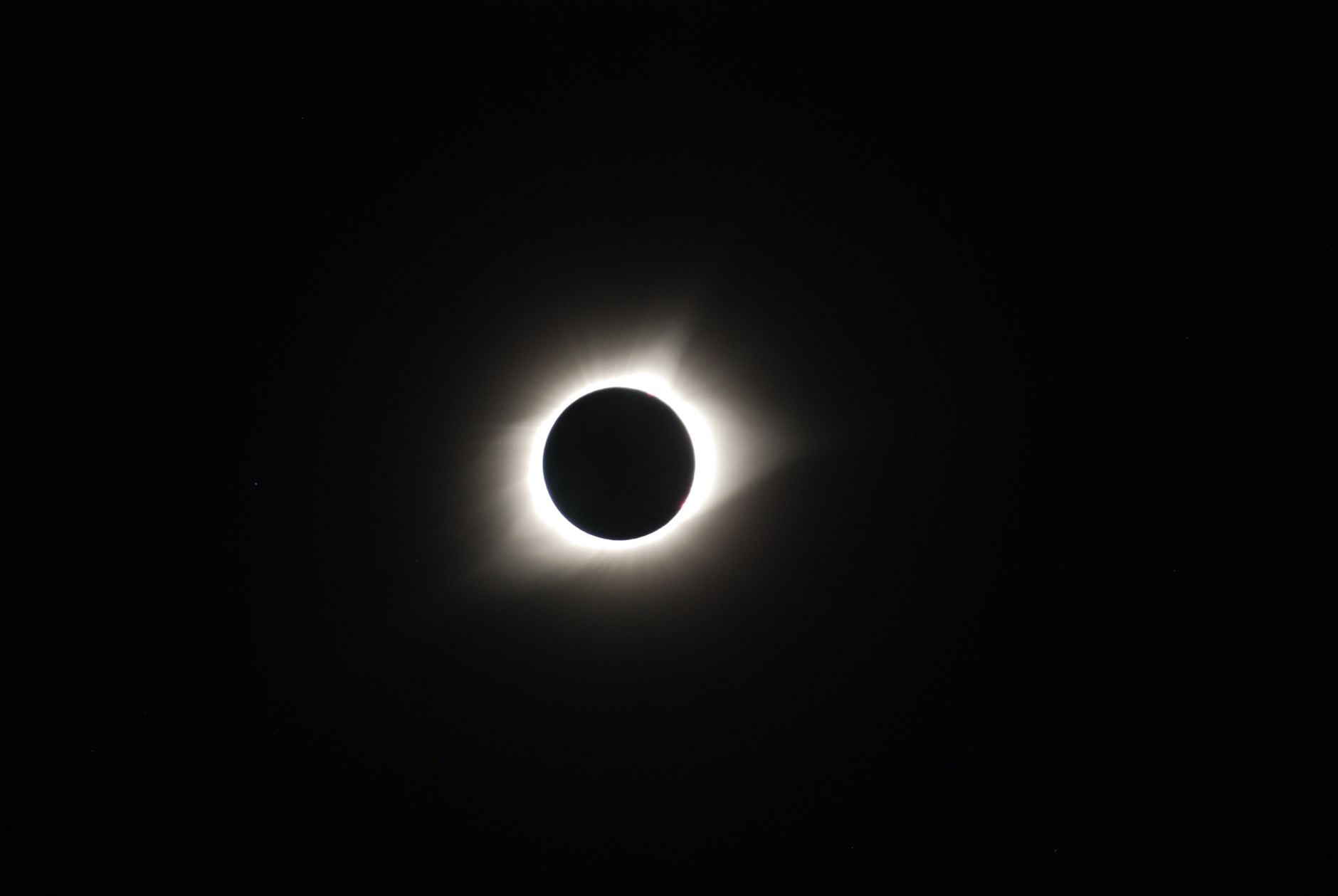
At its closest approaches, Parker Solar Probe passes about 6.2 million kilometres above the Sun’s visible surface. Sunlight there is hundreds of times more intense than it is at Earth. The spacecraft is also moving through the corona, a plasma whose particles can have temperatures measured in millions of degrees.
The equipment doing the measuring sits in the shadow of a shield only 11.43 centimetres thick.
NASA’s current mission overview describes the carbon-composite shield as able to withstand nearly 2,500 degrees Fahrenheit, or 1,377 degrees Celsius. Behind it, much of the spacecraft can remain near 85 degrees Fahrenheit, or 29 degrees Celsius. A temperature difference large enough to melt many metals is maintained across little more than the width of a hand.
The shield makes that possible, but the answer is not the shield alone. Parker survives because the entire spacecraft has been arranged around one strict piece of geometry. The heat shield reflects and slows the incoming energy. A tiny number of connections limits conduction into the spacecraft. Solar panels retreat into the shade and circulate pressurised water. Exposed sensors are made from refractory metals and sapphire. Seven Sun sensors watch for the first sign that the shadow is slipping.
The comfortable temperature a metre behind the shield is therefore the final result of a thermal system, an attitude-control system and the unusual physics of the corona working together.
A million-degree corona is not a million-degree furnace
The first distinction is between temperature and heat transfer.
Temperature describes the energy associated with the motion of individual particles. The particles in the corona move extraordinarily fast, which is why physicists assign the plasma temperatures of a million degrees or more. But the corona is also extremely sparse. There are far fewer particles available to strike Parker and transfer their energy than there would be in a gas at sea level.
A person can briefly put a hand into the hot air of an oven, although doing the same in boiling water would cause immediate injury. The oven may have the higher temperature, but liquid water contains vastly more particles per unit volume and transfers energy much more efficiently. NASA uses this same comparison in its explanation of why Parker does not melt. The probe benefits from a far more extreme version of that density difference.
This does not mean the corona is harmless. Charged particles, radiation and dust all present serious hazards. It means only that “millions of degrees” does not translate directly into the equilibrium temperature of the spacecraft.
The largest continuous thermal load comes from sunlight. At Parker’s closest orbit, the solar energy crossing each square metre is roughly 500 times the flux near Earth. In a vacuum there is no surrounding air to carry heat away by convection. Surfaces gain energy by absorbing radiation and lose it mainly by emitting infrared radiation. The design problem is to reflect as much sunlight as possible, prevent the portion that is absorbed from conducting into the spacecraft, and give other warm components a clear path to radiate their energy into dark space.
That is why the probe does not need a shell capable of surviving the corona’s nominal particle temperature. It needs one surface capable of reaching its own radiative balance under concentrated sunlight while keeping everything vulnerable out of view.
The shield is mostly empty space
Parker’s shield is about 2.4 metres across and weighs roughly 73 kilograms. Those figures matter together. A dense slab able to withstand the temperature might also have been too heavy to launch onto the required trajectory, and it could have conducted more heat towards the instruments.
The Thermal Protection System uses a sandwich construction. Thin carbon-carbon composite face sheets enclose a core of carbon foam nearly 11.5 centimetres thick. The foam is about 97 per cent empty space. NASA’s pre-launch engineering account identifies the shield, the active solar-array cooling system and onboard fault management as the three technologies that made the mission practical.
Carbon is useful here for several reasons. It retains strength at temperatures that destroy ordinary structural materials. The foam contains very little solid material through which heat can conduct. The carbon-carbon outer panels provide the stiffness needed for a broad shield that must maintain its shape through launch vibration, deep cold and repeated solar encounters.
The Sun-facing face carries a specially formulated white ceramic coating. Bare carbon is dark and would absorb a large fraction of the sunlight striking it. The white surface reflects more of that energy before it can enter the shield, while the material can radiate absorbed heat away.
The foam then sustains a steep temperature gradient. Heat does not encounter a magical boundary and stop. Energy continues through the structure, but slowly enough that the hot face can reradiate most of what it absorbs while the rear face and the spacecraft behind it remain far cooler.
Even the mounting arrangement is part of the insulation. The shield is connected to a welded truss at six points, restricting the amount of solid material available to conduct heat around its edge and into the main body. The engineering is closer to a very capable vacuum flask than to a thick wall in a house: reflective surfaces, a poor conducting path and vacuum all do different parts of the work.
A metre of shadow is more important than a metre of distance
Moving one metre farther from the Sun barely changes the intensity of sunlight when the spacecraft is millions of kilometres away. The instruments stay cool because the shield blocks their direct view of the Sun, not because they are meaningfully more distant from it.
This is radiative geometry. A surface in direct sunlight absorbs an enormous flux. A surface in the shield’s umbra can “see” the comparatively cool back of the shield and the darkness of space. It can shed its own heat without continually receiving the Sun’s full energy in return.
The phrase “room temperature” also needs one qualification. Parker has no comfortable room filled with air. The protected electronics and instruments operate in vacuum. The comparison refers to their thermal environment, generally around the mid-20s Celsius, not to pressure or human habitability.
Shade can create similarly counterintuitive conditions elsewhere in the inner Solar System. In my earlier article about Mercury, I looked at how permanently shadowed polar craters preserve billions of tonnes of water ice even though sunlit ground on the same planet reaches about 430 degrees Celsius. Parker’s situation is engineered rather than geological, but the principle is related. Direct exposure matters as much as distance from the Sun.
For the probe, however, the shadow must remain aligned to within tight limits while the spacecraft travels at roughly 690,000 kilometres per hour. Earth cannot steer it in real time. Light takes minutes to cross the gap, and the Sun can overwhelm radio communication around the closest part of each encounter.
Seven solar-limb sensors are positioned around the edge of the shield’s shadow. If unexpected sunlight reaches one, the spacecraft knows that its protected body is beginning to emerge from the shade. Its onboard fault-management and guidance systems can correct the attitude without waiting for a command from Earth. NASA’s overview of the system explains how those sensors make the shadow an actively maintained safe zone.
The shield is therefore not passive armour. It works only because Parker continually points the correct face towards the Sun. A slab of exceptional material aimed a few degrees the wrong way would leave cables, instruments or propellant systems directly illuminated.
The solar panels must hide and remain exposed at the same time
Parker is powered by sunlight, creating a second problem. The solar arrays need photons to make electricity, but full exposure near perihelion would overheat and damage them.
The spacecraft carries articulated arrays that extend when Parker is farther from the Sun. During a close approach, most of each array retracts behind the shield. Only small secondary sections remain in the light. As solar intensity rises, the exposed area can be reduced while still generating the required power.
Those small sections would still become too hot without active cooling. Parker circulates about 3.7 litres of deionised water through narrow channels associated with the arrays. The water absorbs heat and pumps carry it to four radiators, where the energy is emitted into space.
Water sounds ordinary for a spacecraft designed to touch the Sun, but it suits the required temperature range and transports a large amount of heat for its mass. The loop is pressurised so that the coolant does not boil at the system’s upper operating temperature. Heaters prevent it from freezing during colder parts of the mission.
NASA’s account of the Solar Array Cooling System says it was designed to keep the partially exposed cells below about 150 degrees Celsius even when the shield’s front face is far hotter. The shield protects the spacecraft bus; the water loop protects the components that cannot remain completely inside its shadow.
This arrangement is easy to overlook because the carbon disc supplies the memorable image. Yet a probe with a perfect shield and dead solar cells would be no more useful than one whose instruments had melted. Thermal survival has to preserve power generation, pointing, communication and measurement at the same time.
Some sensors have to leave the shade
Most of Parker’s instruments are protected, but a spacecraft cannot sample the solar environment while hiding every detector behind a wall.
The Solar Probe Cup extends beyond the heat shield to collect charged particles directly. It is a Faraday cup, a stack of grids and collectors that sorts and counts electrons and ions in the solar wind. Near the Sun, its grids can become red-hot.
The instrument survives by replacing ordinary engineering materials with ones chosen for high-temperature work. Its cup uses a titanium-zirconium-molybdenum alloy. Tungsten forms grids that must maintain their geometry while carrying high voltages. Niobium wiring runs through sapphire crystal insulators. The electronics that interpret the signals can remain farther back even while the sensing element sits in direct sunlight.
Four of the FIELDS instrument’s two-metre antennas also project into the light beyond the shield. They use a niobium alloy to tolerate temperatures around 1,377 degrees Celsius while measuring electric fields in the plasma. NASA’s instrument guide describes grids in the Solar Probe Cup reaching about 1,650 degrees Celsius while making as many as 146 measurements each second.
Other instruments exploit the shade in different ways. WISPR, Parker’s camera system, looks sideways past the shield rather than staring into the solar disc. Baffles and internal occulters suppress stray light so it can image faint coronal structures beside a source overwhelmingly brighter than them.
The probe is consequently not a conventional spacecraft placed behind a sunshade. Its protected and exposed pieces are interleaved. Each instrument has been positioned according to what it needs to see or touch, with high-temperature materials extending the measurement system back into electronics that can remain cool.
The fourteen-hundred-degree number is a limit, not the whole story
NASA commonly describes the shield as reaching or withstanding nearly 2,500 degrees Fahrenheit, equivalent to 1,377 degrees Celsius. That is the origin of the almost-1,400-degree figure. At that temperature the front face emits visible and infrared radiation and can reasonably be described as glowing.
It should not be read as one fixed temperature recorded everywhere on every pass. Shield temperature changes with distance, spacecraft orientation, surface properties and solar conditions. During Parker’s first perihelion in November 2018, when the probe remained much farther out, NASA estimated the front face at about 438 degrees Celsius. The shield was designed and tested with margin for the much harsher final orbit.
Nor does the 85-degree-Fahrenheit figure mean every component shares one temperature. Different parts have different operating limits and thermal paths. The phrase captures the outcome that matters: sensitive systems in the shield’s shadow remain within ordinary electronics temperatures while a surface centimetres away occupies an entirely different thermal regime.
The distinction is important because the shield is sometimes credited with defeating a million-degree atmosphere. That is not what happened. Sparse plasma transfers much less heat than its temperature suggests. The reflective shield manages solar radiation. Carbon foam slows conduction. Vacuum eliminates convection between the shield and the body. Radiators reject waste heat. Autonomous pointing preserves the shadow. High-temperature instruments accept exposure where science requires it.
No one layer explains Parker’s survival on its own.
The engineering exists so the probe can remain close enough to measure causes
On 24 December 2024, Parker passed about 6.1 million kilometres above the photosphere while moving around 692,000 kilometres per hour. It was out of contact during the encounter and later transmitted a beacon confirming that it had survived, as NASA recorded in its closest-approach status report.
That proximity lets the probe measure solar wind and magnetic structures before they spread, collide and evolve on the journey to Earth. In my article on the Carrington Event, I wrote about a solar eruption whose consequences reached telegraph systems in 1859. Modern infrastructure is incomparably more dependent on electrical grids, satellites, radio links and precise navigation. Understanding where solar disturbances begin is part of understanding what may arrive here later.
Parker’s repeated passes also sample a changing star. I have written about the unexpected rise in solar activity after the unusually quiet minimum of 2008. The Sun moves through an approximately 11-year magnetic cycle, and the corona encountered by the probe is not a static laboratory. Repeated orbits let researchers compare the same close region under different levels of activity.
The shield’s achievement is therefore not that it seals the spacecraft away from the Sun. Parker was launched precisely so matter and fields from the corona could reach its sensors. The design creates a narrow division between exposure and protection: a cup and four antennas in the light, cameras looking around the edge, solar cells cooled at the boundary, and the main body living in artificial night.
Eleven and a half centimetres of carbon are enough because those centimetres are placed in exactly the right orientation and supported by an entire spacecraft designed to preserve their shadow. The front can glow while the instruments remain near room temperature because Parker does not try to make the solar environment gentle. It decides, component by component, which parts must face it and which parts must never see it at all.