The date in the familiar Carrington Event story needs one adjustment. On 1 September 1859, the English astronomers Richard Carrington and Richard Hodgson independently saw patches of intense white light appear over a large sunspot group. The main geomagnetic storm reached Earth roughly 17 hours later, early on 2 September.
Then the night sky changed colour far outside the latitudes where auroras were expected. Reports came from the Caribbean, including Cuba. Telegraph systems across Europe and North America produced sparks, shocked operators and became difficult to control.
One line behaved differently. Operators between Boston and Portland, Maine, disconnected the batteries that normally drove their equipment and continued exchanging messages for about two hours. The line had not become wireless, and electricity was not falling directly from the aurora. A changing magnetic field had turned hundreds of kilometres of grounded wire into part of a planetary electrical circuit.
The visible event began on the Sun
Carrington was projecting a telescopic image of the Sun and drawing its sunspots when two bright patches appeared inside the group. Hodgson, observing independently, saw the same brief white-light flare. Their reports were later published in the November 1859 issue of Monthly Notices of the Royal Astronomical Society.
The connection to what followed was not immediately obvious. Carrington himself was cautious about claiming that the flare had caused the magnetic disturbance. Nineteenth-century physicists knew that auroras, compass movements and telegraph interference sometimes appeared together, but they did not yet have the solar wind, plasma physics or a working picture of Earth’s magnetosphere.
Neither Carrington nor Hodgson saw a coronal mass ejection. That term did not exist, and the first CME would not be imaged from space until 1971. Modern interpretation is that the white-light flare was associated with a fast eruption of magnetised plasma directed towards Earth.
NASA’s history of the event places the arrival about 17 hours after Carrington’s observation. Ordinary CMEs often take several days to cross the approximately 150 million kilometres between the Sun and Earth. The short interval implies an unusually fast disturbance. Research has also considered whether an earlier eruption cleared or altered the solar wind ahead of it, allowing the later structure to travel with less resistance.
A CME is not simply an intense beam of individual particles. That distinction matters. In my earlier article on the extraordinarily energetic particle detected in 1991, the puzzle concerned one atomic nucleus. A CME is a large moving structure of plasma and magnetic field. Its effects at Earth depend not only on speed and density, but on how its embedded magnetic field is oriented when it arrives.
Why auroras appeared over Cuba
Auroras form when energy entering Earth’s magnetic environment accelerates charged particles into the upper atmosphere. Collisions with oxygen and nitrogen leave those atoms and molecules in excited states. As they return to lower-energy states, they emit light.
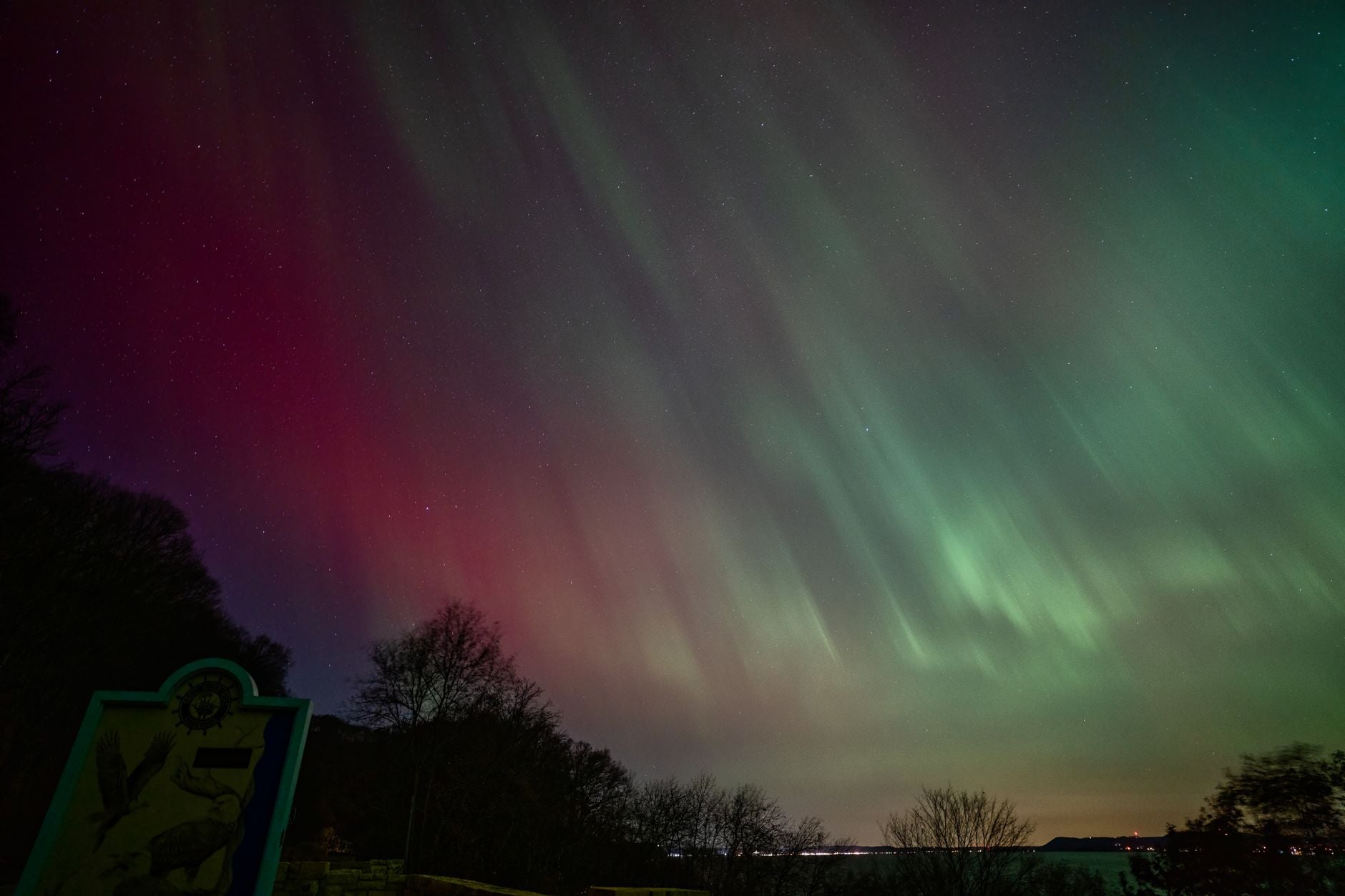
Most auroras are concentrated in ovals around the magnetic poles. During an intense geomagnetic storm, those ovals expand towards the equator. Historical reports gathered from newspapers, ship logs and scientific observations place the September 1859 display at exceptionally low magnetic latitudes. A NASA-hosted review of eyewitness accounts records deep red and crimson displays across a broad part of the world.
Cuba was not the only low-latitude location reporting unusual light. Accounts also came from Central America, the Caribbean and parts of South America. Some descriptions are difficult to interpret after more than 160 years, and the sequence included another major auroral disturbance on 28 and 29 August. The label “Carrington Event” can conceal that several eruptions and geomagnetic disturbances occurred between late August and early September.
Even with those limitations, the geographical spread on 2 September shows that the auroral zone moved far beyond its ordinary range. A 2025 analysis published through the US Geological Survey used historical low-latitude sightings to reconstruct the likely reach and intensity of several major storms. The authors estimated that a Carrington-class event could produce discrete aurora overhead at a geomagnetic latitude of about 24 degrees, although any numerical reconstruction of an 1859 storm remains uncertain.
The colour matters too. High-altitude atomic oxygen can produce red light, which may be visible far from the most active part of an auroral display. That helps explain why historical reports from low latitudes often describe red glows rather than the green curtains familiar from photographs taken closer to the poles.
The telegraph line became a path for induced current
Nineteenth-century telegraph circuits were particularly exposed to geomagnetic disturbance. They consisted of long wires connected to the ground at their ends. A battery supplied current, an operator interrupted it with a key, and a distant electromagnet translated those changes into marks or clicks.
During the 1859 storm, electrical currents already present on the lines alternately strengthened and opposed the battery current. Relays could be held too strongly, then released as the polarity changed. Some apparatus sparked. On the Boston–Portland line, the operators tried removing their batteries. The Boston operator reported, “Mine is disconnected, and we are working with the auroral current.”
George B. Prescott preserved the account in his 1860 History, Theory, and Practice of the Electric Telegraph. He wrote that the line continued without batteries for about two hours, after which the aurora subsided and normal battery power was restored. Other routes reported signals transmitted using the disturbance alone, but the Boston–Portland exchange is the clearest sustained example.
The phrase “auroral current” was sensible observational language for 1859. The modern mechanism is geomagnetic induction. An incoming CME can transfer energy into Earth’s magnetic environment, intensifying and rapidly changing electrical currents in the magnetosphere and ionosphere. Those currents produce magnetic fields of their own. As the magnetic field measured at the ground changes, it produces a geoelectric field in the conducting Earth.
Current then follows available paths through the ground and through long grounded infrastructure. The aurora was a visible sign of the same disturbed near-Earth system. It did not pour charge straight into the telegraph wire.
Why removing the batteries helped
It may seem odd that a disrupted system worked better after its intended power source was removed. The induced current was not steady. It changed strength and sometimes direction. When added to the battery current, it could drive the receiving magnets too hard. When opposed to the battery, it could cancel the intended signal.
With both batteries removed, the operators could use whichever polarity the geomagnetic disturbance supplied, adjusting their instruments as conditions changed. The current was still unreliable, but for part of the storm it was sufficient to operate the line. According to the preserved exchange, Portland at one point received Boston’s writing better without the batteries connected.
Not every telegraph route could do this. The voltage induced along a line depends on the rate and direction of magnetic change, the line’s length and orientation, and the electrical conductivity of the ground beneath it. A Boston–Portland circuit could therefore behave differently from another route at the same time.
This is why the story should not be retold as free power from the sky. The same process that briefly carried usable signals also disrupted other lines, produced dangerous sparks and interfered with normal operation. Removing the batteries was a local improvisation during a fluctuating disturbance, not a general energy source.
The same physics reaches modern power grids
Telegraph networks have disappeared, but their vulnerability has not. High-voltage transmission lines are long conductors connected through grounded transformers. During a geomagnetic storm, slowly varying currents can enter those circuits and push transformers outside their intended alternating-current behaviour.
A US Geological Survey explanation of geoelectric hazards notes that local geology matters because conductive and resistive rock structures shape the electric field at the surface. Grid exposure is therefore not determined by latitude alone. Line orientation, transformer design and the operating state of the network also affect the outcome.
The March 1989 geomagnetic storm demonstrated the modern connection when the Hydro-Québec system lost power within about 90 seconds of protective equipment beginning to trip. Six million people were left without electricity for nine hours. Since then, operators and space-weather agencies have improved monitoring, modelling and mitigation.
NOAA’s Space Weather Prediction Center now uses coronagraph observations to estimate a CME’s size, speed, direction and density. The magnetic field orientation that largely controls how strongly it couples with Earth cannot be measured directly from afar with the same certainty. It is sampled when the disturbance reaches spacecraft upstream of Earth, leaving a much shorter window for the final warning.
A repeat of 1859 would not simply recreate the telegraph episode at larger scale. Modern grids, satellites, radio systems and navigation services fail in different ways, while operators also have forecasts and protective procedures unavailable in the nineteenth century. Precise consequences would depend on the eruption, its magnetic orientation, the state of the infrastructure and where the strongest geoelectric fields developed.
A benchmark rather than a calibrated maximum
The Carrington Event is often called the strongest geomagnetic storm on record. That description needs a qualifier: the record was sparse, several instruments went off scale, and modern storm indices did not yet exist. Researchers reconstruct its intensity from magnetograms, auroral reports and technological effects, producing estimates with substantial uncertainty.
It is better treated as a benchmark than as a precisely measured upper limit. We know the disturbance was extreme. We cannot assign every modern engineering consequence from the nineteenth-century evidence, nor assume that no larger event is physically possible.
Nor does a generally active Sun make a Carrington-scale eruption inevitable. I recently wrote about the unexpected rise in solar activity after the weak conditions of 2008. Solar-cycle strength changes the frequency of active regions and eruptions, but the severity of one geomagnetic storm also depends on whether an eruption hits Earth and how its magnetic field connects with ours.
What 1859 established beyond reasonable doubt was a physical chain linking an event seen on the Sun, a rapid disturbance of Earth’s magnetic environment, auroras at unusual latitudes and currents in human technology. The Boston and Portland operators did not harvest electricity from glowing air. They discovered, by experiment and necessity, that a long wire on a disturbed planet can become part of the storm.