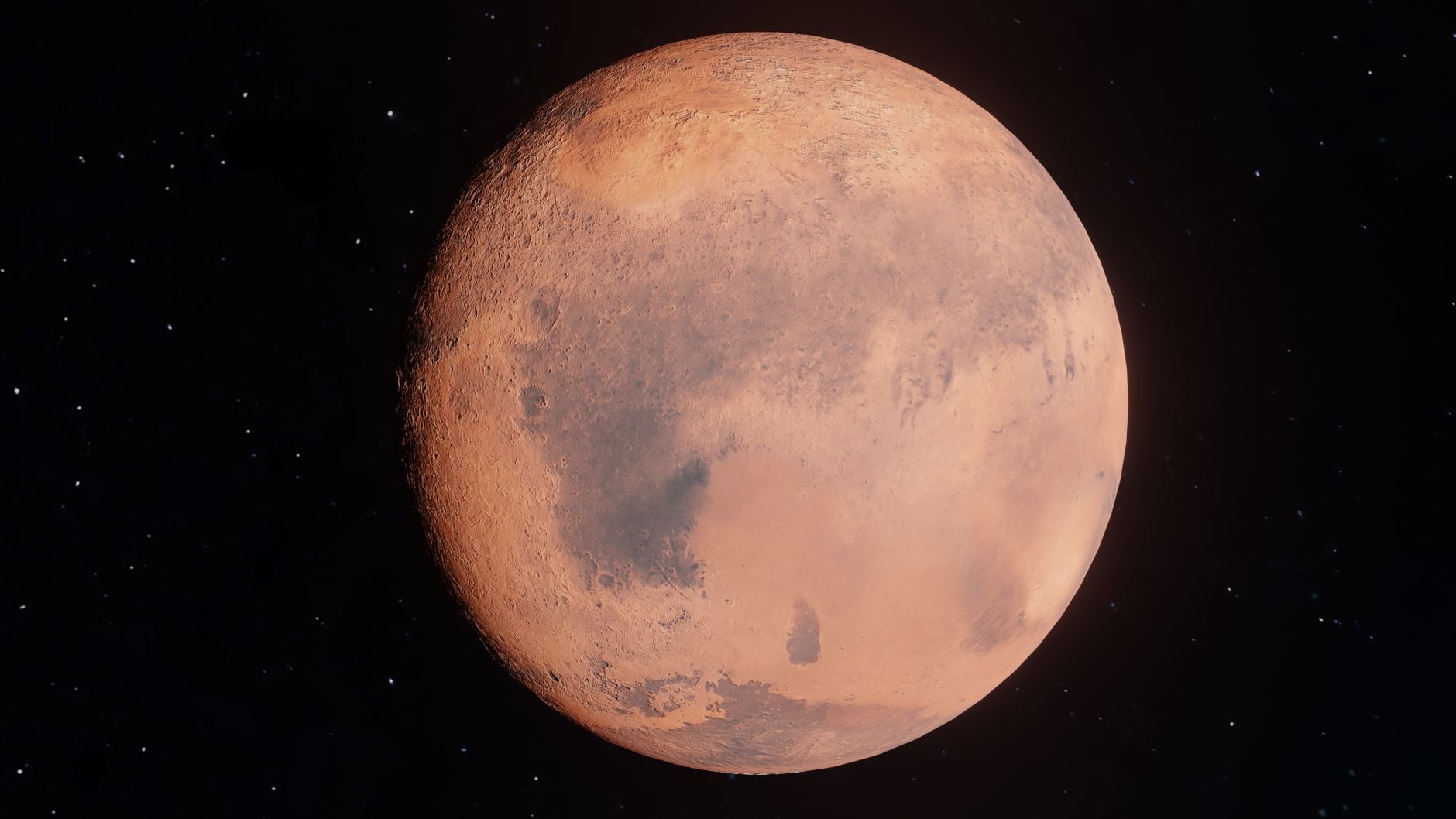
A dark green Martian rock found near Rafsa in Algeria has landed in a part of Mars’s timeline that the most common class of Martian meteorites had left almost blank. In the August 2026 issue of Geochimica et Cosmochimica Acta, Dylan Seal and colleagues report an age of 1,273 million years, with an uncertainty of 21 million years, for Northwest Africa 13441.
One correction to the title’s shorthand matters before I go further. The 600-million-to-2.4-billion-year gap applies to shergottites, the dominant family of Martian meteorites, not to every Martian meteorite. Nakhlites and chassignites have long been dated to around 1.3 billion years old. NWA 13441 is the first shergottite reported in that interval. The distinction makes the finding narrower than the title suggests, but no less useful.
This is one study, not settled consensus. It is also a case where the qualification is part of the story: a single stone can fill an empty place on a chart without making that chart complete.
The rock is small, but its record is unusually well placed
The Meteoritical Bulletin’s official entry records four pieces of NWA 13441 with a combined mass of 84.69 grams. Camel herders found them in December 2019 near Rafsa, Oum El Assel. The stones are described as rounded or tabular and dark green to brownish-green.
That catalogue entry establishes the find and classification. The new peer-reviewed paper goes much further. The team describes NWA 13441 as an olivine-phyric shergottite: a basalt containing conspicuous olivine crystals set in a finer groundmass of pigeonite, olivine and maskelynite, with smaller amounts of chromite and merrillite.
Several independent chemical clues support its Martian origin. The ratios of iron to manganese in its olivine and pyroxene fit Martian rocks, while its oxygen-isotope composition also lands where Martian material should. It carries the marks of a violent impact too. Roughly seven per cent of the analysed rock is pyroxene-rich melt glass, and its minerals show deformation consistent with shock pressures estimated at about 28 to 34 gigapascals.
That impact damage is not what gave the rock its 1.273-billion-year age. The date refers to when its minerals crystallised from Martian magma. It is not the date the rock was blasted off Mars, crossed space or fell onto Earth. These are different chapters, recorded by different clocks.
How the 1.273-billion-year date was obtained
The researchers separated minerals and leached fractions from the meteorite, then measured samarium and neodymium isotopes. Samarium-147 decays into neodymium-143 at a known rate. Minerals that formed together begin with related isotope compositions but hold different amounts of samarium and neodymium. Plotting those measurements can therefore reveal how long the decay has been running.
Nine fractions produced what the authors call a samarium-neodymium errorchron corresponding to 1,273 plus or minus 21 million years. The word errorchron deserves attention. The reported MSWD value of 19 means the points scatter more than a mathematically ideal isochron would predict from analytical uncertainty alone. The authors still interpret the line as a crystallisation age, but this is not a perfectly tidy clock face.
To me, that is a reason to describe the result precisely rather than dismiss it or oversell it. A peer-reviewed age with an uncertainty and visible scatter is evidence readers can evaluate. It is not a magic number detached from the measurements beneath it.
The real gap was in shergottites
Shergottites account for most of the Martian meteorites in collections. Before NWA 13441, nearly all dated shergottites had crystallised less than about 600 million years ago. Two conspicuous exceptions, NWA 7635 and NWA 8159, are about 2.4 billion years old. That left no known shergottite crystallisation ages between those groups.
NWA 13441 now sits almost in the middle. It does not mean Mars was volcanically quiet for the rest of that interval and suddenly active at one moment. It means our collection had failed to sample that activity until this rock was recognised and dated.
The distinction is easy to miss because a meteorite collection can look like a geological survey. It is nothing of the sort. A Martian rock has to be struck hard enough to escape the planet, survive an interplanetary orbit, cross Earth’s atmosphere, land somewhere recoverable and then be found. Multiple named meteorites may also be fragments from the same fall or the same ejection event. The title’s “roughly 400” is a useful sense of scale, not 400 independent, evenly spaced samples of Mars.
I wrote recently about why Antarctica concentrates meteorites. The Sahara offers a different kind of search advantage: dark stones can stand out on pale, dry ground, and low weathering can help preserve them. Where we find meteorites is therefore partly a map of where people can see and recover them, not a map of where they preferentially fell.
A possible third way to read Mars’s mantle
The age is only half of the paper. NWA 13441’s initial neodymium-isotope composition is close to chondritic, and it does not fall neatly into the enriched and depleted source patterns commonly used for shergottites. The authors offer two broad possibilities. The magma may have tapped a previously unsampled, relatively undifferentiated Martian mantle reservoir. Or it may record mixing between enriched and depleted reservoirs already inferred from other meteorites.
The current data do not choose decisively between those explanations. Nor do they identify the crater or volcanic province from which the rock came. What they do show is that the familiar shergottite collection did not capture the full timing or chemical range of magma produced inside Mars.
This is the editorial point I think matters most. Filling a gap does not mean finishing a history. It exposes how much of the apparent pattern was shaped by the tiny and selective sample that happened to reach us.
An accidental sample-return programme
I also wrote recently about the cancellation of the programme intended to return Perseverance’s carefully selected Mars samples. NWA 13441 is a reminder that nature has been delivering Martian samples without waiting for us, but it is not a substitute for bringing known rocks home from known places.
A returned sample would arrive with geological context: the outcrop it came from, the layers above and below it, images of the collection site and measurements made on Mars. A meteorite usually arrives without an address. Its minerals can retain an age and chemistry, yet researchers must reconstruct its origin from the rock alone.
That makes NWA 13441 both valuable and incomplete. Four small stones found by camel herders have extended the dated history of the largest Martian meteorite family by more than half a billion years. They may also preserve material from a part of Mars’s mantle that our previous samples barely represented.
I find the modest version of the story more convincing than the inflated one. This rock does not redraw all of Martian history. It adds one carefully measured point where there had been none, and that single point shows how provisional the gaps in our knowledge really are.