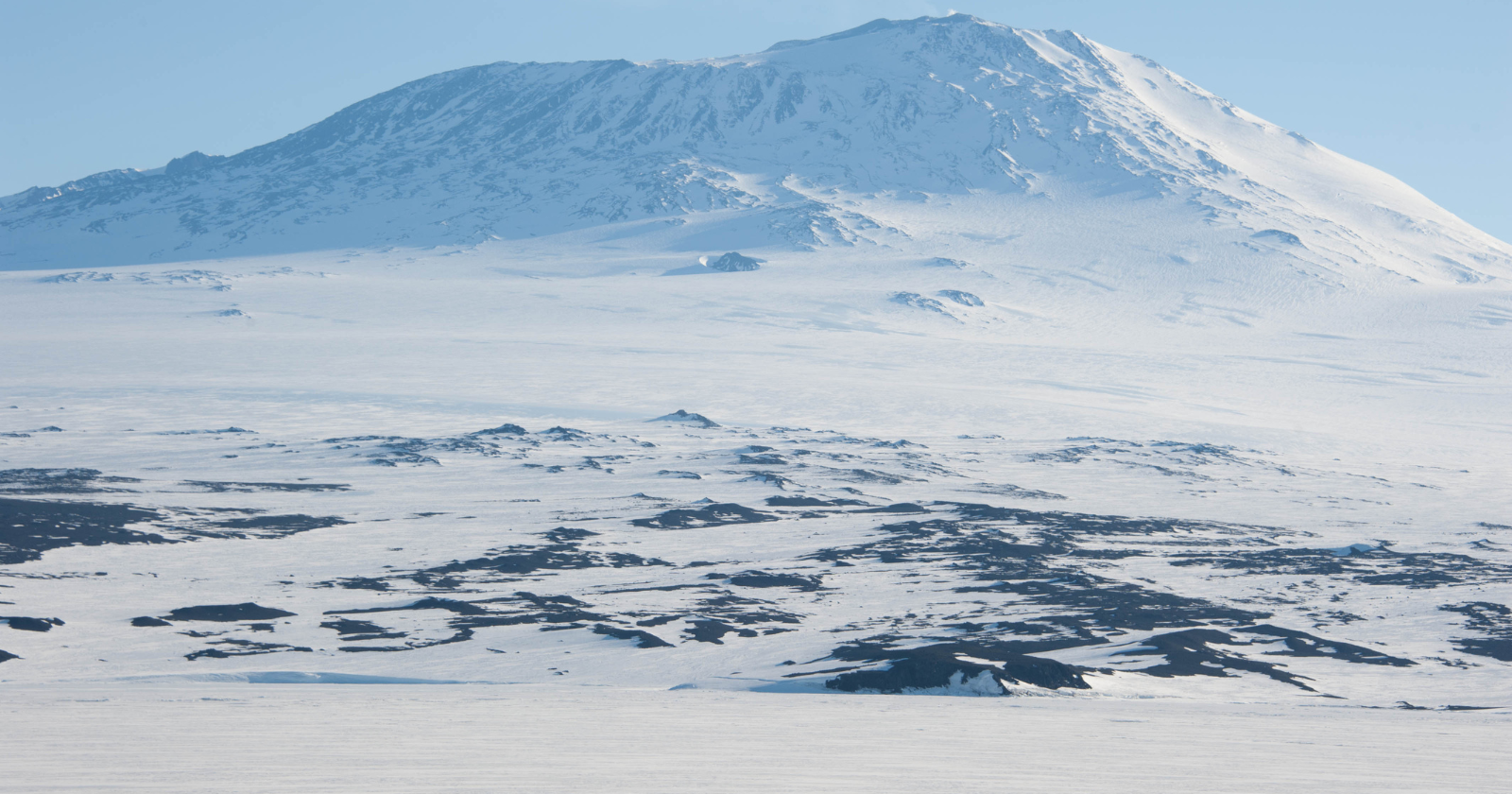
Antarctica does not sit beneath a special rain of space rocks. Meteorites fall across the planet, and most vanish into oceans, vegetation, soil or landscapes crowded with ordinary stones. The frozen continent is exceptional because it gathers, preserves and displays them.
More than 45,000 meteorite specimens have been recovered from Antarctic ice since the first documented find there in 1912, according to NASA’s Earth Observatory. Recent scientific literature puts the worldwide Antarctic collection closer to 50,000.
That count needs a small qualification. A specimen is not always a separate fall. A meteorite can break into several fragments, and researchers may later determine that nearby pieces belong to the same event. Even so, the scale of the collection is extraordinary.
The secret is a slow conveyor system built from flowing ice, mountains, dry wind and time.
Meteorites begin by disappearing into the ice
When a meteorite lands on an Antarctic ice sheet, fresh snow may bury it. Over time, that snow compresses into ice while the glacier creeps outward under its own weight. The embedded rock travels with it, sometimes for tens or hundreds of thousands of years.
Most of that material eventually reaches the coast and is lost into the ocean. But in parts of East Antarctica, flowing ice meets barriers such as the Transantarctic Mountains. The ice slows, piles up or is diverted upward.
At the same time, fierce, dry katabatic winds prevent much new snow from settling and help remove ice from the surface. Some ice is scoured away; some changes directly from solid ice into water vapour through sublimation. The meteorites do neither. As the old ice is exposed and lost, its rocky passengers remain behind.
Given enough time, this process creates a meteorite stranding zone, concentrating material that originally fell across a much larger region.
Blue ice turns the continent into a search field
These accumulation areas are usually blue-ice fields, hard expanses where surface snow is absent and ancient compressed ice is exposed. Their colour and emptiness make dark rocks unusually visible.
Many meteorites develop a dark fusion crust when their exterior melts during atmospheric entry and then cools. Against clean blue or white ice, that surface can stand out from a considerable distance. Search teams travel in spaced lines by snowmobile or on foot, looking for anything that seems not to belong.
The contrast helps, but identification is not as simple as collecting every black stone. Terrestrial rocks can be carried onto the ice from nearby mountains. Meteorites also weather, fracture and lose their textbook appearance. Experienced teams document each candidate’s position, photograph it and collect it using contamination-controlled equipment.
NASA scientist Barbara Cohen described the practical rule in a 2018 account of an ANSMET expedition: searchers are looking for what does not belong in Antarctica.
Most come from asteroids, but a few came much farther
The phrase “pieces of the Moon and Mars” is true, but it should not obscure the proportions. NASA estimates that about 99.8 percent of meteorites found on Earth originated on asteroids. Lunar and Martian meteorites make up only a small fraction.
Those rare planetary rocks reached Earth through a remarkable chain of events. A large impact struck the Moon or Mars hard enough to blast fragments above the body’s escape velocity. Some of that debris eventually crossed Earth’s path, survived atmospheric entry and landed on the surface.
Scientists identify likely Martian and lunar origins through mineralogy, age, trapped gases and chemical or isotopic signatures. Antarctic collections included the first meteorites recognised as coming from the Moon and Mars, and NASA’s Astromaterials 3D collection now lets the public examine digital models of examples from both worlds.
A natural collection still requires careful human work
Systematic recovery transformed the ice’s geological accident into a research resource. Japan began major Antarctic collecting in the 1960s. The United States launched the Antarctic Search for Meteorites program, known as ANSMET, in 1976.
The American program alone has recovered more than 23,000 specimens through a partnership involving NASA, the National Science Foundation and the Smithsonian Institution. Field teams place candidates in sterile bags and keep them frozen during transport. At NASA’s Johnson Space Center, the rocks are thawed under controlled conditions, dried, classified and prepared for research.
This matters because the collection is not simply a cabinet of curiosities. Qualified researchers can request samples. A fragment gathered from the ice can therefore be studied by many laboratories, allowing new analytical techniques to extract information that the original collectors could not have anticipated.
The result is something like a low-cost sample-return programme assembled by nature. It is less targeted than sending a spacecraft to one asteroid, but it samples a far wider range of parent bodies.
The conveyor belt is productive, but not permanent
Scientists estimated in 2022 that as many as 300,000 meteorites might remain exposed or close to the surface in Antarctica. A machine-learning map published in Science Advances used ice velocity, surface temperature, slope and radar properties to predict promising search areas.
Yet blue ice does not guarantee a meteorite hotspot. If the ice flows too quickly, rocks are carried away before they concentrate. If the surface becomes warm enough, a dark meteorite absorbs solar energy, melts the ice beneath it and sinks out of sight. NASA reported that known hotspots remain below minus 9 degrees Celsius for 99 percent of the time.
Antarctica’s collection is therefore not just the product of cold. It depends on a narrow combination of cold, dryness, slow ice and surface loss. The continent receives no special share of material from space. What it offers is a rare Earth system that sorts the arrivals, carries them to particular places and sets them against a background where human eyes can finally find them.