There is a version of this story that sounds almost too perfect.
In it, the first atomic bomb did more than begin the nuclear age. It placed a permanent radioactive signature into the atmosphere, which entered every batch of steel made afterwards. Scientists building radiation detectors were then forced to retrieve uncontaminated metal from warships resting on the seabed. Every precise measurement made today therefore depends on a dwindling inheritance from the world before Trinity.
The image is irresistible: physicists listening for the faintest particles in nature from inside chambers made from the bones of sunken ships.
It also needs correcting.
Pre-1945 steel has genuinely been used in low-background radiation facilities. Some old ship steel has ended up around extraordinarily sensitive instruments. But it is not true that almost every sensitive detector depends on metal salvaged from a wreck, or that science will run out of usable steel when the last pre-war hull is gone.
The accurate story is less folkloric and more interesting. Once an instrument becomes sensitive enough, its own materials can begin to imitate the signal it was built to find. At that point, steel is no longer just structure. It becomes part of the experiment.
The detector can become louder than the radiation it is measuring
A radiation detector never operates in silence. Cosmic rays arrive from above. Radon and its decay products move through the air. Traces of uranium, thorium and potassium occur naturally in rock, concrete, glass and metal. Even a bolt, cable or speck of dust can contribute a few unwanted events.
For an ordinary survey meter checking whether an area is safe, those tiny contributions are usually manageable. For an experiment waiting months or years for an exceptionally rare interaction, they can overwhelm the measurement.
SNOLAB describes the problem in unusually clear terms. Some of the interactions sought in its underground experiments may occur only once per tonne of detector material per year. The laboratory sits beneath 2,070 metres of rock, reducing the cosmic-ray rate by a factor of about 50 million, yet experiments still need clean rooms, carefully screened components and their own layers of shielding.
I wrote about the same principle in my piece on IceCube’s 5,160 light sensors buried in the Antarctic ice. The ice is not merely somewhere convenient to put the detector. Its darkness, clarity and depth help determine what the instrument can distinguish. In low-background counting, the walls around a sensor play a similarly active role.
The task is not simply to detect radiation. It is to know whether a recorded event came from the sample, the sky, the surrounding rock or the machine itself.
Why 1945 became a dividing line for steel
The Trinity test took place in New Mexico on 16 July 1945. Hundreds of above-ground nuclear tests followed around the world, particularly during the 1950s and early 1960s. Their fallout distributed artificial radionuclides through the atmosphere and across the surface of the planet.
Steel made before that period could not have incorporated fission or activation products from weapons fallout during its original manufacture. That made older material attractive for laboratories trying to push their background count as low as possible.
A Pacific Northwest National Laboratory account of low-background steel explains that several US Department of Energy facilities built counting-room shields from pre-World War II metal. These rooms were used for measurements in which a very small amount of radioactive material inside a person had to be distinguished from radiation arriving from everywhere else.
The contamination at issue was not enough to make a bridge, car or kitchen knife dangerous. It mattered because a detector designed to count a handful of gamma rays cannot afford to sit beside a wall that occasionally supplies gamma rays of its own.
Even the phrase “everything smelted after 1945 is radioactive” is too blunt. The radioactive content of metal depends on its raw materials, recycled scrap, manufacturing route, handling and exposure to cosmic rays. Natural uranium, thorium and potassium can matter alongside human-made cobalt-60 and caesium-137. An accidentally recycled medical or industrial source can create a far more serious contamination problem than diffuse bomb fallout.
The atmosphere has changed as well. The US Environmental Protection Agency notes that most above-ground testing ended after the 1963 Limited Test Ban Treaty, and that very little of the radioactivity from weapons testing in the 1950s and 1960s can now be detected in the environment. Radioactive decay and the end of large-scale atmospheric testing weakened the sharp practical distinction between old and new steel.
Old warship steel was used, but shipwrecks were never the whole supply
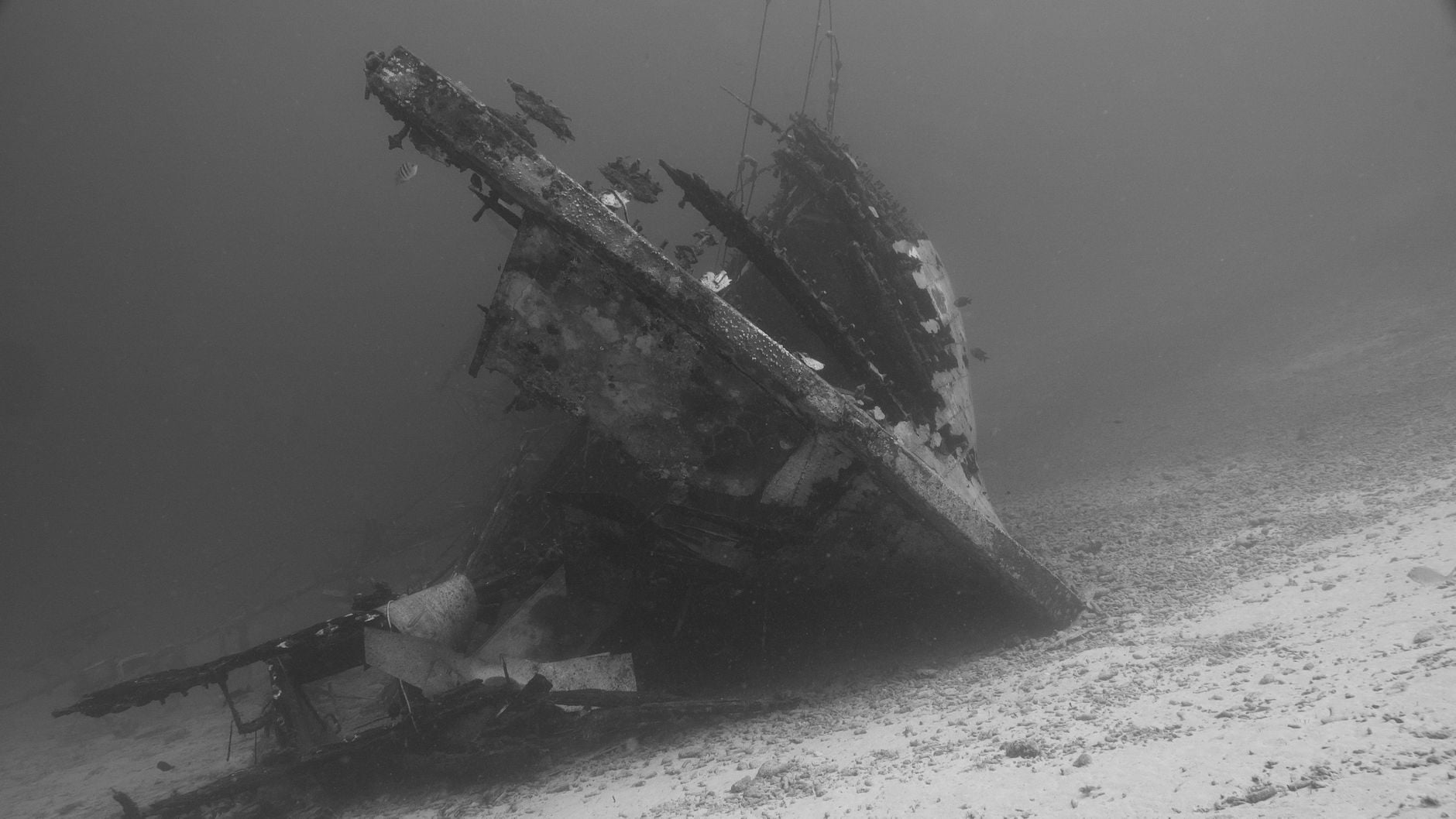
Ships enter the story for a sensible reason. A large vessel contains thousands of tonnes of steel with a known manufacturing date. If it was built before July 1945, scientists know its original metal predates nuclear weapons fallout.
Yet one of the best-documented examples did not come from a wreck on the seabed. Steel from the hull of USS Indiana, a US battleship completed during the Second World War and later scrapped, was reused to construct a shielded room at Pacific Northwest National Laboratory. Thirty centimetres of steel around that room substantially reduced the background from higher-energy photons.
Other facilities have described their shielding as pre-war battleship steel, and submerged wrecks have certainly been discussed and salvaged as sources of low-background metal. But “old ship steel” gradually became “sunken warship steel” in popular retellings, and then became the much larger claim that nearly every Geiger counter, medical scanner and space instrument depends on it.
There is no evidence for that scale of use. The sensing element in a detector may be a gas-filled tube, a germanium crystal, silicon, liquid xenon, scintillating plastic or another specialised material. Low-background steel, where used, is more often a shield, enclosure or pressure vessel around the detector.
This distinction matters. A room built from old steel can house several instruments over many decades. It does not imply that every instrument inside it contains a piece of a ship.
A shield is part of the measurement, not just a thick wall
I recently wrote about how Parker Solar Probe’s carbon shield allows instruments behind it to remain near room temperature while the Sun-facing surface reaches almost 1,400 degrees Celsius. The material solves a different problem, but the design lesson is similar: a scientific instrument is inseparable from the environment its shielding creates.
Low-background experiments rarely rely on one metal. They use nested layers because different sources of interference require different answers.
The Majorana Demonstrator, built to search for an extremely rare form of nuclear decay, offers a useful example. Its shield was designed in layers: polyethylene to slow neutrons, plastic panels to identify passing cosmic-ray muons, an enclosure to exclude radon, lead to block gamma rays, then increasingly pure copper close to the germanium detectors.
The purest copper was electroformed, meaning it was deposited gradually onto a mould using an electric current. Producing it underground helped prevent cosmic rays from activating the material while it was being made and stored.
That is the broader discipline known as low-background physics. Laboratories assay candidate materials before construction, control dust and radon, track exposure at the surface, simulate the radiation from every component and reject events that arrive with the wrong signature. An old steel plate can be useful, but it is one option inside a much larger system.
Modern experiments can make new low-background metal
The finite-supply claim also runs into a straightforward fact: suitably quiet metal can be manufactured today.
For the PandaX-II dark matter experiment, researchers worked with producers to create low-background stainless steel and welding rod for a xenon pressure vessel. Their published measurements put human-made cobalt-60 at roughly one millibecquerel per kilogram or below. Nuclear-grade stainless steel from another producer showed a similar background rate.
The LUX-ZEPLIN dark matter experiment took another route. Its collaboration screened metals and selected specially produced titanium with extremely low measured uranium, thorium, potassium and cobalt-60 activity for a cryostat holding tonnes of liquid xenon.
These projects do not assume that a material is clean because it is old. They measure it. A pre-1945 date removes one possible history of contamination, but it does not remove naturally occurring radioactivity, surface contamination or later exposure. Conversely, a modern date does not make a carefully produced and screened metal unusable.
There is also an important difference between diffuse fallout and contaminated scrap. The metal recycling industry monitors loads because lost medical and industrial radioactive sources have sometimes entered furnaces. The International Atomic Energy Agency documents dozens of accidental source-melting events, most commonly involving caesium-137 and cobalt-60. That is a real safety and manufacturing problem, but it is not evidence that every post-1945 batch carries the same bomb-era signature.
The genuinely finite resource is the wreck itself
The low-background steel story becomes ethically uncomfortable when a historic wreck is treated as an anonymous stockpile.
Many wartime wrecks are archaeological sites and the resting places of people who died aboard them. Their metal may be finite, but so is the history contained in their structure. Removing a hull plate is not equivalent to buying an old beam from a demolished factory.
HMAS Perth, sunk in Indonesian waters in 1942, was stripped on an industrial scale decades later. Low-background steel has often been offered as the motive. A peer-reviewed historical archaeology study of the wreck urges caution: demand for such steel is small, modern low-radioactivity steel is available, and ordinary scrap value may better explain much of the illegal salvage.
So the supply of pre-nuclear shipwreck steel is finite. That does not mean sensitive radiation detection faces a materials deadline. Laboratories can reuse existing shields, select clean stock, manufacture radiopure alloys, electroform copper and design active veto systems that identify unwanted events.
The enduring part of the story is not that modern science survives by consuming sunken fleets. It is that the atomic age changed what the most sensitive instruments had to notice.
When a detector is listening for one event in a tonne of material over a year, history can register as noise. The steel around the experiment has a manufacturing date, a chemical history and a radiation history. Physicists have to understand all three.