There is no altitude at which Earth’s atmosphere simply stops. The blue sky becomes black, aircraft lose the ability to fly and orbital motion takes over, but a vanishingly thin population of particles continues far beyond the conventional edge of space.
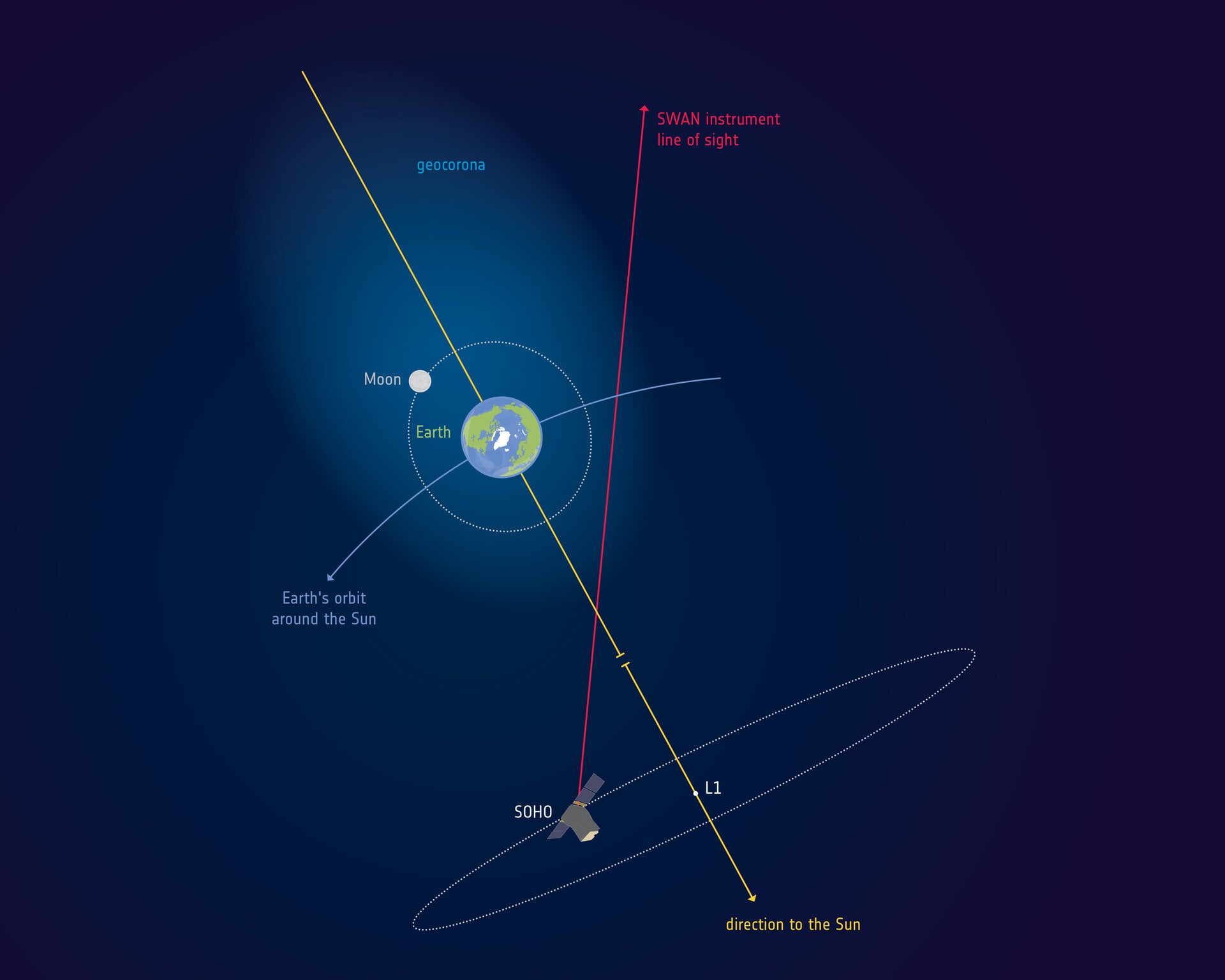
The most extended neutral component is atomic hydrogen. Sunlight makes it glow at an ultraviolet wavelength called Lyman-alpha, creating a vast halo known as the geocorona. Measurements published in 2019 traced that glow to roughly 630,000 kilometres from Earth, almost twice the Moon’s average distance.
This permits a technically true but easily misunderstood statement: the Moon orbits inside Earth’s outer atmosphere. It does not mean astronauts at lunar distance encounter air that can be breathed, felt or used. Near the Moon, the study estimated only about 0.2 hydrogen atom per cubic centimetre, a density that laboratories on Earth would call an excellent vacuum.
The Kármán line is a boundary for flight, not molecules
The 100-kilometre Kármán line is the internationally familiar boundary of space. It is useful because conventional aerodynamic flight becomes impractical and orbital mechanics takes over around that altitude. It separates aeronautical records from astronautical ones; it is not a wall at which the atmosphere ends.
That distinction is easy to lose. When Space Daily looked back at the first photographs of Earth taken from space by a V-2 in 1946, the rocket’s 105-kilometre altitude was enough to place its camera beyond today’s conventional boundary. It was nowhere near the final atmospheric particle.
NASA’s guide to the atmospheric layers says 99.99997 per cent of the atmosphere lies below the Kármán line. The surviving fraction is fantastically small, yet particles become less frequent continuously rather than disappearing together. The exosphere is collisionless: atoms can travel long distances without striking one another, some on ballistic paths back towards Earth and some escaping permanently.
The atmosphere can therefore be visually thin and physically enormous at the same time. Space Daily’s account of the narrow blue line seen by space-station crews describes the dense, optically visible part that protects life. The geocorona is a much larger structure that human eyes cannot see.
The geocorona is sunlight scattered by hydrogen
Hydrogen is the lightest element and the dominant neutral constituent in Earth’s distant exosphere. Some of it begins as water vapour or methane lower in the atmosphere. Photochemical reactions free hydrogen, which diffuses upwards through the thermosphere until individual atoms enter the exosphere.
The Sun illuminates those atoms at 121.6 nanometres, the Lyman-alpha line. A hydrogen atom absorbs a photon and re-emits light in another direction. Seen from far enough away, countless scattering events form a faint ultraviolet crown around Earth. The name geocorona means “Earth crown.”
People on the ground cannot see it because the lower atmosphere absorbs far-ultraviolet light. Even a space-based detector must distinguish Earth’s hydrogen from interplanetary hydrogen that also scatters sunlight throughout the Solar System. That background can be hundreds of times brighter than the geocoronal signal at its furthest detectable reaches.
SOHO found the Moon inside a two-decade-old dataset
The Solar and Heliospheric Observatory, or SOHO, occupies a halo orbit around the Sun-Earth L1 point about 1.5 million kilometres towards the Sun. This placed it outside the geocorona and gave it a view back towards the entire cloud.
SOHO’s SWAN instrument mapped Lyman-alpha across the sky. Its decisive component was a hydrogen absorption cell that could be switched into the optical path. Comparing measurements with the cell activated and deactivated removed much of the geocoronal signal selectively, allowing researchers to disentangle Earth’s faint glow from the Doppler-shifted interplanetary background.
Igor Baliukin and colleagues reanalysed dedicated observations made in January 1996, 1997 and 1998. Their 2019 Journal of Geophysical Research: Space Physics paper detected emission to approximately 100 Earth radii, or about 640,000 kilometres from Earth’s centre. ESA described the reach as 630,000 kilometres, a rounded distance from the planet that is about 50 times Earth’s diameter.
The honest wording is “at least” this far. The researchers found a signal of about five Rayleigh at 100 Earth radii, close to the limit they could separate reliably from the background. They did not encounter a hard shell beyond which hydrogen was absent.
The Moon is permanently embedded, but barely
The Moon’s elliptical orbit carries it between roughly 54 and 64 Earth radii from the planet’s centre. A geocorona measured to about 100 Earth radii therefore surrounds the entire lunar orbit, not only the Moon’s closest approaches.
Density matters more than reach. The team estimated about 70 hydrogen atoms per cubic centimetre at 60,000 kilometres above Earth’s surface. At lunar distance, the estimate fell to only about 0.2 atom per cubic centimetre. A cubic centimetre of air near sea level contains on the order of 10 quintillion molecules.
Calling both regions “atmosphere” is scientifically consistent but physically deceptive if density is omitted. The geocorona produces no breathable pressure, weather, sound or meaningful aerodynamic drag on a lunar spacecraft. An astronaut cannot feel it, and it offers no useful reservoir of propellant. Every Apollo crew flew through Earth’s outermost neutral hydrogen, but their spacecraft behaved as if it were in vacuum.
The Moon is also not acquiring a dense hydrogen atmosphere of its own. The paper concluded that interaction with the lunar exosphere is probably negligible because both media are so collisionless.
Apollo 16 photographed the halo from inside it
In April 1972, Apollo 16 astronauts John Young and Charles Duke placed a gold-plated ultraviolet camera in the shadow of the lunar module Orion. Designed by Naval Research Laboratory scientist George Carruthers, it became the first astronomical observatory operated on another world.
The camera recorded Earth’s atmosphere and geocorona below 160 nanometres, producing the first full view of the planet in far-ultraviolet light. The astronauts were observing Earth’s outer atmosphere from the Moon without knowing that the telescope, the lander and they themselves were embedded within its furthest reaches.
The position that made the image possible also limited it. Apollo 16 looked at the glowing halo from inside the structure and could not measure its remote edge. SOHO eventually supplied the needed distant vantage. In planetary science, a phenomenon’s apparent boundary often depends as much on where the detector sits as on what the phenomenon is doing.
The halo matters more to telescopes than lunar crews
The geocorona is not a meaningful radiation shield at the Moon. Its hydrogen atoms scatter solar ultraviolet light, but ESA’s assessment found the associated exposure negligible compared with radiation arriving directly from the Sun. The particles pose no atmospheric hazard to astronauts either.
For ultraviolet astronomy, faint foreground light does matter. The 2019 study estimated that an observatory on or around the Moon could see roughly 10 Rayleigh of geocoronal emission in directions perpendicular to the Earth-Moon line, added to the stronger interplanetary Lyman-alpha background. Precision measurements of stars, galaxies and diffuse hydrogen may need to model and subtract that local glow.
The halo is also a tracer of atmospheric escape. Hydrogen derived partly from water rises, moves through the exosphere and can be ionised or lost into space. Measuring its distribution helps researchers test how Earth’s atmosphere responds to solar ultraviolet radiation and space weather. Similar extended hydrogen envelopes around other planets may provide clues to water loss and long-term habitability.
The geocorona and magnetosphere are different structures
Earth’s magnetic environment can also stretch beyond the Moon, but it should not be confused with the geocorona. The magnetosphere is organised by Earth’s magnetic field and populated by charged particles. The geocorona consists mainly of neutral hydrogen shaped by gravity, ionisation, solar radiation pressure and atmospheric escape.
The two regions interact because neutral hydrogen can become ionised. Their shapes, densities and response to the Sun nevertheless differ. Saying the Moon is permanently embedded in the geocorona does not mean it is always in the same region of the magnetosphere.
Earth-Moon exchange is real in more than one form. Space Daily’s report on terrestrial oxygen reaching the Moon and helping form hematite concerns charged oxygen ions transported through the magnetotail. The geocorona is a separate neutral, hydrogen-rich connection between the worlds.
Carruthers is now watching Earth’s crown change
The 630,000-kilometre result came from only three observing windows, all near low solar activity. It is not a universal radius fixed to Earth. Solar illumination, radiation pressure, ionisation and the supply of escaping hydrogen should change the halo’s density and shape.
NASA’s Carruthers Geocorona Observatory launched in September 2025, reached a halo orbit around L1 and began its 24-month primary science mission on 1 March 2026. From beyond the geocorona, its wide- and narrow-field imagers are designed to map Lyman-alpha repeatedly, track changes on hourly timescales and help reconstruct the hydrogen cloud in three dimensions.
Space Daily covered Carruthers’ first ultraviolet views of Earth and the Moon in December. The mission is named for George Carruthers, whose Apollo 16 instrument first photographed the crown from within it. More than half a century later, an observatory bearing his name is looking back from outside the halo to learn how its extent changes.
The Kármán line remains a useful place to say space begins. It was never the place where Earth ends. The atmosphere fades through layer after layer until the last hydrogen atoms are so sparse that only their ultraviolet glow reveals that the outermost air of home still reaches around the Moon.