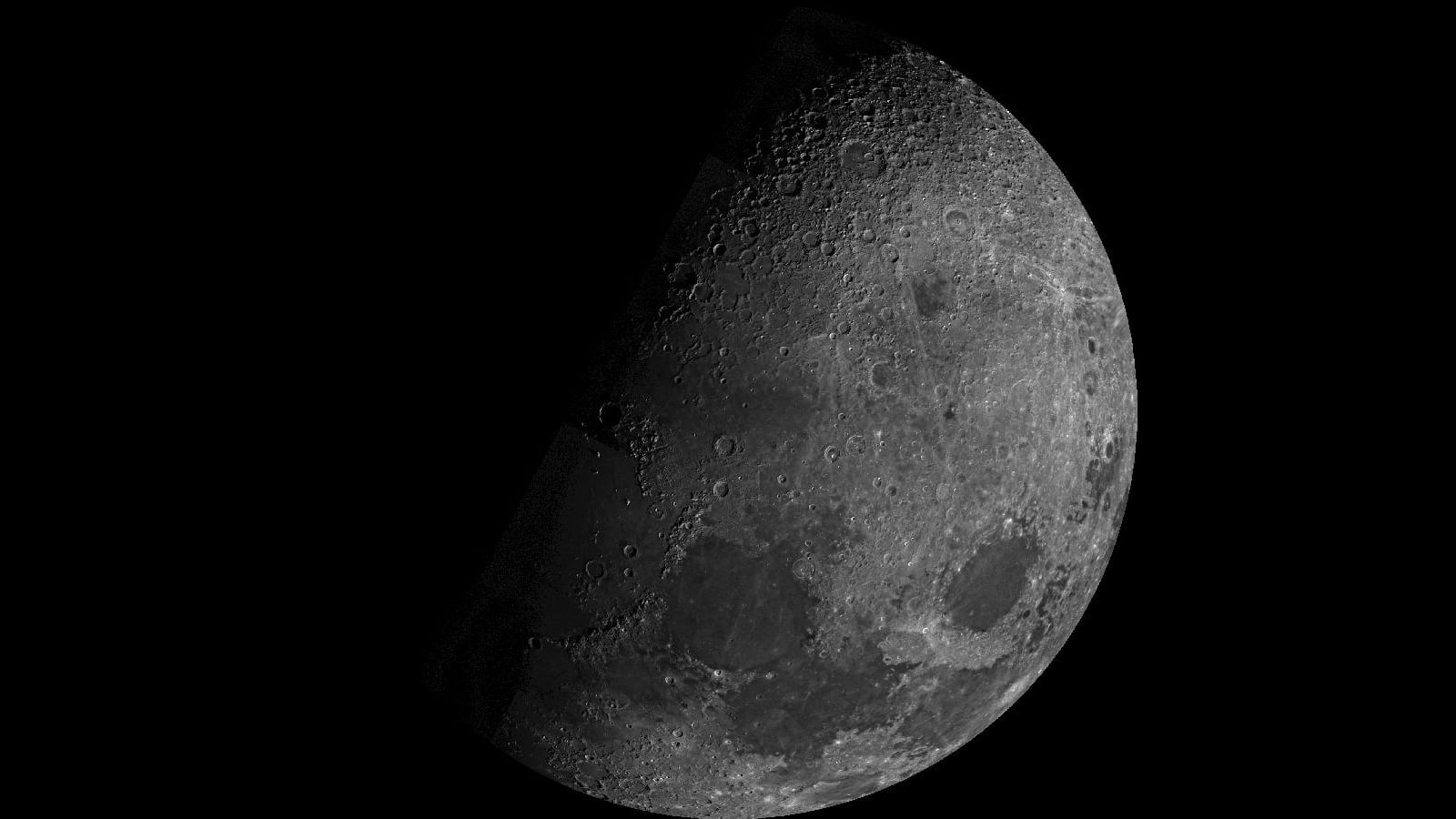
Rust should be close to impossible on the Moon. It has no substantial atmosphere, almost no liquid water and a surface bombarded for most of every month by hydrogen from the solar wind. Hydrogen is a reducing agent, the chemical opposite of the oxidising conditions that turn iron into rust.
Yet researchers analysing data from India’s Chandrayaan-1 orbiter found hematite at high lunar latitudes. Hematite is iron oxide, Fe2O3, and on Earth it is one of the minerals commonly called rust.
The leading explanation makes Earth both the supplier and the shield. Oxygen ions escape our upper atmosphere and reach the Moon through the long magnetic tail extending away from the Sun. Around full Moon, that same magnetotail suppresses most of the hydrogen-rich solar wind for several days, opening a recurring chemical window in which lunar iron can oxidise.
The clue appeared in Chandrayaan-1 spectra
NASA’s Moon Mineralogy Mapper, or M3, flew aboard Chandrayaan-1 and measured reflected light across visible and infrared wavelengths. In a 2020 Science Advances study, Shuai Li and colleagues identified absorptions consistent with hematite, mainly in both polar regions between about 75 and 90 degrees latitude.
The distribution was not symmetrical. Hematite appeared more extensively on the near side, which permanently faces Earth, than on the far side. It also tended to occur on east- and equator-facing slopes of topographic highs. That combination suggested a supply arriving from Earth, with local water or hydroxyl and micrometeoroid heating influencing where oxidation proceeds.
The discovery grew out of the same instrument record used to study lunar hydration. Space Daily has previously reported how M3 mapped water and hydroxyl beyond the permanently shadowed poles. The Moon is extraordinarily dry by terrestrial standards, but “almost no liquid water” does not mean that every grain is chemically waterless.
Earth’s magnetic shield stretches past the Moon
The solar wind compresses Earth’s magnetosphere on the dayside and draws it into a vast magnetotail on the nightside. At full Moon, the Moon is almost directly behind Earth from the Sun and crosses this tail. Japan’s Kaguya orbiter detected energetic oxygen ions of terrestrial origin at lunar distance, a result reported in a 2017 Nature Astronomy paper.
The distance travelled is roughly 385,000 kilometres. Space Daily explored the larger implication in July when it described modelling of terrestrial atmospheric particles implanted in lunar soil. The magnetic field usually described as Earth’s shield can, under this geometry, also become part of a transport system.
The tail creates a brief oxidation window
For more than three-quarters of each orbit, the Moon sits in the ordinary solar wind. Its abundant protons implant hydrogen into the regolith, encouraging reduction rather than oxidation. During the magnetotail passage around full Moon, conditions change for roughly several days.
According to NASA’s account of the discovery, Earth’s magnetic tail blocks more than 99 per cent of the solar wind during the relevant periods. It simultaneously carries oxygen ions from the upper atmosphere. The Moon does not acquire breathable air; individual energetic particles strike iron-bearing minerals in the soil.
This explains two observations at once: why oxidation is possible in a strongly reducing environment, and why the signal is more common on the Earth-facing hemisphere. It is an accumulated effect repeated over immense spans of time, not a monthly reddish bloom visible through a telescope.
Laboratory oxygen made rust without liquid water
The 2020 proposal was based on orbital mineral maps and space-plasma measurements. In 2025, Xiandi Zeng and colleagues tested the chemistry directly. They baked iron-bearing samples to remove adsorbed water, placed them under vacuum and irradiated them with energetic oxygen ions. Their Geophysical Research Letters study produced microscopic hematite on metallic iron, iron sulphide and ilmenite.
That experiment demonstrated an anhydrous route: oxygen implantation can oxidise suitable minerals without liquid water. It also revealed a contest between formation and erasure. High-energy hydrogen ions reduced hematite back towards metallic iron, while lower-energy hydrogen intended to represent ordinary solar wind was much less effective under the tested conditions.
A second laboratory study published in Icarus in July 2026 adds an important qualification. With basaltic powder, its strongest ferric-iron signatures appeared when low-flux oxygen irradiation, trace adsorbed water and a brief laser pulse simulating micrometeoroid heating acted together. Its dry basalt run produced no pronounced ferric feature.
Water and impacts may decide where rust survives
The experiments are complementary rather than identical. They used different starting minerals, ion doses and detection methods. One shows that oxygen ions alone can make hematite on favourable iron-bearing phases; the other indicates that hydration and short bursts of heat can make the pathway more effective in basaltic material.
The lunar poles contain both permanently shadowed ice and more dispersed molecular water or hydroxyl. As Space Daily’s earlier look at polar cold traps stressed, these are not lakes beneath the dust. Rust formation may need only trace hydration in grains, while micrometeoroids provide transient heating and expose fresh iron.
The remaining far-side hematite also warns against declaring the case closed. Terrestrial oxygen should favour the near side, but impacts, implanted solar-wind oxygen or other local processes may contribute elsewhere. “Leading explanation” is stronger than “proven sole cause.”
Lunar rust could preserve a history of Earth
A returned hematite grain could do more than settle a mineralogical argument. Oxygen arrives in isotopes whose proportions can identify its source. If lunar hematite was built from terrestrial oxygen, grains associated with surfaces of different ages may retain pieces of Earth’s atmospheric history across billions of years.
Orbital spectra identify the mineral, Kaguya detected the oxygen transport and laboratory experiments show plausible chemistry. What is still missing is the chain of evidence inside an uncontaminated polar sample: where its oxygen came from, when oxidation occurred and which combination of ion implantation, hydration and impact heating produced it.
The rust itself is sparse and microscopic. The connection it records is planetary in scale: material escaping Earth can cross 385,000 kilometres and alter the Moon, a few days at a time.