
The Moon is easy to misread from Earth. It looks dry, grey, and inert, a world of dust and stone with no rivers, clouds, or blue trace of atmosphere. The Apollo samples seemed to support that picture for decades. The Moon, in the standard view, was a place where water could not last for long near the surface.
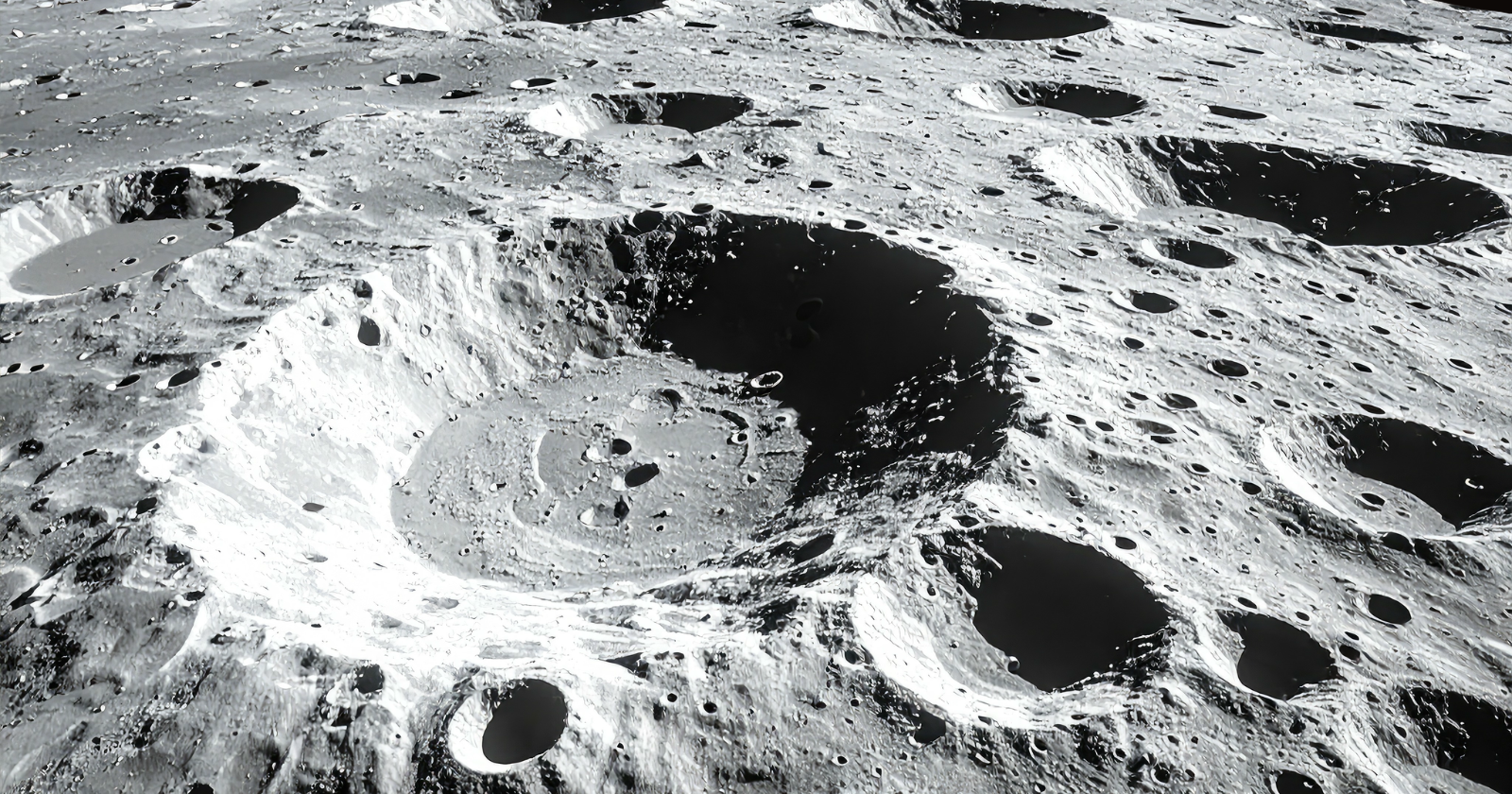
That picture is now too simple. NASA’s overview of water and ices on the Moon describes a long shift in the evidence, from early hints of hydrogen at the poles to later confirmation of water ice in permanently shadowed regions. The most important places are not the bright plains visible through a backyard telescope, but the cold interiors of craters near the poles that sunlight never reaches.
Those dark craters are not lakes, glaciers, or easy reservoirs waiting with pumps attached. They are more difficult and less romantic than that. But they may hold one of the most useful materials future lunar crews could find: water ice. If it can be extracted in useful quantities, water could support astronauts directly, be processed into oxygen, and be split into hydrogen and oxygen for propellant.
Why ice can survive there
The Moon has almost no atmosphere, and most of its surface swings between harsh heating and deep cold. In sunlit places, exposed ice would not behave like ice in a terrestrial freezer. It would tend to sublimate, breaking away into vapour and eventually escaping or being broken apart.
The poles change that calculation. Because the Moon’s rotational axis is only slightly tilted, some crater floors near the north and south poles remain in permanent shadow. NASA’s Moon water history notes that the idea goes back at least to theoretical work in the 1960s, when scientists argued that volatile substances such as water could remain trapped in crater bottoms that never receive sunlight.
These regions are often described as cold traps. That phrase is literal. A water molecule that reaches one of these deep, lightless pockets can lose energy and stay frozen for long periods. Over time, impacts by comets, asteroids, and icy micrometeorites, along with interactions between solar wind hydrogen and oxygen-bearing lunar minerals, may have supplied material that migrated into these traps.
The south pole is especially interesting because it combines permanently shadowed crater interiors with nearby high ground that can receive more frequent sunlight. That makes the region scientifically valuable and operationally attractive. Ice may sit in cold darkness, while power, communications, and landing operations may be easier near illuminated ridges.
How the evidence built up
The case for lunar water did not arrive all at once. NASA’s Clementine mission in 1994 suggested possible ice in a permanently shadowed region. Lunar Prospector then found that the largest concentrations of hydrogen were in areas never exposed to sunlight. Those early results were suggestive, but not decisive.
The next major step came in 2009. NASA’s Lunar Crater Observation and Sensing Satellite, or LCROSS, deliberately sent a rocket stage into Cabeus crater near the lunar south pole, then flew through the plume of excavated material. The impact was not done for drama. It was a controlled way to lift hidden material from a permanently shadowed region into view of instruments.
NASA’s account says that LCROSS and the Lunar Reconnaissance Orbiter, which launched together, showed grains of water ice in the ejected material. The LCROSS science team later reported water in the impact plume in Science. LRO continued to map the Moon and has provided data used to characterize lunar resources, including hydrogen. Together, those missions made the pole less like a blank dark zone and more like a place with measurable volatile chemistry.
Then came a more direct confirmation from the Moon Mineralogy Mapper, a NASA instrument carried on India’s Chandrayaan-1 mission. In 2018, an analysis of M3 data published in PNAS revealed multiple confirmed locations of water ice in permanently shadowed regions of the Moon. The confirmed deposits were found at both poles, with more abundant signals near the south pole.
Why water matters more than gold
Gold is valuable on Earth because people have built economies and symbols around it. On the Moon, the value system changes. A kilogram of water is not glamorous, but it solves several practical problems at once.
First, water can be used for drinking and other life-support needs. It can also help with radiation shielding if enough of it is available. More importantly for long-term exploration, water can be processed. Electrolysis splits H2O into hydrogen and oxygen. Oxygen is needed for breathing and can also serve as a rocket oxidizer. Hydrogen can be used as fuel, especially when paired with oxygen in cryogenic propulsion systems.
That is why lunar ice is discussed so often in the context of in situ resource utilization, usually shortened to ISRU. The idea is simple in concept: use local materials instead of launching every kilogram from Earth. The implementation is hard. But the reason the idea matters is hard to miss. If astronauts can make some consumables and propellant on the Moon, the logistics of lunar operations change.
It is expensive to lift mass out of Earth’s gravity well. Every kilogram of water, oxygen, shielding material, or propellant launched from Earth has to ride a rocket. A usable lunar water source could reduce some of that burden. It could also support fuel depots or longer surface missions, if the extraction and processing systems work reliably.
The engineering problem
The word “ice” can make the problem sound easier than it is. The Moon’s south pole is not known to contain clean slabs of exposed ice that astronauts can cut like blocks from a lake. The ice may be mixed with regolith, present as grains, patchy deposits, or thin coatings. The exact distribution, concentration, depth, grain size, and accessibility still matter enormously.
Mining in permanently shadowed regions would also be difficult. These craters are extremely cold, dark, and often rugged. Machinery has to survive temperatures far below anything found in ordinary terrestrial mines. Power has to be delivered into darkness. Dust can abrade equipment. Communications may be complicated by terrain. Robotic systems have to dig, heat, capture vapour, purify water, and store products without constant human repair.
Then the water has to be processed. Splitting water into hydrogen and oxygen takes energy. Storing hydrogen and oxygen as cryogenic propellants adds another layer of complexity. The benefit is potentially large, but so is the equipment chain needed to turn dirty, cold lunar material into breathable oxygen or rocket fuel.
This is why the water ice is best understood as a promising resource, not a finished infrastructure. The confirmation of ice answers one question. It does not answer how much can be practically extracted, at what cost, using which machines, under which mission constraints.
A scientific archive as well as a resource
The ice is not only useful. It is also a record. Permanently shadowed regions may preserve material that has accumulated over billions of years. That material could contain clues about comet impacts, micrometeorites, solar wind chemistry, and the history of volatiles in the inner Solar System.
That creates a tension. The same ice that future astronauts may want to mine is also scientifically valuable. A careless extraction campaign could disturb a record before scientists have read it. The first missions to these regions will therefore need to balance exploration, sampling, resource assessment, and preservation.
The south pole is attractive because it might support human activity. It is also attractive because it can answer questions about how water moves across an airless body, how cold traps accumulate material, and how the early Solar System delivered volatiles to rocky worlds.
What changed in the Moon’s story
The old image of a completely dry Moon was understandable. Apollo landed in sunlit equatorial and mid-latitude regions, not inside polar cold traps. The samples were not designed to represent every possible lunar environment. As instruments improved and missions looked in different places, the story changed.
The modern Moon is still dry by earthly standards. NASA’s own water overview makes clear that water exists in sunlit and shadowed regions, but many questions remain about its origins, movement, and future behaviour. The discovery is not that the Moon is secretly wet like Earth. It is that the Moon is not chemically empty in the way scientists once assumed.
That difference matters. A barren rock becomes a more complicated world when its darkest craters contain water ice. A destination becomes a potential working landscape when that water can, in principle, support air, fuel, shielding, science, and longer human stays.
The Moon has not become easy. It has become more interesting. Near its south pole, the most valuable ground may be the ground no sunlight touches, because in that darkness the Moon has preserved a resource future explorers may need more than any metal: frozen water.
