

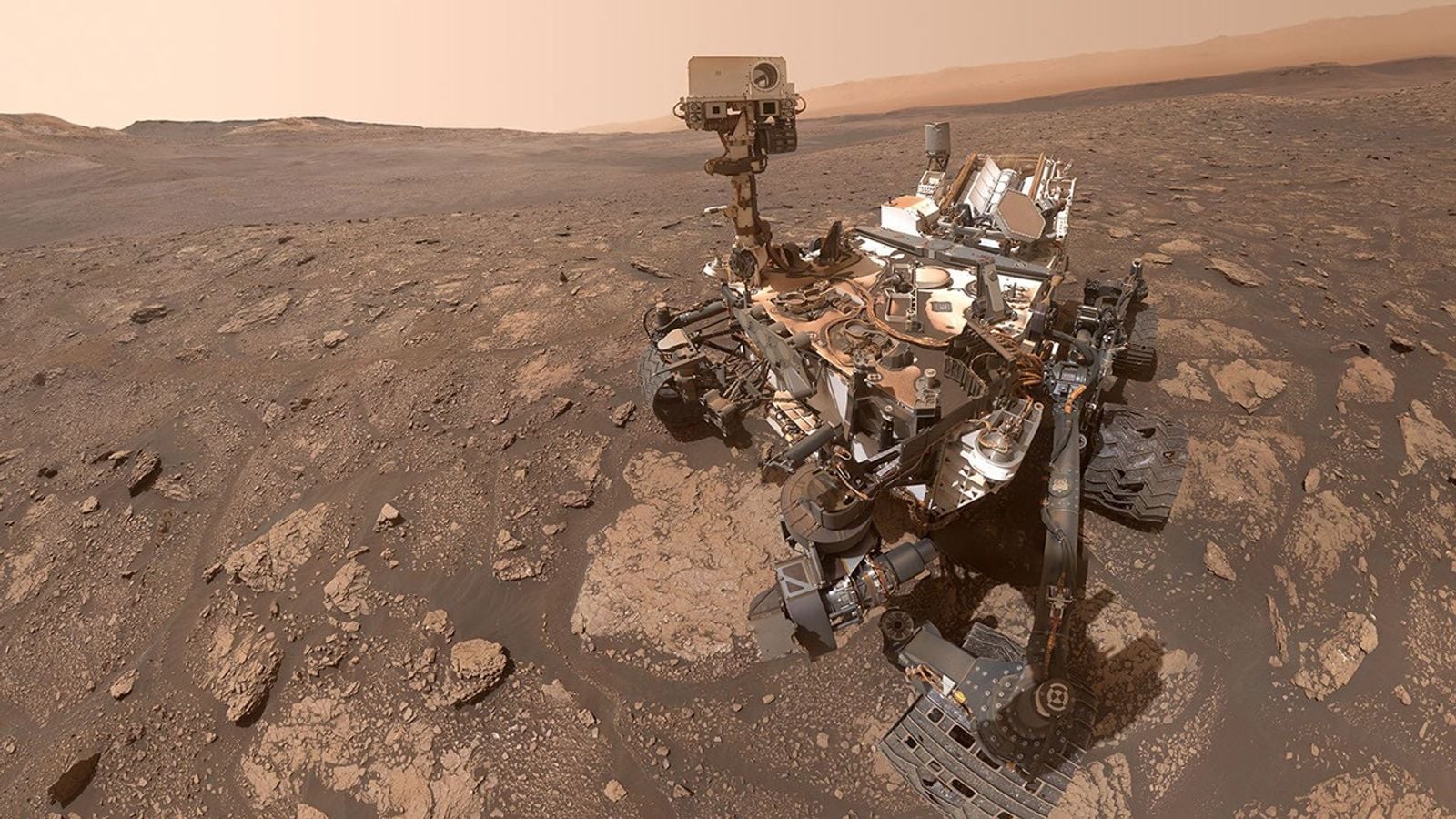
The phrase “first nitrogen heterocycle on Mars” sounds cleaner than the measurement behind it. NASA’s Curiosity rover did not pull an intact molecular ring from a rock and hold it up for inspection. Its laboratory heated a chemically treated powder, separated the gases that came off and reconstructed likely structures from their fragment patterns.
In April 2026, that process produced the first surface signal consistent with a nitrogen-bearing ring, a family of structures used in the chemistry of RNA and DNA. Yet the peer-reviewed paper in Nature Communications calls it a possible nitrogen heterocycle. The best library match and the timing through the chromatography column did not fully agree.
This is one study, not settled consensus. It is not evidence of life. It is a careful, instrument-mediated glimpse of complex organic matter preserved in a Martian lakebed, and understanding the instrument is essential to understanding the claim.
Curiosity used chemistry to open a chemical archive
The rock powder came from Mary Anning 3, a drill target collected in October 2020 in Gale Crater’s clay-rich Glen Torridon region. Its sandstone formed roughly 3.5 billion years ago in a landscape shaped by lakes and streams. Clay is a useful archive because organic matter can bind to its minerals and survive conditions that would destroy exposed molecules.
Curiosity placed about 163 milligrams of powder into a cup containing tetramethylammonium hydroxide, or TMAH, then heated it to roughly 550°C. The reagent can cleave a large, stubborn organic network into smaller volatile pieces. A gas chromatograph separates those pieces by travel time; a mass spectrometer records the fragments produced from each one. This was the first TMAH wet-chemistry experiment carried out on another planet.
The method revealed more than 20 organic compounds. Our earlier Space Daily account of the Mary Anning sample explains that full inventory and why seven of its members were new for Mars. Here, the narrower question is how confidently one of those members can be called a nitrogen heterocycle.
The signal was close to dimethyl-indole, but not identical
The mass spectrum of the signal labelled peak 22 was most consistent with dimethyl-indole. Its most prominent fragments had mass-to-charge values of 145, 144 and 146, and the comparison with a reference library was strong. If the mass spectrum were the only clue, dimethyl-indole would have been the natural label.
Chromatography supplied another check. On a laboratory version of SAM’s column, dimethyl-indole emerged after 20.7 minutes. The candidate from Mars emerged after 17.0 minutes. The authors therefore stopped short of that specific identification and proposed a methylated, double-ring aromatic containing a nitrogen heterocycle.
There is also a reagent caveat. TMAH contains nitrogen and can create methylated amine products during heating. The paper says the nitrogen signals may have formed when TMAH reacted with a larger Martian organic precursor, although a contribution from SAM’s internal hydrocarbon trap cannot be completely excluded. That can still imply interesting material in the rock, but it makes the detected product different from a pristine molecule extracted unchanged.
NASA’s 21 April account used the simpler label “nitrogen heterocycle.” The wording is understandable in a public summary, but the journal paper’s qualification matters. One can take the result seriously without making it more definite than the instrument allows.
RNA and DNA are context, not the finding
The familiar nucleobases are nitrogen heterocycles. Adenine and guanine use fused rings; cytosine, thymine and uracil use single rings. Their presence inside RNA and DNA makes this molecular architecture central to life on Earth.
The Martian candidate is not one of those bases. It is not RNA, DNA or a fragment that uniquely points to either. Its relevance is that nitrogen-bearing rings occupy the same broad chemical landscape from which more elaborate prebiotic molecules can emerge.
“Prebiotic” often gets read as “almost alive,” but that is too strong. It means chemistry relevant to stages before biology. The building materials and pathways can exist without cells. Calling a compound prebiotic says something about chemical possibility, not who or what made it. The result shows that an ancient Martian sediment preserved chemistry relevant to those pathways; it does not show that Mars completed the journey to biology.
The non-biological possibilities are substantial
The authors compared Mary Anning 3 with the carbon-rich Murchison meteorite. In matching laboratory experiments, 16 of the 28 confirmed or tentative Martian products also appeared from Murchison material. Nitrogen heterocycles have been found in carbonaceous meteorites, so impact delivery is a credible source of at least some organic matter.
Mars can also manufacture organics through geology. Water-rock reactions, electrochemical reduction of carbon dioxide and other abiotic processes create carbon compounds. The wet history we recently explored at Space Daily supplied environments in which such chemistry could run. It also supplied habitats that life might have used. The environment leaves both doors open.
This is why organic detection is the start of interpretation, not the end. Meteorite delivery, Martian geology and ancient biology can overlap in the compounds they produce. A single ring structure cannot choose among them. Even a close resemblance to chemistry used by life on Earth does not establish a biological source.
Preservation is the firmer conclusion
The strongest part of the April paper is not the exact name of peak 22. It is the evidence that large organic matter survived inside an ancient Martian sediment. Several methylated benzene and naphthalene products appeared after wet chemistry but not when a Mary Anning sample was simply heated, suggesting that TMAH broke up a larger macromolecular source.
That source endured about 3.5 billion years of geological alteration and radiation. The experiment robustly confirmed compounds including naphthalene and the sulfur-bearing benzothiophene. It also exposed at least one plausible nitrogen-bearing structure whose precise identity remains unresolved. Not every item in the same experiment deserves the same confidence, and the paper does not pretend otherwise.
The preservation result strengthens the reason to drill. Mars’s surface is hostile to organics, but minerals a few centimetres down can keep a damaged yet readable chemical record. The best material may still be deeper, beyond Curiosity’s reach.
The path from interesting chemistry to evidence of life
The next step is not simply to collect a longer list of molecules. It is to measure patterns. A biological case would become stronger if researchers found unusual distributions, isotope ratios, molecular handedness and mineral associations that converged on the same history. A 2026 Nature Communications perspective on searching for life through Martian organics argues for this kind of pattern-based approach.
Space Daily’s report on the Cheyava Falls “leopard spots” sits at the same boundary. There, minerals and organic carbon form a pattern that can be associated with microbial activity, while non-living chemistry has not been eliminated. Neither result earns a biological conclusion merely by being intriguing.
NASA’s account points to the Mars Organic Molecular Analyzer aboard ESA’s Rosalind Franklin rover as a next-generation descendant of SAM. Its deeper drill and complementary methods should give researchers a cleaner look below the irradiated surface. Returned samples would let Earth laboratories apply several high-precision techniques to the same grains, testing explanations that a rover must leave open.
So the durable claim is narrower than the most exciting wording and richer than a dismissal. Curiosity found a signal consistent with a nitrogen-bearing ring in a genuinely complex Martian organic archive. The signal belongs in the chemistry leading toward life’s molecular toolkit. Whether life ever travelled that road on Mars remains unanswered.