
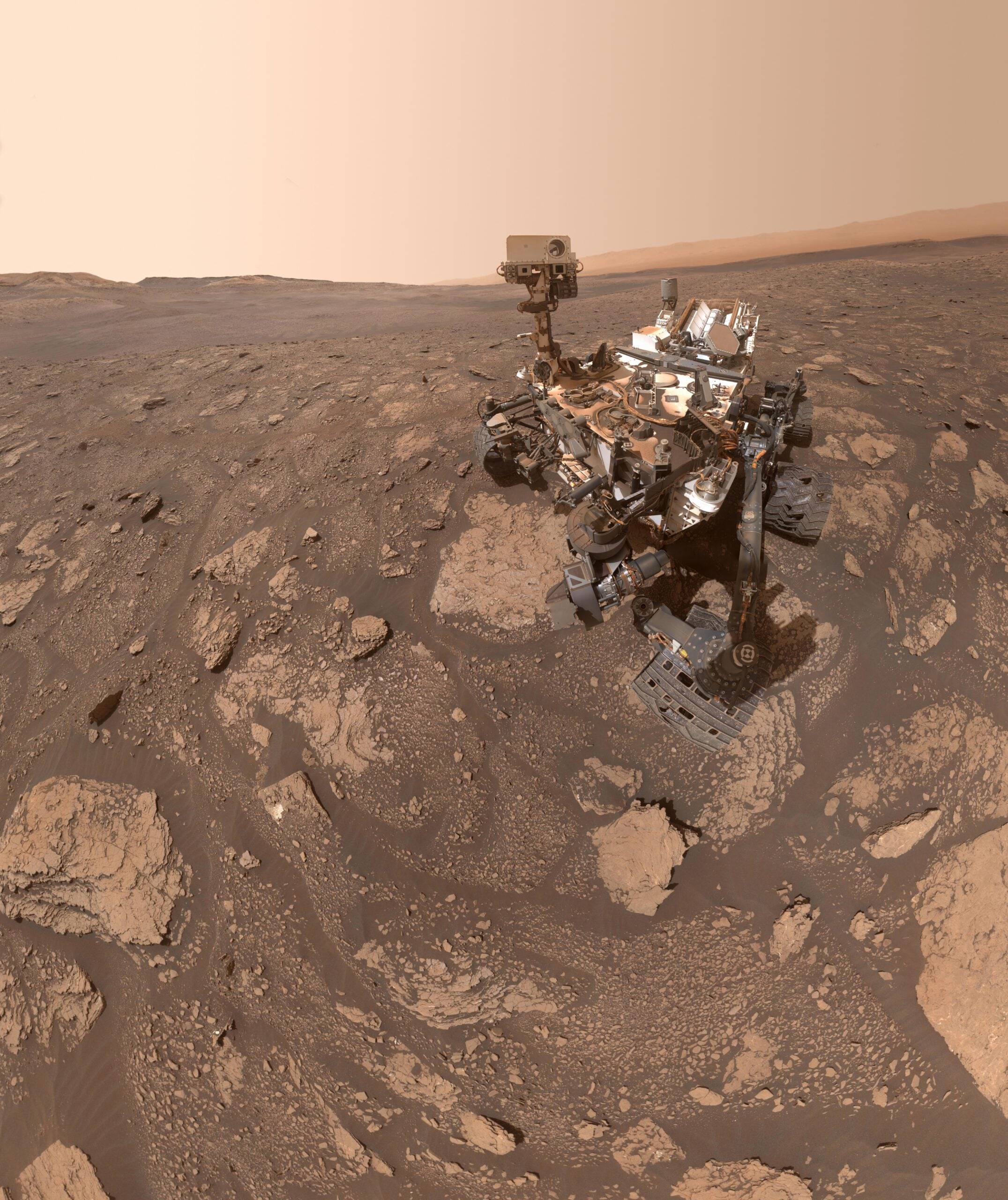
NASA’s Curiosity rover has added a more detailed layer to one of the hardest questions in Mars science: not whether ancient Mars was ever habitable, but how much chemical evidence can survive long enough for a rover to find it.
In a paper published in Nature Communications on 21 April 2026, Amy J. Williams of the University of Florida and colleagues report that Curiosity identified more than 20 organic molecules in a clay-bearing sandstone from Gale Crater. NASA’s Jet Propulsion Laboratory described the sample as containing 21 carbon-based molecules, seven of them detected for the first time on Mars.
The finding is worth taking seriously, but it should not be read as the final word on life on Mars. Organic molecules are carbon-containing chemistry. They can be made by biology, but they can also be made by non-living geological processes, delivered by meteorites, or formed through other abiotic pathways. The paper does not identify a biological source.
What it does show is still important: ancient Martian sediments can preserve complex organic chemistry for billions of years, even under the radiation and chemical conditions at the surface of Mars.
A sample from a once-wet crater
The rock came from a target nicknamed Mary Anning 3, drilled by Curiosity in 2020 in the Glen Torridon region of Gale Crater. Gale has been Curiosity’s home since 2012, and the rover has spent years climbing the lower slopes of Mount Sharp, reading layers of rock that record changing environments from Mars’ ancient past.
Glen Torridon was already a high-interest area because it contains clay minerals. On Earth, clays are good at trapping and preserving organic matter. On Mars, they matter for the same reason: they can hold chemical traces inside mineral structures and protect them from some of the destructive chemistry that makes the Martian surface so difficult for organics.
NASA says the Mary Anning 3 sample came from a part of Mount Sharp shaped by lakes and streams billions of years ago. The Nature Communications paper places the material in the approximately 3.5-billion-year-old Knockfarrill Hill member of Glen Torridon. That is old enough to reach back into the period when Mars had standing or flowing water in places now dry and cold.
The chemistry was detected by Sample Analysis at Mars, or SAM, the laboratory inside Curiosity’s body. SAM can heat powdered rock and study the gases released, but this experiment used something more specialised: a wet-chemistry cup containing tetramethylammonium hydroxide, usually shortened to TMAH.
Why the TMAH experiment matters
The TMAH method is not a simple sniff test. It is designed to help break larger, less volatile organic material into fragments that can be analysed by gas chromatography and mass spectrometry. That matters because some organic matter on Mars may not be present as small, easy-to-detect molecules. It may be bound into larger material, attached to minerals, or altered by time.
Curiosity had only a limited number of these wet-chemistry cups. NASA says the Mary Anning 3 sample was the first to be exposed to TMAH, making the experiment a high-value use of a scarce onboard resource.
The paper reports diverse thermochemolysis products, including benzothiophene, methyl benzoate, naphthalene-related compounds and other aromatic molecules. Seven molecules were confirmed in the gas chromatography-mass spectrometry data as absent from the instrument’s clean-up runs and pre-sample analyses. Other peaks were detected but not fully identified.
That caution is part of the result. The authors distinguish confirmed molecules from plausible detections and from unidentified peaks. Space instruments do not have the luxury of a full Earth laboratory. They work through constraints: limited reagents, aging hardware, background contamination, instrument history and the difficulty of interpreting complex mixtures after heating.
Even with those constraints, the signal was rich. NASA’s summary says 21 carbon-containing molecules were identified in the sample. The paper describes more than 20 organic molecules from clay-bearing sandstone, released by the TMAH wet-chemistry experiment.
The nitrogen-bearing ring is intriguing, not proof
The molecule that draws attention is a nitrogen heterocycle: a ring structure that includes nitrogen. In terrestrial chemistry, nitrogen-bearing rings are important because they appear in the broader chemical family connected to nucleic acids, including RNA and DNA.
That does not mean Curiosity found RNA, DNA, or life. It means it found a kind of structure that can sit upstream of more complex prebiotic chemistry. NASA quoted Williams saying these structures can be chemical precursors to more complex nitrogen-bearing molecules, while also noting that scientists cannot tell whether the detected organics were produced biologically or geologically.
This distinction matters because Mars organics are often pulled too quickly into a life-or-no-life frame. The better reading is narrower and more useful. Curiosity has shown that at least some ancient Martian rocks can retain complex carbon chemistry long after burial, exposure, radiation and geological alteration.
The paper’s authors also compared the TMAH technique with laboratory work on the Murchison meteorite, a carbon-rich meteorite more than 4 billion years old. In those tests, TMAH broke larger organic matter into some of the smaller molecules seen in the Martian sample, including benzothiophene. That comparison supports the idea that the Mary Anning 3 molecules may be fragments released from larger and more complex organic material.
Preservation may be the bigger story
The most important part of the result may be preservation. Mars is not gentle to organics at the surface. Radiation, oxidants, salts and geological time can all degrade carbon-bearing molecules. Yet Curiosity’s sample still yielded a varied organic inventory from ancient bedrock.
That matters for future missions. ESA’s Rosalind Franklin rover is designed to drill below the immediate surface, where radiation damage should be reduced. NASA’s Dragonfly mission to Titan will also carry a mass spectrometer designed to examine complex organic chemistry in a very different environment. The Curiosity result helps refine how these instruments may look for organic matter without assuming that the most meaningful molecules will be sitting loose and intact.
It also sits alongside Curiosity’s earlier organic detections in Gale Crater and Perseverance’s observations of organic signatures in Jezero Crater. The point is not that Mars is known to have hosted life. It is that multiple sedimentary settings on Mars are now showing that organic chemistry can be preserved and detected by robotic missions.
Mary Anning 3 is therefore not a dramatic answer. It is a careful addition to the archive. In a clay-rich rock laid down billions of years ago, Curiosity found a chemical mixture complicated enough to keep Mars interesting, and restrained enough to remind us how much interpretation still sits between organic molecules and biology.
Sources
- Williams et al., Nature Communications: Diverse organic molecules on Mars revealed by the first SAM TMAH experiment
- NASA/JPL: NASA’s Curiosity Finds Organic Molecules Never Seen Before on Mars
- NASA Science: Mars Science Laboratory Curiosity Rover
- NASA/JPL image detail: Curiosity’s Selfie at the Mary Anning location on Mars
