

On 12 August 2026, astronomers reported something in Nature that sounds almost too theatrical to be useful science: a “black hole star.” It is not a conventional star, and nobody has watched a black hole replace a stellar core. It is a young massive black hole apparently wrapped in such a dense, extended envelope of hydrogen that the whole system develops some of the spectral features of a gigantic star.
The object is called MoM-BH*-1. We see it at a redshift of 7.7569, meaning its light began travelling when the universe was about 660 million years old. The team argues that much of the gas doing the work sits roughly 10 to 100 astronomical units from the black hole. That is the scale of a solar system, but it is important to be precise: Webb did not take a picture of a sharply bounded star that wide. The scale comes from the physical model that best reproduces the spectrum.
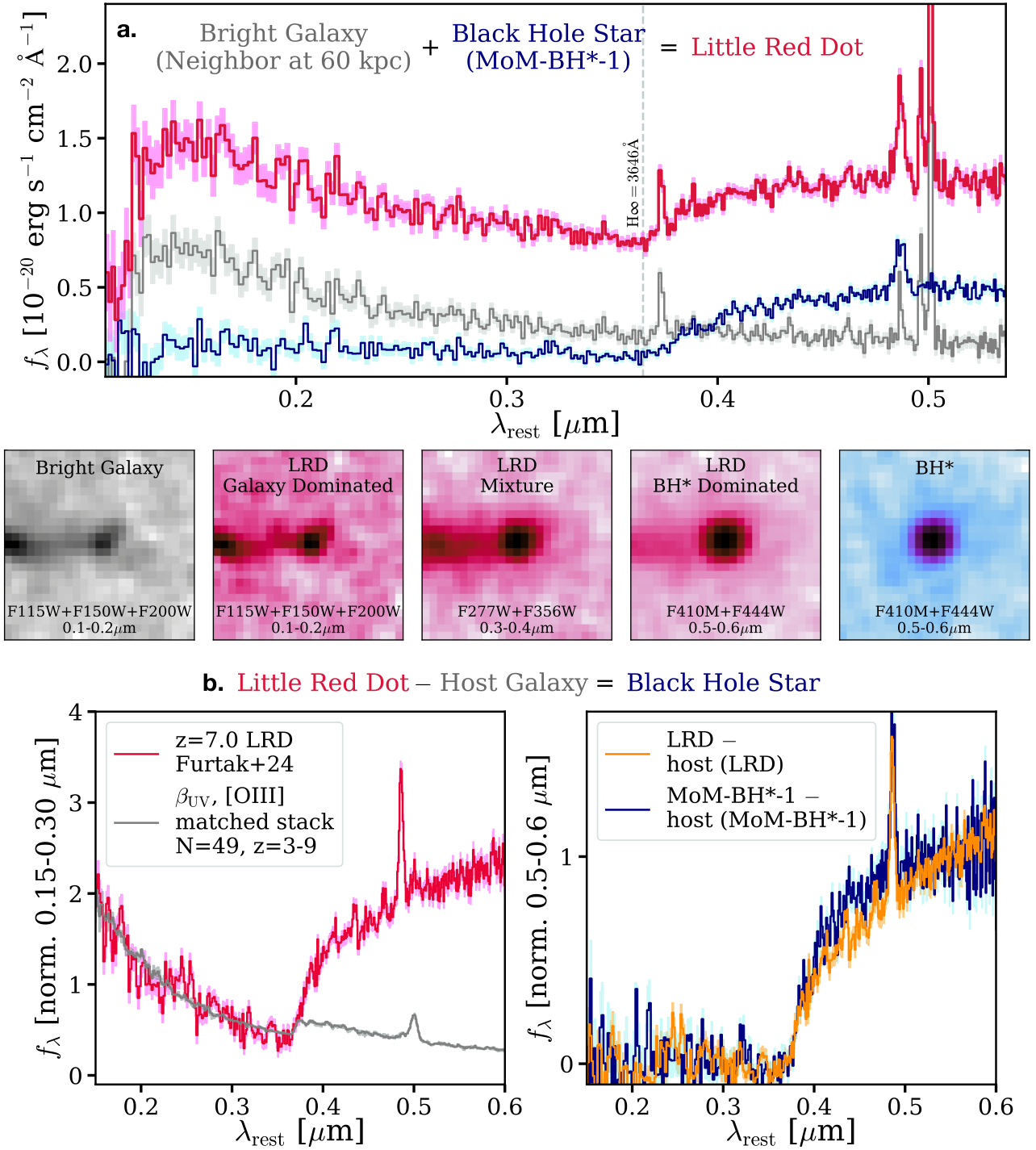
That spectrum may be more valuable than a direct image. It offers an unusually clean view of a component astronomers have suspected was hiding inside the hundreds of compact, puzzling Little Red Dots found by JWST. Add the light of a young galaxy to this black-hole-powered object, the researchers found, and the result looks remarkably like a typical Little Red Dot.
The name is outrageous, but the physics is precise
A normal star pays its energy bills through nuclear fusion. Pressure and temperature in its core become high enough for light nuclei to combine, releasing energy that works its way out through the star. MoM-BH*-1 appears to have a completely different engine. Matter falls into the deep gravitational well of a black hole, heats up as it spirals inward, and converts some of that infall energy into radiation.
The black hole itself does not shine. Nor is the surrounding envelope simply an oversized version of the Sun’s atmosphere. In the researchers’ preferred interpretation, radiation from the feeding black hole travels through an enormous quantity of dense hydrogen. The gas absorbs, scatters and re-emits the light until the escaping spectrum begins to resemble radiation from a stellar atmosphere.
The model points to a black hole of roughly one million to ten million solar masses. The word “star” therefore describes the appearance of the enshrouding gas, not the identity or mass of the central object. “Black hole star” is a memorable working description of the configuration. It is not yet a taxonomic box into which astronomers have confidently placed an entire population.
A spectrum ordinary starlight struggles to make
MoM-BH*-1 was found in JWST observations from the Mirage or Miracle survey. Its crucial fingerprint is an extraordinary Balmer break, an abrupt change in brightness around wavelengths shaped by hydrogen atoms. The measured break strength is 7.7, with the flux dropping by more than a factor of 20 across a narrow observed interval. Normal dust-free stellar populations peak at around 3 in the paper’s comparison; even an artificial population made entirely of A-type stars remains below 5.
That is not the only oddity. Webb recorded broad, multi-peaked hydrogen-beta emission together with Balmer absorption, and the source may have varied between observations taken about a year apart. A galaxy full of ordinary stars can produce a Balmer break. A conventional active galactic nucleus can produce broad emission lines. Producing this extreme break, the absorption and the structured broad line in the same compact source is the difficult part.
The team’s simplified calculation uses gas with a hydrogen density of about 100 billion particles per cubic centimetre and a huge column along our line of sight. The envelope is Compton-thick, meaning even energetic X-rays have a hard time escaping it, yet it contains very little dust. Hydrogen itself can redden the spectrum. That combination neatly addresses two recurring Little Red Dot headaches: why many are weak in X-rays, and why their redness is not accompanied by the strong far-infrared glow expected if warm dust were doing all the obscuring.
The calculation is deliberately an idealisation. Its spherical geometry, turbulence and gas distribution are tools for learning which physical conditions could make the spectrum, not a claim that every parcel of gas has been mapped. The achievement is showing that one coherent set of extreme but plausible conditions can reproduce features that previously seemed mutually awkward.
The unusually clean clue hidden inside a crowded field
Most Little Red Dots do not let astronomers inspect their ingredients separately. Their short-wavelength light can come from young stars spread through a small host galaxy, while a compact accreting black hole may dominate farther into the rest-frame optical. Those components overlap in a telescope’s data. It is like trying to identify two singers after hearing only the mixed recording.
MoM-BH*-1 is useful because the ordinary host around it appears unusually faint. The authors place an upper limit of about 300 million solar masses on its stellar mass, while the black-hole-powered component dominates the relevant spectrum. The object remains unresolved on scales below roughly 100 parsecs in Webb’s images, but the much smaller 10-to-100-AU envelope is inferred from the gas physics.
A brighter galaxy, with around three billion solar masses in stars, lies about 60,000 light-years away in projection and may eventually merge with the black hole’s faint host. That separation gives researchers something close to two ingredients laid out side by side: a relatively clean black-hole-envelope spectrum and a plausible source of young-galaxy light.
Our earlier look at MoM-BH*-1 focused on the sheer strangeness of an unresolved, star-like source powered by accretion. The more consequential point may be methodological. This is not merely one more exotic object. It could be the reference spectrum needed to untangle a much larger population.
How one black hole star can manufacture a Little Red Dot
The researchers performed a wonderfully direct exercise. They took the spectrum of MoM-BH*-1, shown in blue in their figure, and added the spectrum of the nearby bright galaxy, shown in grey. The combined spectrum, in red, develops the familiar V shape of a Little Red Dot: relatively bright ultraviolet light, a trough, then a strong rise into the rest-frame optical with broad hydrogen emission.
This addition also explains why the same object can look different through different Webb filters. At ultraviolet wavelengths, spread-out stars in the host supply much of the light, so the source can appear extended. At longer wavelengths, the compact gas-wrapped black hole takes over and the dot tightens around the centre. The “dot” is therefore not necessarily a lone object with one source of light. It can be a wavelength-dependent blend whose balance changes across the spectrum.
The idea fits the broader gas-cocoon picture explored in our guide to black hole stars and Little Red Dots. It also makes diversity less mysterious. Change the brightness of the host, the mass and feeding rate of the black hole, the gas column or our viewing angle, and one underlying arrangement can produce a range of colours, line widths and apparent sizes.
A separate 2026 search has already identified 241 candidate black-hole-star-dominated sources in Webb data. That number does not mean 241 confirmations. Candidate selection can find contaminants, and models can imitate one another across limited wavelengths. It does show that MoM-BH*-1 offers a testable population-level hypothesis rather than a story designed for one peculiar dot.
Why this is a promising answer, not the answer
Several independent lines of evidence now point in the same general direction. A January 2026 Nature study of Little Red Dots argued that electrons in dense ionised cocoons can scatter emission-line photons and make the lines look broad. That matters because broad lines are usually converted into enormous black hole masses by assuming the gas is moving rapidly under gravity. If scattering contributes heavily, some early black holes may be smaller and feeding faster than those standard estimates imply.
Another object, GLIMPSE-17775, produced more than 40 spectral features consistent with a dense, relatively cool gas envelope around an accreting black hole. NASA described it in June as the strongest evidence yet for black hole stars. MoM-BH*-1 reaches farther back in time and appears less muddied by its host, which is why it can serve as such a clean spectral template.
There is also direct dynamical evidence that at least some Little Red Dots contain overgrown black holes. In another 2026 Nature result, astronomers measured motions in a source called QSO1 and inferred a black hole of about 50 million solar masses in a surprisingly lightweight galaxy. These studies do not prove that every red dot has the same anatomy, but they make a buried accretion engine much harder to dismiss as a universal modelling convenience.
Real alternatives remain. Some spectra could be dominated by unusual stellar populations, and a supermassive metal-free star model can reproduce important features of MoM-BH*-1 without using the same black-hole envelope. The current gas model is intentionally simple, the source is spatially unresolved at the scale being discussed, and one clean template cannot establish the composition of hundreds of objects. “May explain” is exactly the right level of confidence.
What astronomers should look for next
The value of this proposal is that it makes connected predictions. If many Little Red Dots are composites of young galaxies and black hole stars, deep spectra should repeatedly uncover very dense hydrogen, Balmer absorption and breaks too large for normal stars. Their rest-frame optical light should be more compact than their ultraviolet light. Their X-rays should be suppressed by thick gas without the strong warm-dust signature expected from ordinary obscuration.
Time helps too. A compact feeding black hole can vary more quickly than the combined output of millions of stars. Repeated Webb observations could watch the putative black-hole component brighten or fade while the surrounding host stays comparatively steady. Better spectra can test whether the line wings come from rapid motion, electron scattering or both. Longer-wavelength observations can measure how little dust is truly present, while future X-ray facilities could search for the hard radiation that leaks through the cocoon.
The growth question is just as important. If the usual black hole mass estimates are inflated by scattering, MoM-BH*-1 could contain a smaller seed consuming matter at several times its formal Eddington limit. A dense envelope might both deliver fuel and trap radiation, allowing unusually rapid growth in the first billion years. That would help explain how the early universe built massive black holes so quickly without requiring every seed to begin enormous.
Little Red Dots may not turn out to be one new species. They may be systems in which the proportions change: sometimes the galaxy leads, sometimes the buried black hole does, and sometimes the two contribute almost equally. What MoM-BH*-1 provides is a possible view of one component with the mixing dial turned nearly all the way down. Put the galaxy light back in, and hundreds of mysterious red points begin to look less like unrelated surprises and more like variations on the same physical arrangement.