

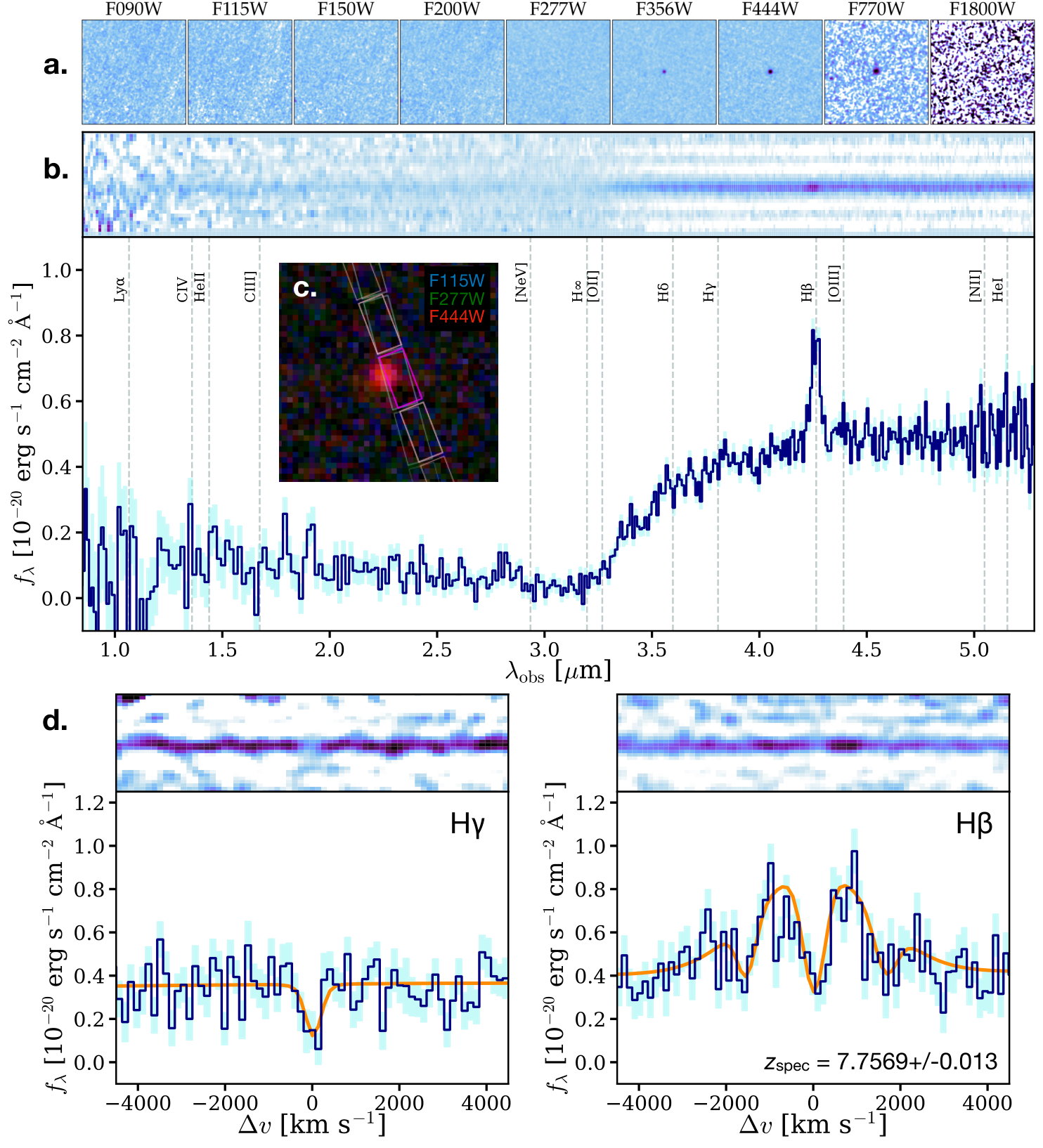
In a Webb image, MoM-BH*-1 is scarcely more than a red point. Its spectrum, however, looks like no ordinary star or galaxy. The object existed only about 660 million years after the Big Bang and radiates on the order of 100 billion Suns, yet the team studying it argues that nuclear fusion is not the power source.
The proposed engine is an accreting black hole buried inside an extraordinarily dense cocoon of gas. Radiation released as matter spirals toward the black hole heats and filters through that envelope, giving the whole object a star-like atmosphere. Astronomers call the configuration a “black hole star,” but the name describes its appearance and radiative physics, not a star with a conventional fusion-burning core.
A red point that disappeared at shorter wavelengths
MoM-BH*-1 was identified in the PRIMER extragalactic field and selected for spectroscopic follow-up by Webb’s Mirage or Miracle program. The survey deliberately pursued risky targets that might be remarkable early objects or mundane interlopers. This one stood out as the reddest source in an area covering roughly 250 square arcminutes.
Webb’s NIRCam detected it in the F356W and F444W filters, while it appeared to vanish at wavelengths shorter than about two micrometres. The source remained unresolved, so “enormous star” should not be read as a direct measurement of a stellar surface. What Webb actually recorded was a point-like light source with a peculiar sequence of colours.
NIRSpec then supplied the decisive evidence. Several features fixed its redshift at 7.7569, corresponding to a universe about 660 million years old under the standard cosmological model. A 4.5-hour prism spectrum and an independent, higher-resolution spectrum showed that the red colour came from a huge change in brightness across the Balmer limit.
The Balmer break was too strong for ordinary stars
A Balmer break arises from the way hydrogen atoms absorb photons around a wavelength of 364.6 nanometres in the rest frame. Stellar populations rich in A-type stars can produce a conspicuous break, so astronomers often use it to infer the ages of galaxies. MoM-BH*-1’s break strength was measured at 7.7, with uncertainty of plus 2.3 and minus 1.4.
That is the anomaly. Standard dust-free stellar populations were expected to reach only about 3. Even the contrived limit of a population composed entirely of A-type stars remained below 5. Across the observed spectrum, the flux increased by more than a factor of 20 from Webb’s F277W band to F444W.
The object also showed broad, multi-peaked hydrogen-beta emission with a width around 3,036 kilometres per second, plus absorption in hydrogen-beta and hydrogen-gamma. A narrow oxygen doublet anchored the redshift. The combination of broad emission, deep absorption and the extreme break gave the researchers more than an unusual colour; it provided a set of physical constraints that a successful model had to reproduce. The measurements and model appear in the team’s primary study of MoM-BH*-1.
A black hole wrapped in a gaseous photosphere
The researchers tested close to a million radiative-transfer models. Their preferred solution puts an active galactic nucleus inside metal-poor gas with a hydrogen density around 1011 particles per cubic centimetre and a column density near 1025.8 particles per square centimetre. Turbulent motion around 500 kilometres per second helps broaden the absorption.
Crucially, this envelope is almost dust-free in the model. Hydrogen gas itself blocks and reprocesses the short-wavelength radiation, producing the steep Balmer break. That differs from explanations in which ordinary dust reddens a familiar quasar spectrum. The finding is consistent with broader work suggesting that many little red dots are young black holes inside dense ionized cocoons.
The black hole’s accretion flow is the furnace. Gas falling inward loses gravitational energy, heats and emits radiation. The surrounding material absorbs much of that output and radiates it again from a much larger effective surface, rather as a star’s photosphere releases energy produced deeper inside. The model places this gaseous “atmosphere” across roughly 10 to 100 astronomical units. It is star-like in radiative behaviour, not in its central power source.
One hundred billion Suns describes power, not mass
A bolometric luminosity near 1045 ergs per second is of order 1011 solar luminosities, hence the comparison with roughly 100 billion Suns. It does not mean the object contains 100 billion solar masses, is 100 billion times the Sun’s diameter or releases that energy through fusion. The number is an estimate of total power across wavelengths, and it depends on how the observed spectrum is converted into bolometric output.
The black-hole mass is much less certain. Depending on which assumptions are applied to the unfamiliar line-forming environment, estimates fall broadly around one million to ten million solar masses, with some conventional calibrations returning still larger values. The authors warn that standard relations derived from nearby active galaxies may overestimate black-hole masses and underestimate their accretion rates in these sources.
Webb also did not see the black hole directly. An event horizon this distant is far beyond the telescope’s resolving power, and the dense gas is supposed to hide the innermost accretion flow. The evidence is spectral: a central high-energy source plus gas with extreme density and opacity reproduces the light that escaped. That distinction matters because an alternative calculation has shown that a supermassive metal-free star can match several little-red-dot signatures, including the hydrogen-beta width of MoM-BH*-1.
A missing piece in the little red dot puzzle
Little red dots appeared in large numbers once Webb began surveying the first two billion years of cosmic history. They are compact and red in visible rest-frame light, often possess broad hydrogen lines associated with accreting black holes, yet tend to be faint in X-rays. Treating all their light as starlight can imply galaxies that assembled uncomfortably quickly, one part of the wider tension explored as Webb rewrites early galaxy formation.
A gas cocoon can join several of those clues. It reprocesses the central engine’s radiation into a cooler, star-like continuum, absorbs X-rays, suppresses forbidden emission lines at high density and changes the assumptions used to infer black-hole mass from broad lines. A separate, exceptionally deep Webb spectrum of GLIMPSE-17775 has now supplied more than 40 spectral lines supporting the same general picture.
MoM-BH*-1 is especially valuable because almost all its observed light appears to come from the black-hole-star component rather than a bright host. The object lies near a young galaxy at the same redshift, but the two are distinct. By adding a host galaxy’s light to the MoM-BH*-1 spectrum, the team could reproduce the mixed appearance of more familiar little red dots. A lower-redshift source nicknamed “The Cliff” independently showed a similarly extreme break that researchers attributed to absorption in dense gas rather than old stars.
The cocoon is a strong interpretation, not a photograph
The evidence fits a black hole star, but it does not make the internal geometry uniquely proven. The authors explicitly describe their model as simplified. The assumed accretion spectrum, gas shape, turbulence and energy transport can trade off against one another, while the tentative variability was measured with different instruments. Future time monitoring, deeper spectra and longer-wavelength observations can test whether the source varies like an active black hole and whether its cocoon behaves as predicted.
If the interpretation holds, the object may capture a brief stage in which a young black hole feeds faster than ordinary radiation pressure should allow. A sufficiently opaque envelope can trap or redistribute the accretion energy, reducing the outward force that would otherwise expel the fuel. The black hole could then grow rapidly before the cocoon thins, revealing a more conventional active galactic nucleus or quasar.
That would address one of early-universe astronomy’s hardest timing problems. Billion-solar-mass black holes already existed within the first 700 million years, leaving little time to grow from ordinary stellar remnants. MoM-BH*-1 does not yet prove one formation channel. It does show that Webb can isolate the strange, buried phase in which a massive seed may have acquired its extraordinary head start.