
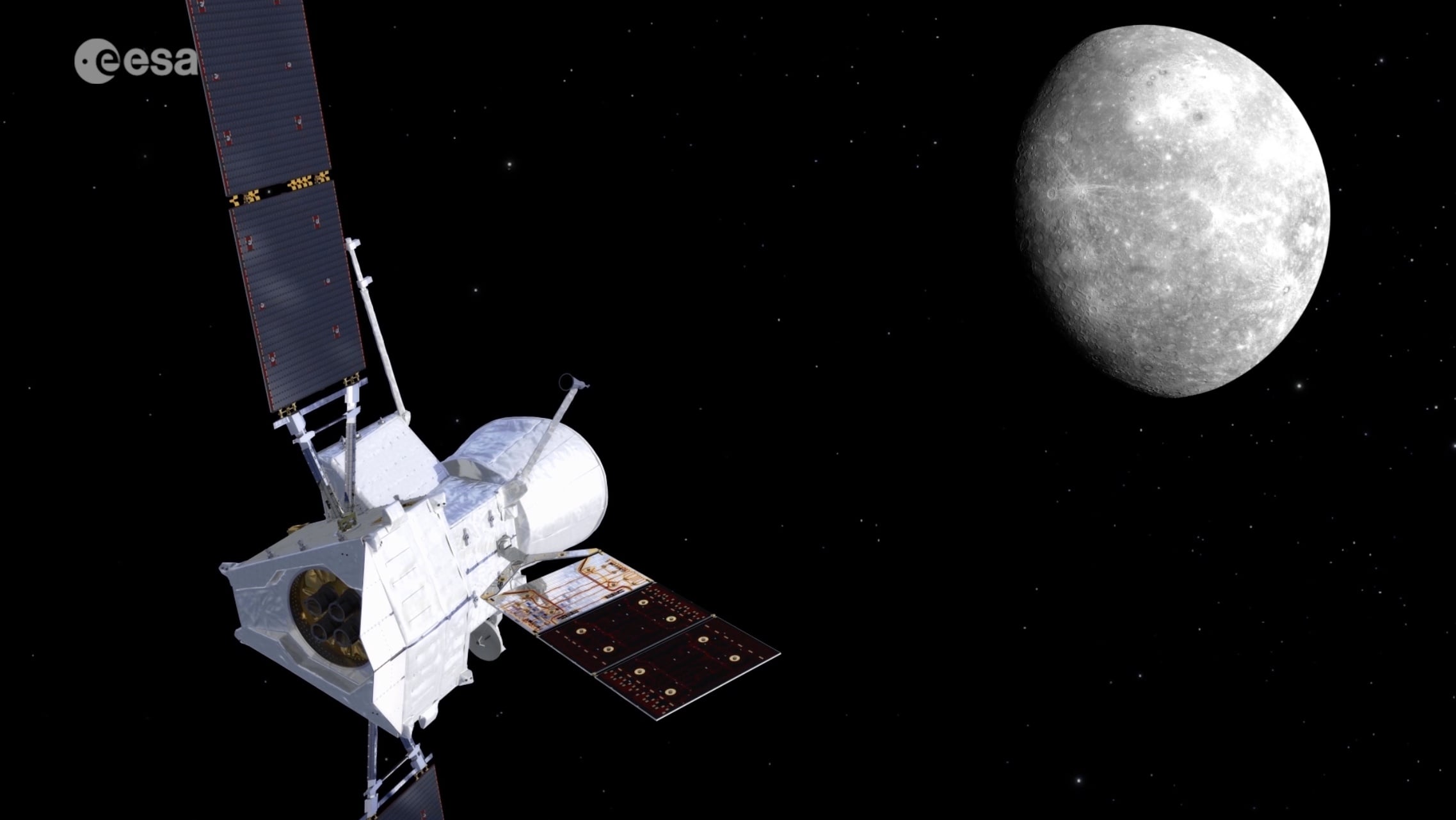
Mercury is only two planets inward from Earth, yet stopping there is one of the hardest jobs in planetary exploration. The European Space Agency says that placing a spacecraft into a stable orbit around Mercury demands more energy than sending one to Pluto.
That comparison needs one important qualification. It contrasts capture at Mercury with a flight to Pluto, such as the New Horizons flyby, not with stopping in orbit around Pluto. A Pluto orbiter would also need an enormous braking manoeuvre. And BepiColombo did not loop around nine different planets. It completed nine planetary flybys involving three planets: one of Earth, two of Venus and six of Mercury.
Distance is not the energy bill
Spacecraft do not leave Earth from a standing start. Earth carries them around the Sun at roughly 30 kilometres per second, mostly sideways relative to the Sun. A spacecraft bound for Mercury must shed a large part of that sideways motion to lower the inner edge of its solar orbit.
As it falls closer to the Sun, solar gravity converts potential energy into speed. By the time the spacecraft reaches Mercury’s neighbourhood, it is moving rapidly through a region where Mercury itself races around the Sun. Entering orbit requires cancelling enough of the difference in velocity for Mercury’s modest gravity to capture the visitor.
This is why a short geometric distance can carry a punishing propellant cost. It is also why missions aimed towards the Sun repeatedly borrow help from planets. NASA’s explanation of why reaching the Sun is surprisingly difficult makes the same point: the real obstacle is cancelling the sideways speed inherited from Earth. Lachlan Brown explored the result at the opposite extreme in his Space Daily account of how Parker Solar Probe survives inside the Sun’s outer atmosphere.
Why Pluto can be easier if you do not stop
A fast spacecraft can be launched onto an outward trajectory and allowed to coast past Pluto. It takes years to cross the distance, but a flyby does not have to erase all of its arrival speed. New Horizons did exactly that in July 2015, collecting its observations during a rapid passage instead of firing engines to enter orbit.
Brown’s recent look at the active world New Horizons revealed at Pluto is a reminder of what that trade delivered. The probe reached a remote target with enough speed to keep going. BepiColombo has the opposite requirement: arrive at a nearby world slowly enough to stay.
Nine flybys of three planets
BepiColombo launched in October 2018 on what ESA describes as an eight-year journey. Its route included an Earth flyby in April 2020, two Venus encounters in October 2020 and August 2021, then six Mercury flybys between October 2021 and January 2025. Each encounter reshaped the spacecraft’s orbit around the Sun and reduced the energy that its propulsion system would otherwise have had to remove.
The sequence was not a detour caused by weak navigation. It was the mission-enabling solution. ESA’s guide to why BepiColombo takes so long to reach Mercury notes that a more direct path could reach the planet in months, but the spacecraft would arrive too quickly to enter orbit with a practical amount of fuel.
How gravity becomes a brake
During a flyby, a planet bends the spacecraft’s path in the planet’s own frame of reference. Viewed from the Sun, the geometry can transfer a tiny amount of the spacecraft’s orbital energy to the planet. The planet’s motion changes by an immeasurably small amount, while the much lighter spacecraft leaves on a different and, for BepiColombo, less energetic solar orbit.
Mercury’s six encounters progressively synchronised the probe’s path with the planet it must eventually orbit. The process resembles a series of carefully timed handoffs, with every pass setting up the next years in advance. Navigation errors that look small on Earth can grow into missed opportunities millions of kilometres away.
Ion engines paid the remaining bill
Gravity assists did not do all the work. BepiColombo’s transfer module carried four QinetiQ T6 ion thrusters. Solar electricity ionised xenon gas, and the engines expelled the ions to produce a gentle but persistent push. The thrust was tiny compared with a chemical rocket, yet it could operate for months and accumulate a substantial change in velocity without carrying an impossible mass of propellant.
ESA reported that the mission’s final solar-electric thrust arc ended on 15 June 2026. The spacecraft is now in its complex arrival phase, with Mercury orbit insertion scheduled for 21 November 2026. Chemical propulsion will handle the critical capture and the later adjustments needed to release the two science orbiters into their separate paths.
What all that braking is for
Once separated, ESA’s Mercury Planetary Orbiter and the Japan Aerospace Exploration Agency’s Mio will study the planet and its magnetic environment from complementary orbits. The payoff is sustained access that a flyby cannot provide: repeated measurements across different locations, lighting conditions and phases of solar activity.
Among the targets are the permanently shadowed polar craters discussed in Brown’s article on Mercury’s unexpected stores of water ice. Reaching those questions required treating the inner Solar System as a moving system of energy and momentum, not a map of straight-line distances.
BepiColombo’s long route is therefore not evidence that Mercury is far away. It is evidence that in orbital mechanics, stopping can be much harder than getting there.
