
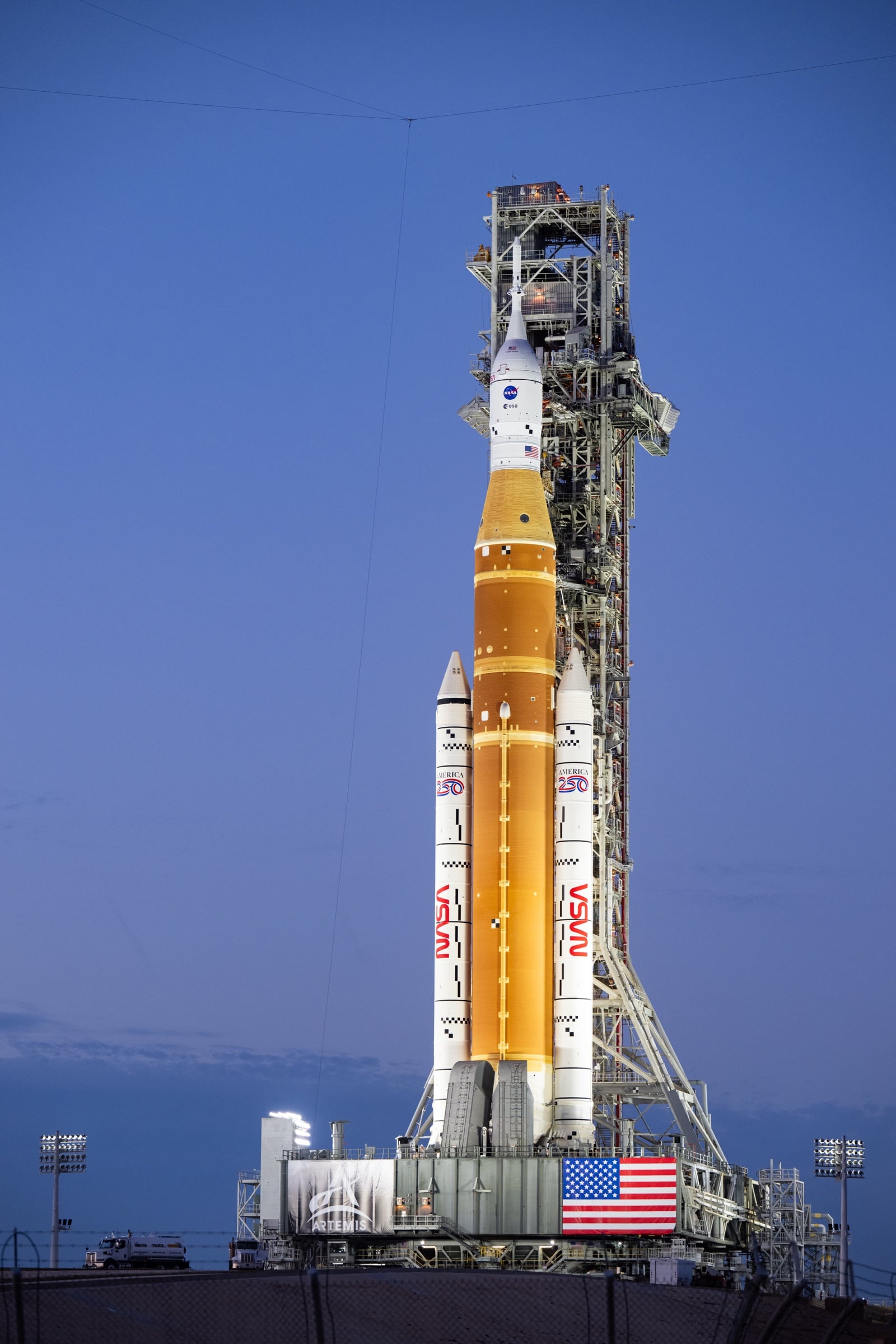
The widest speed range in the Artemis II mission began before the rocket ever left the ground. On 17 January 2026, NASA’s fully assembled Space Launch System rocket, Orion spacecraft and mobile launcher moved from the Vehicle Assembly Building to Launch Pad 39B at Kennedy Space Center. The four-mile trip took nearly 12 hours.
Less than three months later, Orion brought Reid Wiseman, Victor Glover, Christina Koch and Jeremy Hansen home from the Moon at close to 25,000 miles per hour. That was its speed at the beginning of atmospheric entry, not at splashdown. Even so, comparing it with the crawler’s maximum loaded speed of 0.82 miles per hour gives a ratio of more than 30,000 to one.
The arithmetic is memorable, but it is not a story about a slow old vehicle becoming a fast spacecraft. It is a story about handing four people through a chain of machines, each designed for a different part of the flight.
The first trip was a lifting problem
NASA’s record of the January rollout says the stack reached Pad 39B at 6:42 pm after a trip of nearly 12 hours. Crawler-transporter 2 had carried the roughly 11-million-pound load at no more than 0.82 miles per hour, pausing after it cleared the Vehicle Assembly Building so crews could reposition Orion’s access arm.
The crawler is hardly a small machine. It weighs about 6.6 million pounds, measures 131 feet long and 114 feet wide, and can carry as much as 18 million pounds. NASA’s Artemis II reference guide says it was designed for 2 miles per hour when unloaded and 0.83 miles per hour while carrying a rocket. Engineers choose the actual speed according to the smoothness of the ride.
That last point matters. The job was not simply to cover four miles. Hydraulic jacking, equalisation and levelling cylinders had to keep the mobile launcher level while the crawler climbed the roughly five-degree pad slope. NASA’s account of crawler operations describes the machine changing height beneath the load rather than allowing the rocket to lean with the road. Near the mounting points, positioning is measured in inches.
Nearly 12 hours included deliberate pauses
The January move was the first Artemis II rollout, made so teams could conduct pad tests and wet dress rehearsals with cryogenic propellants. It was not the final trip before liftoff. Following the tests, an upper-stage helium-flow problem sent the rocket back to the assembly building, a rollback Space Daily covered in February.
Teams repaired the problem, refreshed batteries and performed other work before SLS and Orion rolled out again on 20 March. That second trip took about 11 hours. The sequence is a useful correction to the neatest version of the story: the rocket did not crawl to the pad once and launch from there. Ground operations deliberately preserved the option to test, retreat, repair and try again.
At crawler speed, stopping costs little. With a 98-metre rocket standing vertically on top of a mobile launch tower, avoiding vibration and maintaining alignment are worth far more than arriving a few hours earlier.
Launch turned careful movement into controlled acceleration
SLS lifted off from Pad 39B at 6:35 pm EDT on 1 April with 8.8 million pounds of thrust. The rocket placed Orion into Earth orbit, where the crew checked systems and practised manual handling before the spacecraft departed for the Moon. Orion then followed a free-return trajectory, a path shaped so that lunar gravity would direct it back towards Earth.
The nearly 10-day mission covered an officially updated total of 695,081 miles. At its farthest point, the crew reached 252,756 miles from Earth. As Space Daily reported in its comparison with Apollo 13, Artemis II passed the 1970 distance record by 4,101 miles, doing deliberately what Apollo 13 had done during an emergency return.
Speed in space is also more complicated than a single peak number. SLS provided the initial acceleration, but Orion’s smaller burns controlled the route, corrected its approach and placed the crew module into the narrow entry corridor needed to reach the Pacific recovery zone.
The 25,000 mph figure belongs to entry, not splashdown
At 7:53 pm EDT on 10 April, Orion reached entry interface 400,000 feet above Earth. NASA’s live mission record described the capsule as travelling nearly 35 times the speed of sound. NASA officials rounded the figure to 25,000 miles per hour in the agency’s post-mission release.
That is when the return became an exercise in removing energy. Orion’s heat shield faced temperatures of about 3,000 degrees Fahrenheit as compressed and ionised gas formed around the capsule. The crew experienced up to 3.9 times Earth’s gravity, while the plasma caused a planned communications blackout of roughly six minutes.
The atmosphere performed most of the braking before any parachute opened. At 23,400 feet, the drogue parachutes deployed and the recorded speed fell to 479 feet per second, about 327 miles per hour. At 5,400 feet the three main parachutes opened, cutting the speed below 200 feet per second before slowing Orion to roughly 20 miles per hour for splashdown at 5:07 pm Pacific time.
What the 30,000-fold contrast actually shows
The comparison uses two real speeds, but they belong to different machines and different moments. The crawler protected a tall, heavily loaded structure from unnecessary motion. SLS supplied enough thrust to leave Earth. Orion’s propulsion guided the flight. The heat shield, atmosphere and parachutes then removed nearly all the speed before the Pacific arrived.
At one end, success meant moving so slowly that engineers could monitor the load and stop. At the other, it meant entering the atmosphere at lunar-return speed and following a descent sequence that could not pause at all. Artemis II connected those regimes safely. The speed ratio is memorable because it compresses the whole mission into one number, but the real achievement was controlling every transition between them.