
On 2 August 2027, the Moon’s central shadow will cross southern Egypt and pass directly over Luxor, turning one of the world’s most famous archaeological landscapes into a total-eclipse site. Calculations for the city put totality at about 6 minutes 22 seconds. The eclipse reaches a global maximum of about 6 minutes 23 seconds slightly away from Luxor, so the temple city misses the theoretical peak by only a second.
A narrow shadow crosses three continents
The eclipse begins over the Atlantic and its path of totality runs across southern Spain and North Africa before continuing over the Red Sea, the Arabian Peninsula and the Horn of Africa. The partial phase will be visible across a much wider region, but only observers inside the central path will see the Moon completely cover the Sun.
NASA’s catalogue of central solar eclipses gives the event a maximum duration of 6 minutes 23 seconds and a magnitude of 1.079. A magnitude greater than one means the Moon’s apparent disk is large enough to cover the Sun completely along the centerline. For Luxor specifically, local eclipse calculations show 6 minutes 22 seconds of totality within an event lasting roughly 2 hours 46 minutes from first to last contact.
Why this totality lasts so long
Total eclipses are never identical because the apparent sizes of the Sun and Moon change. The Moon follows an elliptical orbit, so it looks larger when it is closer to Earth. Earth’s orbit also changes the Sun’s apparent size slightly during the year. The 2027 geometry combines a relatively large-looking Moon with a relatively small-looking Sun, producing a broad interval in which the solar disk is fully covered.
Duration also depends on where an observer stands within the moving shadow. Locations near the centerline receive more totality than places near its edge. The shadow’s speed across Earth’s curved surface matters too. Luxor sits very close to the part of the track where these effects combine most favourably, which is why its total phase is measured in minutes rather than the much shorter totalities common to many eclipses.
This does not mean the city experiences six minutes of ordinary night. During totality, the solar corona becomes visible around the Moon, bright planets and stars may appear, and the horizon can retain a band of twilight. The dramatic change is the disappearance of direct sunlight and the rapid cooling and dimming that follow.
The next longer eclipse comes in 2114
The comparison in the headline is global, not limited to Egypt. NASA’s catalogue of long total solar eclipses shows that no total eclipse after August 2027 exceeds 6 minutes 23 seconds until an eclipse in 2114 reaches 6 minutes 32 seconds. Several intervening events come close, including one in 2045 lasting just over six minutes, but none is longer.
That makes the 2027 eclipse the longest totality available anywhere on Earth for 87 years. It is not the longest eclipse possible, nor the longest in recorded history. It is a precise statement about the sequence of predicted eclipses and their maximum durations. At the temples, the useful number remains Luxor’s local 6 minutes 22 seconds rather than the one-second-longer global maximum.
Totality arrives over an ancient ceremonial landscape
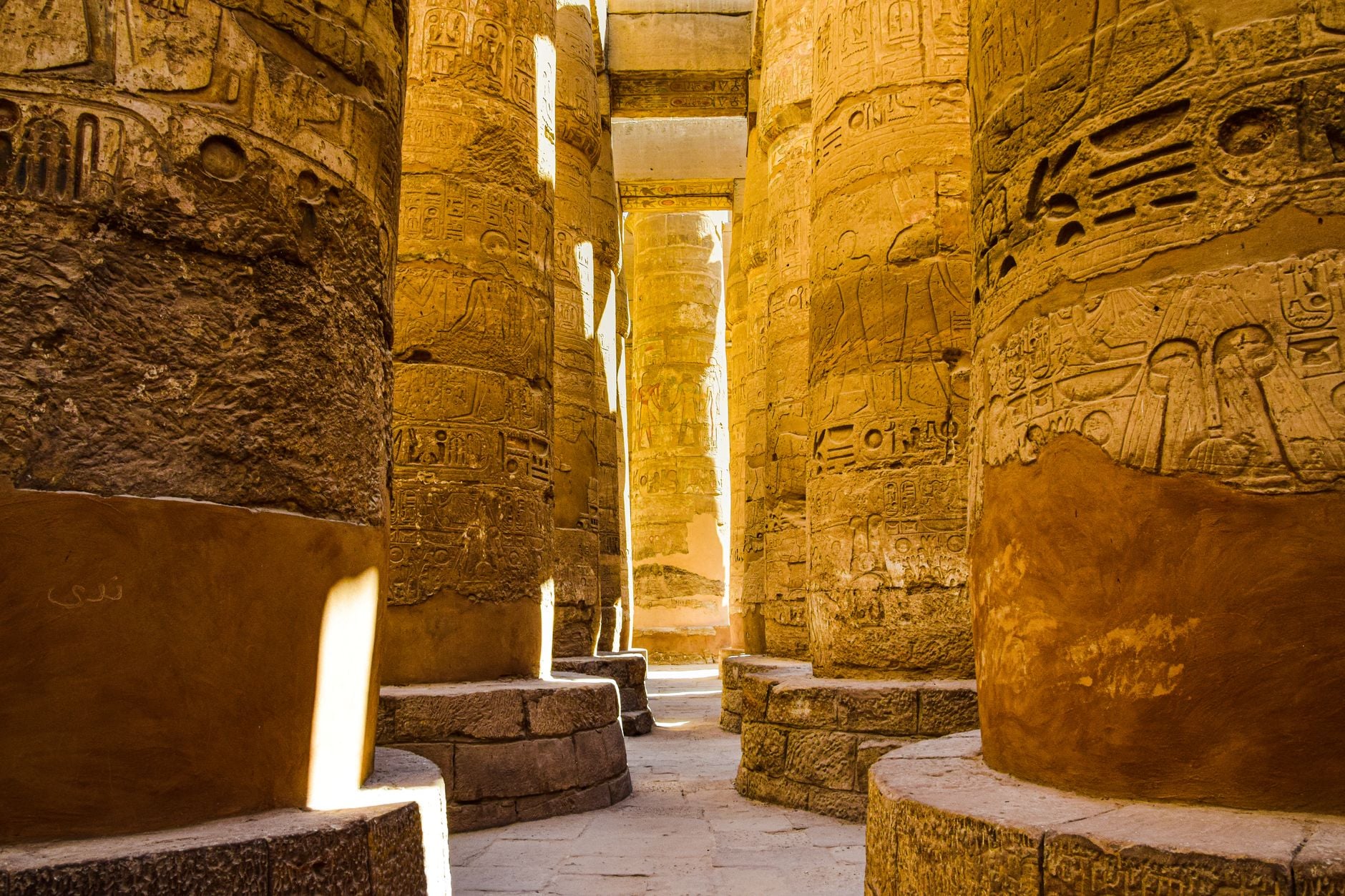
Luxor occupies part of ancient Thebes, where monumental complexes stand on both sides of the Nile. The UNESCO World Heritage listing for Ancient Thebes includes Karnak and Luxor temples as well as the Valley of the Kings and Valley of the Queens. Luxor Temple’s main construction under Amenhotep III dates to the 14th century BCE, making the description “3,300-year-old temples” a useful shorthand for the setting.
The ruins are not all one age. Karnak was built, altered and enlarged across many reigns, while later rulers also added to Luxor Temple. On eclipse day, the Moon’s umbra will move across a landscape assembled over centuries, not a single monument completed in one year.
The setting is one reason interest has surged so early. But a place inside the calculated path does not guarantee an unobstructed view, access to a particular monument or favourable weather. SpaceDaily has previously examined why experienced eclipse chasers weigh mobility and conditions alongside duration.
Safe viewing still depends on the partial phases
The long total phase is the only interval when the Sun can be viewed directly without a solar filter. During every partial phase, including the moments immediately before and after totality, viewers need eclipse glasses or another safe viewing method. Ordinary sunglasses are not sufficient. NASA’s eclipse safety guidance says filters should comply with the ISO 12312-2 standard and should be inspected before use.
Exact contact times vary by position, even within Luxor, so observers should use location-specific predictions and follow the event rather than a rounded duration. The Moon will cover the Sun for a little over six minutes above the temples, then its shadow will continue east. No total solar eclipse anywhere on Earth will surpass that maximum duration again until 2114.
