
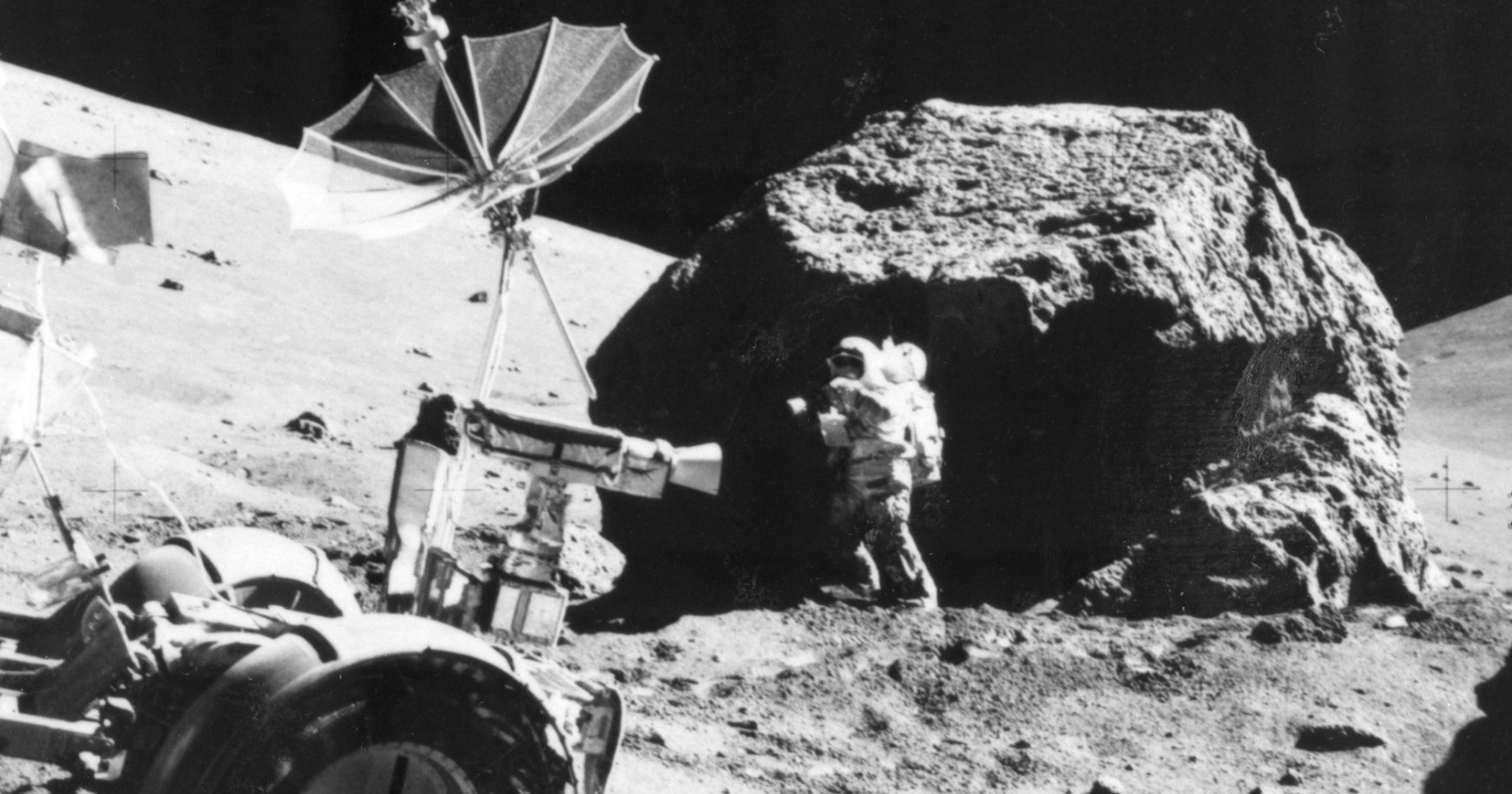
Apollo 17 was the last time human beings walked on the Moon, but the mission did not behave like an ending. It behaved like a field season. In December 1972, Gene Cernan and Harrison “Jack” Schmitt landed in the Taurus-Littrow valley, drove a battery-powered rover across black lunar dust, and packed 741 rock and soil samples into boxes for the trip home.
The total came to 110.5 kilograms, the largest lunar sample return of the Apollo program.
One of the most arresting pieces of that haul was not a boulder or a glittering crystal. It was orange soil, found near Shorty Crater, made of tiny volcanic glass beads from an eruption roughly 3.64 billion years old.
The mission had gone to Taurus-Littrow partly because planners wanted old highland material and possible signs of younger volcanism on the valley floor. What Cernan and Schmitt found was stranger. The orange glass really was volcanic, but the crater beside it was not the vent that made it.
The last Apollo landing was built for science
Apollo 17 launched from Kennedy Space Center at 12:33 a.m. Eastern time on December 7, 1972. It was the only night launch of the Apollo lunar program, a Saturn V rising in white flame while the last Moon crew rode toward a landing site chosen for rocks, not symbolism.
The crew had three men. Eugene Cernan commanded the mission. Ronald Evans remained in lunar orbit aboard the command module America. Harrison Schmitt, the lunar module pilot, was a professional geologist and became the only scientist to walk on the Moon.
That mattered before the crew ever reached the surface. Earlier Apollo landings had proved that humans could land, work, and return. Apollo 17 was meant to stretch what a lunar expedition could do when the field crew included someone trained to read rocks as a landscape.
NASA’s mission plan sent Cernan and Schmitt to Taurus-Littrow, a valley on the southeastern edge of Mare Serenitatis. The site offered two temptations at once: old material from the lunar highlands and possible evidence of volcanic activity on the valley floor.
They landed the lunar module Challenger on December 11, 1972. Cernan reported that Challenger had landed, then the crew and Mission Control checked the spacecraft carefully in case an emergency liftoff was needed. Only after that did the valley become a workplace.
Taurus-Littrow was a valley full of targets
To the astronauts, Taurus-Littrow was not just scenery. It was a map of objectives. The South Massif, North Massif, Sculptured Hills, nearby craters, rolling boulders, and dark valley floor each held a different possible piece of lunar history.
The mission was one of Apollo’s J-type flights, which meant longer surface stays, expanded science equipment, and a Lunar Roving Vehicle. The rover let Cernan and Schmitt reach stations no walking crew could have covered efficiently in bulky suits.
Across three moonwalks, they spent more than 22 hours outside the lunar module. They drove about 35.7 kilometres in the rover, stopping at geology stations, sampling boulders, scraping trenches, shooting photographs, reading checklists, and loading sample bags.
The rover also made the Moon messier. During the first excursion, Cernan accidentally knocked off the rover’s right rear fender with a hammer handle sticking out from his suit pocket. Without the fender, abrasive dust sprayed over the astronauts, the vehicle, and their equipment.
Mission Control and the crew improvised a repair using onboard maps, clamps, and tape. It was not elegant, but it worked well enough to keep the dust under control during later drives.
The orange soil was real, but the first explanation was wrong
The most famous discovery came during the second moonwalk near Shorty Crater. Schmitt saw orange material in the soil and called attention to it immediately. On a grey world, colour was not a small detail.
Cernan and Schmitt sampled the orange material and nearby black soil. The discovery seemed, at first glance, to fit one of the mission’s big hopes: finding evidence of relatively young volcanic activity in the Taurus-Littrow region.
The truth was more complicated. Later study showed that the orange and black material consisted of volcanic glass beads, formed in a fire-fountain eruption about 3.64 billion years ago. The melt came from deep inside the Moon, roughly 400 kilometres below the surface.
Shorty Crater, however, was not the volcanic vent. It was an ordinary impact crater that happened to expose older volcanic glass. The bright colour was real. The easy story was not.
That is why Apollo 17 still matters to lunar science. The mission did not just collect souvenirs from the last human visit. It returned samples that forced geologists to separate what the Moon looked like from what had actually happened there.
The samples kept speaking after the astronauts left
The Apollo 17 collection included basalts, breccias, highland crustal rocks, rare deep-crust materials, rake samples, core samples, and soil from multiple stations. The 741 individual samples gave laboratories on Earth a physical archive of Taurus-Littrow.
Some rocks helped scientists study ancient basin-forming impacts. Others recorded mare volcanism, when lava once filled low areas of the Moon. The orange glass preserved a more explosive story, with droplets frozen from molten material thrown out billions of years ago.
The crew also drilled a deep core reaching material from about three metres below the lunar surface. That core let researchers examine layers that had been shielded from the most recent surface exposure.
Half a century later, Apollo samples are still being reanalysed with instruments the original mission teams did not have. The rocks Cernan and Schmitt packed into boxes in 1972 remain active scientific material, not relics.
That is why new work on Apollo material keeps appearing. A sample can sit quietly in storage for decades, then meet a better microscope, a more precise mass spectrometer, or a new question about the Moon’s interior.
Scientists are still pulling new chemistry out of Apollo 17 material today, including from samples returned in 1972 and preserved for later generations of instruments. Recent analysis of Apollo samples has continued to reveal hidden details about the Moon’s mantle.
The suits made fieldwork feel mechanical
For all the grandeur of the photographs, Apollo 17 geology was hard physical labour. Cernan and Schmitt worked in pressurized suits, sealed helmets, stiff gloves, and portable life-support backpacks. Every sample bag, rake stroke, core tube, and camera frame had to pass through machinery wrapped around the body.
Cernan’s flown A7-LB suit is now preserved by the Smithsonian. It was the last spacesuit worn on the lunar surface, with the red commander stripes visible in the images that still define Apollo 17.
Inside that suit, a geologic field stop became a sequence of constrained movements. Bend carefully. Grip through gloves. Balance in one-sixth gravity. Keep track of the sample number. Keep dust out of the wrong places. Describe the rock clearly enough for scientists on Earth to follow the work.
Schmitt’s presence changed the texture of the mission. He could look at a rock, a slope, or a patch of soil and narrate what made it geologically interesting. Cernan handled the rover, equipment, drilling, navigation, and command decisions while Schmitt kept reading the valley.
That partnership is the centre of Apollo 17. One astronaut brought the instincts of a Navy pilot and mission commander. The other brought the eye of a field geologist. Taurus-Littrow needed both.
There is a thoughtful video by Justin Brown that examines why difficult, quiet work can feel so different from work that brings constant feedback, which gives the Apollo 17 surface record a useful modern echo without changing what the mission actually was.
The final footprints were not the final experiment
Before leaving the surface, Cernan and Schmitt parked the rover so its television camera could watch Challenger lift off from the Moon. The rover stayed behind, along with the descent stage, tools, experiment hardware, footprints, wheel tracks, and the disturbed grey dust around the work sites.
Cernan was the last person to climb the ladder from the lunar surface. That fact gives Apollo 17 its emotional weight, but it can also flatten the mission into a farewell scene. The better way to understand it is as a scientific expedition that happened to be the last one.
The final Apollo astronauts also left objects that still connect the Moon to Earth. Earlier Apollo crews and Apollo 17 left retroreflectors that scientists have used to bounce laser pulses off the lunar surface, a continuing measurement of the Earth-Moon distance and the Moon’s slow movement away from us.
Those retroreflectors are still part of a live experiment. So are the rocks, in a different way. Every time a sealed Apollo 17 sample is opened for a new generation of instruments, the mission extends beyond December 1972.
Cernan also left a private mark for his daughter Tracy in the lunar dust, a small human gesture beside the official science and hardware. The initials he traced into the regolith are likely still there, not because they were protected, but because the Moon has no wind or rain to erase them.
The rover is still in Taurus-Littrow. The orange glass is on Earth. The footprints and wheel tracks remain in dust that has not felt weather since the astronauts lifted away. Apollo 17 ended as a flight, but as a field record it is still open, waiting in rock boxes, transcripts, photographs, and a valley no human has crossed since.
