
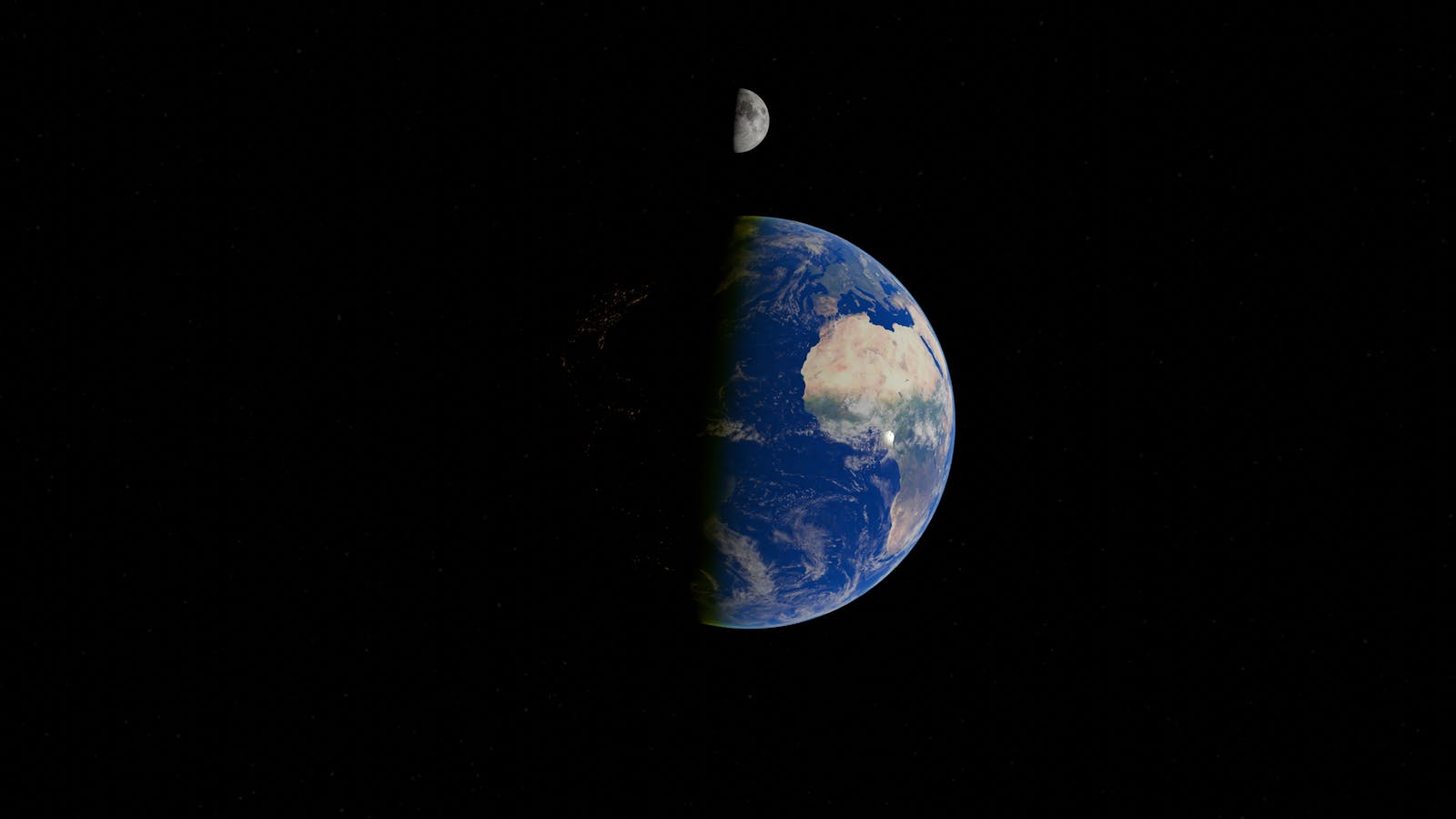
On a clear night at the Apache Point Observatory in New Mexico, a 3.5-meter telescope fires a pulse of green laser light at the Moon. The beam, after traveling roughly 384,400 kilometers, strikes a suitcase-sized panel of cube-corner mirrors that has been sitting in the lunar dust since the Apollo 11 mission in 1969. A handful of photons bounce back. Two and a half seconds after the pulse left Earth, a detector catches them. From that round-trip time, measured to a precision of a few trillionths of a second, physicists know the distance to the Moon to within about three centimeters. They also know, with the same certainty, that the Moon is sliding away from Earth at roughly 3.8 centimeters per year, about the speed at which a human fingernail grows.
That number is not a guess. It is one of the most precisely verified facts in planetary science.
The retroreflectors are still working after more than 50 years
Three of the six Apollo crews left retroreflector arrays on the lunar surface. Apollo 11 placed the first one in the Sea of Tranquility. Apollo 14 added a second at Fra Mauro. Apollo 15, the largest of the set, was deployed at Hadley Rille and contains hundreds of fused-silica corner cubes, each one machined so that any incoming light beam bounces back along the exact path it came from. Two Soviet rovers, Lunokhod 1 and 2, carried reflectors that contribute additional return points.
The hardware is passive. No batteries. No electronics. Nothing to fail. A cube corner is just three mirrors meeting at right angles, and the geometry does the work. That is why an experiment installed during the Nixon administration is still returning data while Apollo’s astronauts are in their nineties.
NASA’s Lunar Laser Ranging program has been firing pulses at these mirrors since the reflectors were placed. The catch rate is brutal. Of the photons in a single laser pulse, only a handful come back to the telescope. Atmospheric turbulence, beam divergence, dust on the reflector face and the simple geometry of bouncing a flashlight off a target nearly 400,000 kilometers away conspire against the experiment. Yet over millions of shots, the statistics resolve into a distance measurement accurate to a few millimeters.
How a round-trip time becomes a recession rate
The principle is elementary. Light travels at a fixed speed in vacuum, 299,792,458 meters per second. Time the pulse out and back, divide by two, multiply by the speed of light, and you have the distance. The hard part is timing it well enough.
Modern stations use hydrogen maser clocks and single-photon-counting detectors with timing resolution in the picoseconds. Stack thousands of returns, fit them to a model of the Earth-Moon system that includes lunar libration, tidal deformation of Earth’s crust, atmospheric refraction and relativistic corrections, and the residual scatter shrinks to a couple of centimeters.
Repeat the measurement for half a century, and the secular trend pops out cleanly. The Moon, on average, is farther away every year than it was the year before. Astronomy Magazine puts the figure at 1.49 inches, or 3.78 centimeters, per year.
Why the Moon is leaving
The cause is tidal friction. The Moon’s gravity raises a bulge in Earth’s oceans. Because Earth rotates faster than the Moon orbits, that bulge is carried slightly ahead of the line between the two bodies. The mass of the bulge tugs the Moon forward in its orbit, giving it a tiny gravitational kick. Angular momentum has to be conserved, so the Moon climbs into a higher orbit while Earth’s rotation slows down.
Days are getting longer as a result. Billions of years ago, an Earth day was substantially shorter than today. Coral and tidal rhythmite fossils, which record daily and seasonal layers, confirm the pattern in the geological record. The Moon was closer then, and the spin-down of Earth has been ticking along ever since.
If you naively project the current 3.8 cm/year rate backward, the Moon collides with Earth about 1.5 billion years ago, which is absurd given that the Moon formed roughly 4.5 billion years ago in the Theia impact. IFLScience notes that the recession rate has not been constant. Continental configuration matters. Today’s Atlantic Ocean happens to resonate near the tidal frequency, amplifying friction. In the deep past, with different ocean basins, the rate was slower.
What 3.8 centimeters a year actually buys you
It is a small number. Over a human lifetime of 80 years, the Moon recedes about three meters, the height of a basketball hoop plus a foot. Over the entire span of recorded human history, roughly 5,000 years, it has moved off by about 190 meters, less than the length of two football fields.
Over geological time, the effect is dramatic. A billion years from now, the Moon will be about 38,000 kilometers farther away. The angular size of the lunar disk in the sky will be perceptibly smaller. The coincidence that lets the Moon almost exactly cover the Sun during a total eclipse, the fact that both objects span roughly half a degree of sky, is the product of where the Moon sits right now. Four billion years ago the Moon appeared roughly three times larger in the sky than today, far too big for the kind of ring-of-fire totality humans are used to.
An earlier analysis of lunar recession and eclipses shows that every total solar eclipse human beings see is something a future civilization will not. The last total solar eclipse on Earth will occur hundreds of millions of years from now. After that, the Moon will be too small in the sky to completely cover the solar disk. Annular eclipses, with a thin ring of sun showing around the silhouette, will be the only kind left.
The endgame, projected forward 50 billion years
The Moon does not actually drift away forever. As Earth’s rotation slows, the angular momentum exchange has a natural endpoint. Eventually Earth would rotate so slowly that one Earth day equaled one lunar orbit. Both bodies would then be tidally locked to each other, the Moon hanging motionless above a single hemisphere of Earth, just as the Moon already keeps the same face toward us.
This crossover would occur billions of years from now. NASA’s discussion of tidal locking describes the same physics that already binds the Moon’s near side to Earth, just running in the other direction.
The endpoint is academic. The Sun becomes a red giant in roughly five billion years and probably engulfs Earth, or at least bakes it sterile, long before the Earth-Moon system can finish settling. Earth and the Moon will not survive the Sun’s evolution intact. They go down together.
What the laser ranging data has revealed beyond the recession rate
The 3.8 cm/year figure is the headline, but lunar laser ranging has done a lot of other work along the way. The data has tested Einstein’s equivalence principle, the idea that gravitational mass equals inertial mass, to extraordinary precision. It has constrained possible variation in the gravitational constant G over time. It has measured the size of the Moon’s fluid outer core by detecting tiny wobbles in the lunar rotation that only make sense if there is liquid sloshing inside.
The Apollo samples themselves keep yielding new science. Recent analysis of rocks brought back in 1972 turned up exotic sulfur isotopes that point to material from the deep lunar mantle, more than half a century after the crews who collected them came home.
What the astronauts left on the surface keeps producing data. What they brought back keeps producing data. The Apollo program, in a real sense, never stopped returning results.
The fingernail comparison, made literal
Human fingernails grow at roughly 3.5 millimeters per month, which works out to about 4.2 centimeters per year. The Moon’s recession rate of 3.8 centimeters per year is a hair slower. The two numbers are close enough that, if you cut your nails today and the Moon held still while yours grew, your nails would outpace it by about the width of a pencil over the course of a year.
That kind of comparison sounds whimsical. It is also exact. Multiple summaries of the lunar laser ranging result converge on the same figure, give or take a few hundredths of a centimeter, depending on which years of data are folded in.
The Moon is going. Slowly. At the same pace your body keeps building keratin. Every Apollo retroreflector still on the surface is, in effect, a ruler measuring that retreat one photon at a time.
What it took to get there
It is easy to forget the chain of events that makes this measurement possible. The Saturn V had to work. The lunar module had to land. The astronauts had to walk the array out and level it within a few degrees of the local vertical. The mirror surfaces had to survive 14-day lunar nights at -170°C and lunar days at over 100°C, the abrasive dust kicked up by every later landing, and decades of micrometeorite impacts. None of those things were guaranteed in 1969.
Today, ground stations in New Mexico, Hawaii, France and Italy keep firing pulses. The reflectors keep returning photons, though with reduced efficiency, since lunar dust appears to be slowly degrading the optical surfaces. While the long arc of NASA’s lunar program from Apollo through Artemis has been widely documented, the retroreflectors are the part that has been quietly working the entire time, without crew, without funding crises, without political reauthorization.
Two and a half seconds. That is how long the laser takes to go up and come back. By the time you finish reading this sentence, several pulses could have made the trip. And the Moon, by the time you go to bed tonight, will be roughly a hundredth of a millimeter farther away than when you woke up.
