

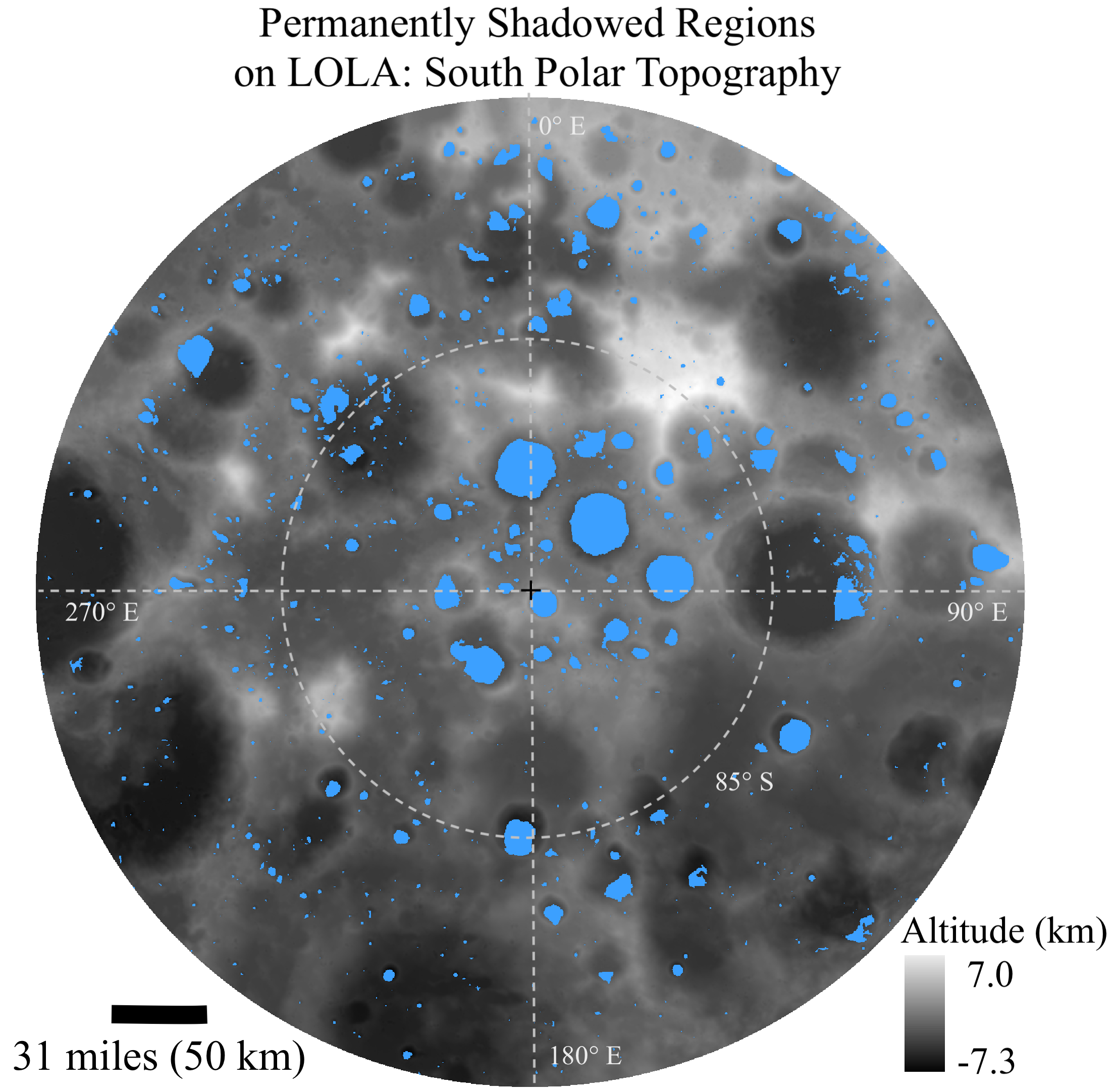
The Moon may hold enough polar ice to fill a modest terrestrial reservoir. That does not mean a lunar settlement could open a tap.
A NASA Lunar Trailblazer press kit says earlier mission data suggest up to 600 million metric tonnes of ice in permanently shadowed regions. Other estimates range from millions of tonnes in shallow deposits to a billion tonnes in hypothetical deep ice.
Those large totals answer an inventory question. A mine needs local answers: concentration, depth, continuity, physical form, contaminants, terrain and the amount of usable water recovered per unit of equipment and energy. That is the gap between a blue patch on a polar map and a water supply.
A global estimate is not a mine plan
The US Geological Survey’s 2023 lunar-resource assessment applies the vocabulary used for terrestrial deposits. Under that framework, a reserve is the part of a technically recoverable resource that can be converted into a commodity within budget and mission constraints.
The report classified lunar ice as a “speculative unrecoverable resource” under its 2022 assessment. That does not mean recovery is impossible forever. The available evidence could not support reliable deposit models or a complete recovery system.
The USGS cited a plausible range of 100 million to one billion tonnes, roughly 0.1 to one cubic kilometre of water. The upper end included deeply buried ice that is beyond present detection and remains hypothetical.
NASA’s 600-million-tonne figure should be read in the same spirit: “up to”, not “available”. Total mass says nothing about whether one accessible site contains useful ore grade. A thin, patchy mixture spread across a large area can produce an impressive inventory while imposing an impractical processing burden.
The only local grade came from an impact plume
Evidence for lunar polar water is no longer confined to one instrument. Neutron, radar, infrared and ultraviolet measurements probe different depths and footprints. In 2009, NASA’s LCROSS mission drove a Centaur upper stage into Cabeus crater and flew through the debris.
The impact produced the most direct local abundance estimate used by the USGS: 5.6 per cent water by mass, with a standard deviation of 2.9 percentage points. At roughly 95 per cent confidence, the report says the range runs from zero to 11 per cent.
That result came from excavated material at one site and cannot safely be multiplied across every cold trap. LCROSS also detected other volatile compounds, so future processing may require separation and purification rather than simply melting clean ice.
SpaceDaily’s earlier account of how missions established the case for lunar ice made the central distinction: confirmed water does not imply a continuous buried lake. It may occur as surface frost, isolated grains, cement between particles or deeper deposits beneath dry regolith.
Cold traps create an energy problem
Ice survives in these craters because direct sunlight does not reach the floor and temperatures can remain extraordinarily low. The same environment that preserves water withholds the easiest source of power from the mining face.
Machinery must enter darkness, cross rough terrain, tolerate vacuum and abrasive dust, and keep moving parts within workable temperatures. Hauling soil to a sunlit plant adds transport. Processing it in place requires power delivery and vapour capture.
The chain extends beyond extraction. A propellant plant must split water into hydrogen and oxygen, then compress or liquefy, store and transfer them. Efficient sublimation may still perform poorly after excavation, capture, purification and storage are counted.
Twenty-seven approaches, no production line
A 2025 open-access review in Space and Planetary Resources examined 27 simulated or experimentally tested lunar-water extraction approaches. Most use heat from microwaves, electrical elements, redirected sunlight or another source, either in the ground or after excavating regolith into a processor.
The diversity is useful, but it also reveals how early the field remains. The review found inconsistent definitions and reporting, making systems difficult to compare. Tests used different ice arrangements, simulants, pressures, temperatures and measures of efficiency.
Most physical experiments worked with grams or kilograms of prepared simulant. The reviewers found no demonstration adequate to show scale-up to operationally useful tonnes. Vapour capture, dust, maintenance and steps beyond heating were often incomplete or outside scope.
The deposit determines the machine. Surface frost might need little digging. A buried sheet requires drilling or overburden removal. Ice mixed through metres of soil could demand high-throughput excavation. Building first risks optimising for a deposit that is not there.
Prospecting should measure recovery, not colour maps
Orbital maps remain essential for narrowing the search. SpaceDaily recently reported on NASA and IBM’s lunar foundation model, which ranked ice prospectivity from multiple data layers. Its output represents favourable conditions, not measured tonnes beneath each pixel.
A proposed seismic method covered separately by SpaceDaily could add three-dimensional structure by exploiting the faster passage of waves through ice-rich regolith. Even a successful seismic map would not reveal purity, grain size or extraction cost without drilling and chemical measurements.
The next decisive dataset will resemble a prospecting log, recording concentration with depth, continuity, texture, contaminants, ground strength and temperature, then connecting them to power consumed and water captured.
Economics comes last because it depends on all of those values and on the customer. Water for nearby life support, oxygen for a lander and hydrogen-oxygen propellant for a depot are different products with different processing and transport costs. A 2025 value-of-information study found that uncertainty in deposit composition and technology performance is central to the business case, and argued that surface prospecting can therefore be worth more than its mission cost in representative scenarios.
The Moon probably has no shortage of water in the broad inventory sense. The unresolved problem is finding a concentrated, reachable deposit and recovering it with a system that closes its mass, power and cost accounts. Until that chain works on the lunar surface, hundreds of millions of tonnes remain an estimate, not a utility.