

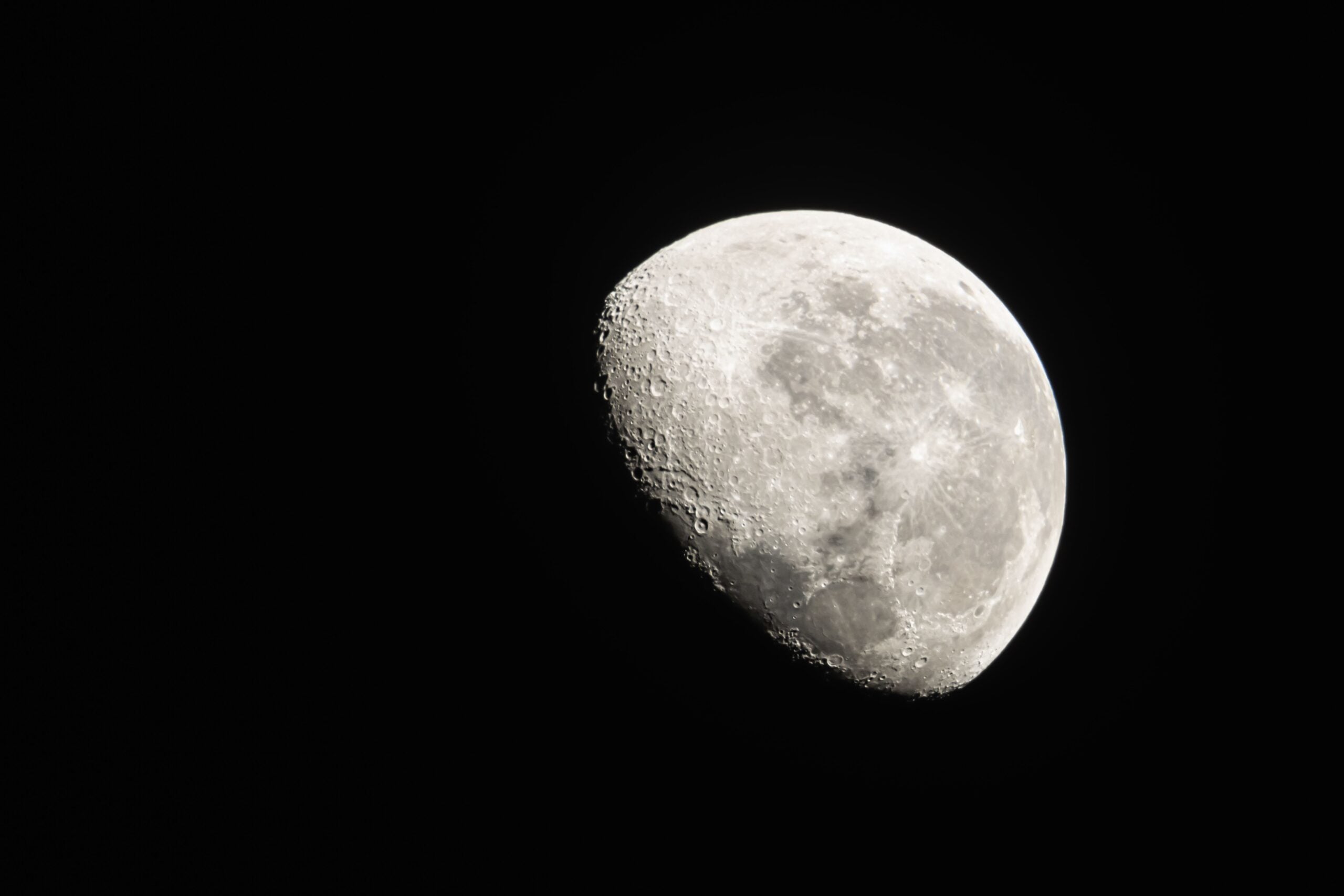
The bright mark that stopped image specialist Robert Wagner during a routine data check was not the crater itself. It was debris thrown across the Moon when an asteroid or comet fragment struck the surface. In a comparison designed to expose change between old and new Lunar Reconnaissance Orbiter images, the disturbed ground around the impact stood out against terrain that had weathered in space for far longer.
That observation became McGetchin crater, a newly measured bowl 222 metres across and about 43 metres deep on the eastern edge of the Moon’s near side. Images constrain its formation to the interval between April 11 and May 22, 2024. No telescope recorded the collision as it happened, so the dates are limits set by the last view without the crater and the first view showing that it existed.
NASA announced the result in September 2026, alongside two related papers in Science Advances. Together, the observations turn an exceptionally fresh crater into a record of what an impact does before long exposure and later bombardment begin to soften its optical, physical and thermal signatures.
Why fresh lunar ejecta can look bright
On the Moon, bright rays are often an indicator of relative youth. An impact excavates rock and dust from below the exposed surface and flings the material outward. Much of that subsurface material has not accumulated the same effects of solar-wind particles and micrometeorite impacts as the mature soil above it.
Those processes are collectively called space weathering. They modify tiny mineral grains, create glass and nanometre-scale particles of metallic iron, and gradually change how the ground reflects light. The mature surface generally becomes darker and redder in its spectrum than freshly exposed material of similar composition.
NASA’s comparison of fresh craters on the Moon and Earth notes that newly exposed lunar material is initially bright and darkens with time. The process is slow enough that a lunar crater described as fresh can still be hundreds of millions of years old. McGetchin is different because orbital images date it to a seven-week interval in 2024.
Brightness is therefore not a precise stopwatch by itself. Composition, grain size, viewing geometry and local terrain also affect reflectance. In McGetchin’s case, the brightness becomes particularly informative because scientists can compare images of the same location taken before and after a known surface change.
How a 2024 impact was found in 2025
The Lunar Reconnaissance Orbiter has been mapping the Moon since 2009. Its Wide Angle Camera repeatedly covers broad areas at moderate resolution, while two Narrow Angle Cameras record much smaller regions at roughly metre scale. The combination lets the team first find change and then inspect it closely.
Wagner was examining a temporal ratio made by comparing views of the same region under similar illumination. Features that did not change tend towards grey in this product. Differences in reflectance appear bright or dark, although variations in lighting and image alignment also produce false signals that must be rejected manually.
On October 24, 2025, the McGetchin pattern was too large and organised to dismiss. The Wide Angle Camera showed a bright point surrounded by an extensive disturbed zone. The team searched the Narrow Angle Camera archive, found useful pre-impact images and requested new close views during later orbital opportunities.
The LROC team’s technical image release reports an average crater diameter of 222 metres and a depth of 43 metres. Its walls average 24 degrees, reach nearly 40 degrees in places, and meet a rim standing about eight metres above the previous surface. Those dimensions came from stereo images and a digital terrain model, not from the bright spot in the original global comparison.
The crater cut across two different terrains
McGetchin is centred near 1.35 degrees north and 67.18 degrees east, close to the Moon’s eastern limb as seen from Earth. It formed at a boundary between dark mare basalt and brighter anorthositic highland crust. That setting complicates the simple shorthand that bright means young.
Composition also affects reflectance. The southeastern part of the ejecta is darker than other sections, which the team interprets as possible evidence of the basalt and highland contact. Billions of years of small impacts had churned and mixed the upper surface before 2024, making the boundary difficult to see in earlier images.
McGetchin abruptly sampled below that mixed layer. The impact excavated material from depths exceeding 20 metres and placed some of it outside the rim. A new crater is therefore more than a hole: it is a rough, violent cross-section through ground that orbiting instruments could not previously inspect in the same way.
NASA’s lunar-crater guide explains how an impact shock compresses the crust before material moves upward and outward as ejecta. The resulting rays may include fine deposits, larger fragments and secondary craters made when blocks strike the surface again.
Disturbance reached much farther than the gleaming blanket
In the crater study led by Mark Robinson, researchers report surface changes at distances exceeding 100 kilometres. These distant modifications are not a continuous layer of rock hundreds of kilometres wide. They are scattered effects produced as ejecta and high-speed particles returned to the ground.
The images also suggest that some material left the impact at angles greater than 10 degrees, compared with roughly two degrees in a commonly used description of the fastest near-surface jetting. Nearer the crater, overlapping textures imply at least two waves of ejecta deposition. The case gives modelers a rare target whose initial condition and age are unusually well constrained.
A second paper led by Tyler Powell used LRO’s Diviner thermal instrument to study the aftermath. Measurements made from November 2025 through February 2026 revealed a cold spot about seven kilometres wide. During the lunar night, parts of it were roughly nine degrees Celsius cooler than surrounding terrain.
The proposed explanation is physical rather than compositional. Impact shaking loosens, or fluffs, the regolith. A more porous surface conducts and retains heat differently, so it cools more quickly after sunset. The thermal anomaly extends far beyond the 222-metre cavity, recording disruption that visible images alone do not fully describe.
A once-per-132-years estimate is not a schedule
Crater-production models suggest that an impact making a feature this size occurs on the Moon about once every 132 years. That figure is a model average derived from the expected population and impact rate of small bodies. It is not a clock, and it does not mean the previous event occurred exactly 132 years earlier or that the next will wait the same interval.
Robinson and colleagues describe McGetchin as the largest contemporary impact crater yet found in the Solar System. “Found” is important. Planetary surfaces are not watched continuously at all scales, and the event itself escaped detection in real time. LRO eventually revealed it because a long-running camera programme had accumulated suitable before-and-after coverage.
The practical implication is not that a similar impact is imminent at a planned landing site. It is that lunar infrastructure will exist in an environment where distant impacts can redistribute particles and change the regolith well beyond a crater rim. Surface equipment designed to last for years must account for direct micrometeoroid exposure as well as debris produced elsewhere.
The Moon changes in other ways too. Space Daily has previously examined the tectonic ridges produced as the lunar interior cools and contracts. McGetchin records a different process: an abrupt external impact whose aftermath can be mapped from optical shape, reflectance and nighttime temperature.
A name tied to the physics of ejecta
The International Astronomical Union approved the name McGetchin on May 4, 2026. It honours Thomas R. McGetchin, an American geologist and planetary scientist who lived from 1936 to 1979 and helped develop models of how ejecta is distributed around impact craters.
The naming is unusually apt. The new crater is already testing assumptions about ejection angles, layered deposition and the reach of surface disturbance. Its location at a geological boundary also provides a clean demonstration of how crater excavation can expose material hidden beneath a mixed surface.
McGetchin’s rays will not retain their present contrast forever. Solar particles, microscopic impacts and continuing regolith mixing will gradually make the exposed material resemble its surroundings. The crater itself will remain much longer than its gleam.
What makes this event valuable is the combination of youth and documentation. The Moon carries bright-rayed craters whose ages must be inferred across immense spans of time. For McGetchin, images show that an unbroken surface on April 11, 2024 had become a 222-metre crater by May 22. That narrow bracket gives planetary scientists something lunar geology rarely supplies: a large impact feature with a beginning date measured in weeks rather than geological eras.