
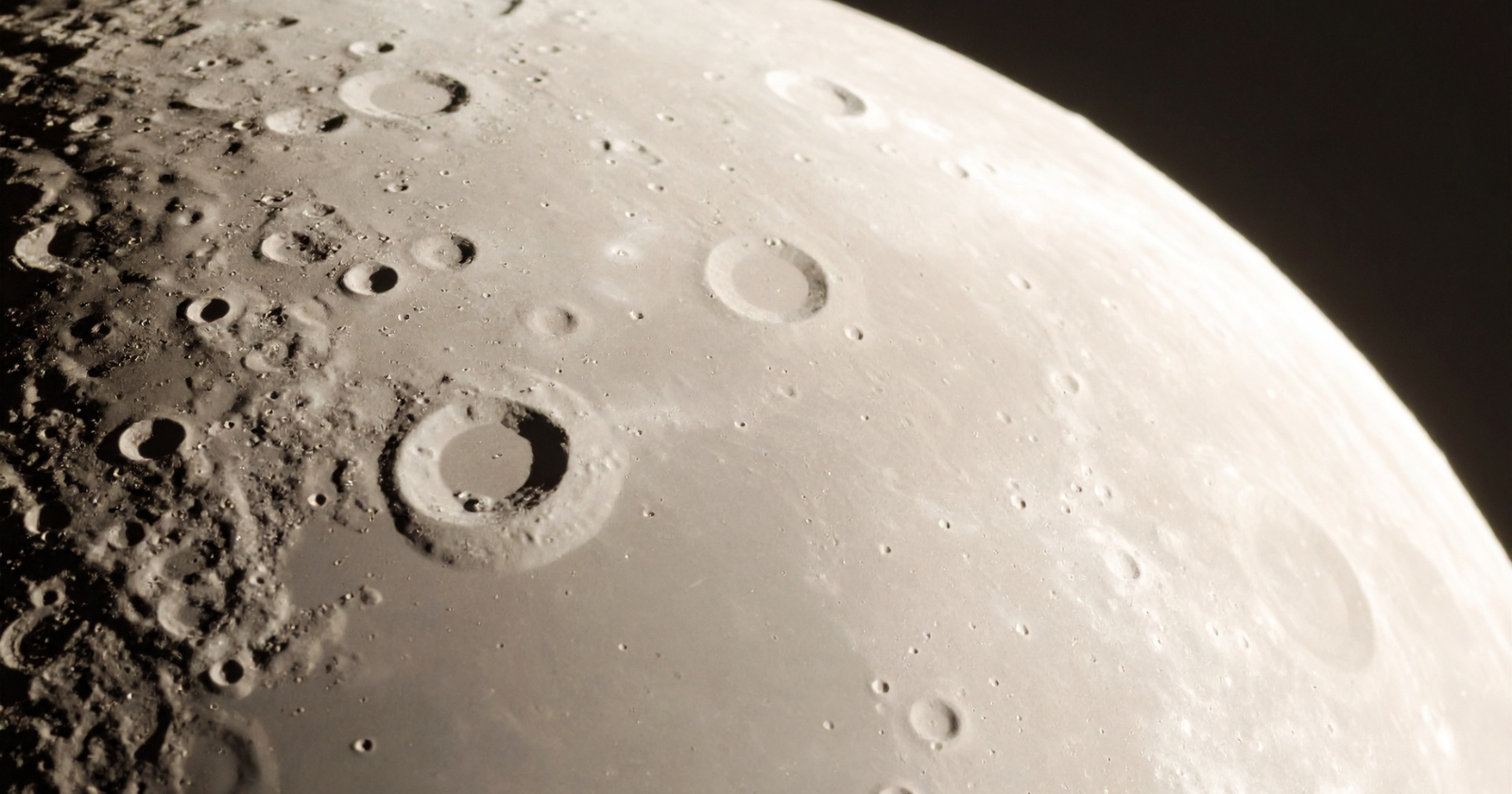
The Moon does stillness unusually well. It has no weather to soften its craters, no oceans to erase a coastline and no moving plates that rebuild the surface on an Earth-like schedule. The same face turns toward us, carrying scars that have remained visible for billions of years.
That appearance encouraged a useful but incomplete label: geologically dead. The Moon is certainly quieter than Earth. It is not inert.
A new global analysis led from the Smithsonian’s National Air and Space Museum has added 1,114 previously unrecognised segments of small tectonic ridges to the map of the lunar near side. Together with earlier surveys, 2,634 segments are now catalogued across the Moon’s dark volcanic plains. The ridges are geologically young, formed by shallow thrust faults and distributed widely enough to change the picture of recent lunar contraction.
The Smithsonian announced the result in February 2026. The underlying paper was actually published on December 24, 2025. That date matters less than another distinction: the researchers did not watch a ridge form or detect a fresh moonquake. They mapped landforms that record recent faulting and identified many more places where shallow moonquakes could originate.
What the team found, and what it counted
Cole Nypaver, a research geologist at the Center for Earth and Planetary Studies, led the study with Thomas Watters, Maria Banks, James Clark and Theresa Frueh. Their paper, “A New Global Perspective on Recent Tectonism in the Lunar Maria,” appeared in The Planetary Science Journal.
This is one study, not settled consensus about the activity of every mapped fault. Its contribution is a global catalogue and analysis of small mare ridges, usually shortened to SMRs.
The maria are the large dark patches that form the familiar pattern on the lunar near side. They are plains of basalt, created when lava flooded ancient impact basins and later hardened. Planetary geologists have long known that the maria contain large wrinkle ridges associated with the emplacement, cooling and subsidence of those dense lava deposits.
SMRs are a different scale of feature. They are lower, narrower and often more sinuous than the large ancient wrinkle ridges. The study defined them by three main traits: elongated positive relief, a degree of symmetry around a central axis and a distinct, relatively undegraded boundary with the surrounding surface.
The team first divided mapped mare terrain into a five-kilometre grid and searched a global mosaic made by the Terrain Camera on Japan’s Kaguya spacecraft. Candidate features were then mapped in detail with Narrow Angle Camera images from NASA’s Lunar Reconnaissance Orbiter. Those images provide a resolution of about 0.5 to 2 metres per pixel, fine enough to trace subtle scarps, small craters and changes in ridge form.
The resulting catalogue added 1,114 previously unmapped SMR segments across the near-side maria. “Segments” is the precise unit. A tectonic ridge system can branch, bend, disappear under later material or be divided into separate mapped stretches. Describing the result as more than a thousand new ridges conveys its scale, but it should not be read as 1,114 entirely independent fault systems.
Combined with the team’s earlier far-side survey, the total reached 2,634 SMR segments. The advance is not merely the larger number. It is the demonstration that these young contractional features are widespread through the lunar maria rather than confined to a handful of unusual local settings.
How a ridge acquires an age
There is no preserved date stamped into a lunar fault. Researchers instead read the order in which surface events occurred. A ridge that cuts and deforms an impact crater must be younger than that crater. A crater that sits undisturbed on top of a ridge must have formed later. Counts of accumulated craters provide another way to estimate how long a surface has been exposed.
Using these relationships, the team estimated formation ages between about 50 million and 310 million years for the SMRs it analysed in detail. The average was 124 million years. Against a Moon about 4.5 billion years old, these are recent landforms.
The average is also close to the estimated 105-million-year age of lobate scarps, cliff-like contractional features found mainly in the brighter lunar highlands. Age alone does not establish a common cause, but the map offered a more direct connection. Some fault systems display the form of a lobate scarp in highland terrain and change into an SMR where they enter mare basalt.
Elastic modelling indicated that the ridges sit above shallow, low-angle thrust faults with an average dip of about 38 degrees. Under compression, one block of crust is pushed over its neighbour. The surface responds with a low ridge or scarp rather than the broad tearing and separation associated with an extensional fault.
Why the Moon contracts
The Moon began hot. Its interior has been shedding heat ever since, and cooling materials contract. The amount is small compared with the lunar radius, but the outer crust is brittle. It cannot smoothly accommodate every change in volume. Compressive stress accumulates until rock deforms or slips along a fault.
Global cooling is only part of the stress picture described in the paper. The Moon is slowly receding from Earth, changing the tidal deformation it experiences. Solid-body tides continue to flex the lunar interior and crust during each orbit. The authors interpret the young highland scarps and mare ridges as responses to a combination of contraction, orbital recession and tidal stress.
The team estimated areal contractional strain of 0.0034 to 0.0040 percent across the maria from the mapped SMRs. Earlier work on lobate scarps placed the equivalent highland strain between 0.0031 and 0.0054 percent. The similar ranges support deformation on a global scale, expressed differently where the crust consists of highland material and where basalt fills the maria.
Previous estimates based largely on lobate scarps suggested that the lunar radius decreased by about 25 to 100 metres over the past 500 million years. The new study shows that mare deformation must be included in a complete account, but it does not offer a revised final shrinkage figure. Nor does “shrinking” mean the Moon is visibly changing size from year to year. The contraction is detectable through accumulated structures over geological time.
The shaking was measured by Apollo
The case for a seismically active Moon does not depend on ridges alone. Apollo astronauts placed seismometers on the surface, and four stations operated as a network until 1977. The instruments recorded thousands of events from several causes, including meteoroid impacts, thermal changes near the surface, deep tidal moonquakes and 28 shallow moonquakes.
Shallow events are the group most plausibly produced by slip on crustal faults. In 2019, Watters and colleagues reanalysed their locations for a paper in Nature Geoscience. Eight of the 28 relocated events lay within 30 kilometres of young faults visible in Lunar Reconnaissance Orbiter imagery. Six of those eight occurred when the Moon was at or near apogee, where tidal stress from Earth added to the compression. The team calculated that the probability of this clustering arising by chance was less than four percent.
That work provided evidence that some young thrust faults remain active. It did not give every quake a uniquely identified fault, because the Apollo seismic network was small and epicentre estimates carried substantial uncertainty. The recorded shallow events ranged from roughly magnitude 2 to magnitude 5, according to NASA’s account of the analysis.
The new SMR study makes a related but narrower step. Because small mare ridges appear to be the same kind of contractional structure as lobate scarps, their shallow faults become plausible seismic sources. The catalogue therefore extends the possible geography of contraction-related moonquakes across the maria. It does not demonstrate that every SMR is active now.
A geological map is not yet a hazard forecast
For future crews, a long list of possible faults is useful but incomplete. Risk depends on how often a fault slips, how large an event it can produce, the distance to a lander or habitat, local ground conditions and whether shaking can destabilise nearby slopes.
Lunar seismic waves can persist because the dry, fractured crust dissipates energy differently from Earth’s wetter geology. NASA notes that moonquake shaking may continue for hours, although long duration does not by itself tell engineers how damaging a specific event would be. A fault mapped beside a proposed outpost is not proof of an imminent quake.
Work published in 2024 examined young thrust faults and slope stability near the lunar south pole. NASA’s summary of that study said strong local shaking was possible from slip on existing faults or the formation of new ones, and argued that potential activity should be considered when choosing and engineering permanent sites.
The same practical logic now reaches into the maria. Better orbital maps can guide site studies, but a modern network of surface seismometers is needed to show which faults are moving, how frequently they move and how seismic energy travels through different lunar terrains.
Active does not mean Earth-like
Calling the Moon tectonically active can invite the wrong comparison. It has no known system of mobile crustal plates like Earth’s. Its major volcanic plains formed long ago. The deformation described here is slow contraction within a one-plate body, modified by orbital and tidal forces.
It is nevertheless geological activity. Heat continues to leave the interior. Stress continues to act on the crust. Faults have formed within the most recent few percent of lunar history, and Apollo instruments recorded shallow quakes consistent with slip on young faults.
The strongest part of the 2025 study is its change in scale. Young contractional structures were already recognised in the highlands. The expanded catalogue shows comparable deformation throughout the volcanic plains and adds more than a thousand newly mapped segments to the inventory of possible seismic sources.
The Moon can therefore be still on the timescale of a night’s observation and active on the timescale of geology. Its surface is not being remade quickly, but neither is its story finished. It continues to cool, contract and occasionally release stress through a crust that records almost everything.
