
A rounded grain smaller than a millimetre has added a mineral to the known inventory of Mars. Tanya Kizovski and colleagues identified andradite, an iron- and calcium-rich member of the garnet family, inside a mounted piece of the Martian meteorite Northwest Africa 8171 held by the Royal Ontario Museum.
Their peer-reviewed paper in Geochemical Perspectives Letters reports the first confirmed garnet-bearing rock type in a Martian meteorite. The clast measures about 540 by 830 micrometres, smaller than one millimetre in both directions, and its tightly intergrown minerals preserve several plausible histories.
This is one study, not settled consensus. NWA 8171 is Martian, and the mineral identification is supported by three laboratory methods. The unresolved question is whether this particular clast formed on Mars and, if it did, which process made it.
NWA 8171 is a rock made from other rocks
NWA 8171 belongs to 18 paired Martian regolith breccias, stones thought to come from the same original meteorite material. A polymict breccia is a mixture: fragments from several source rocks sit inside a fine-grained matrix. That structure makes each small clast a separate geological archive, and it also leaves room for debris delivered by an impactor.
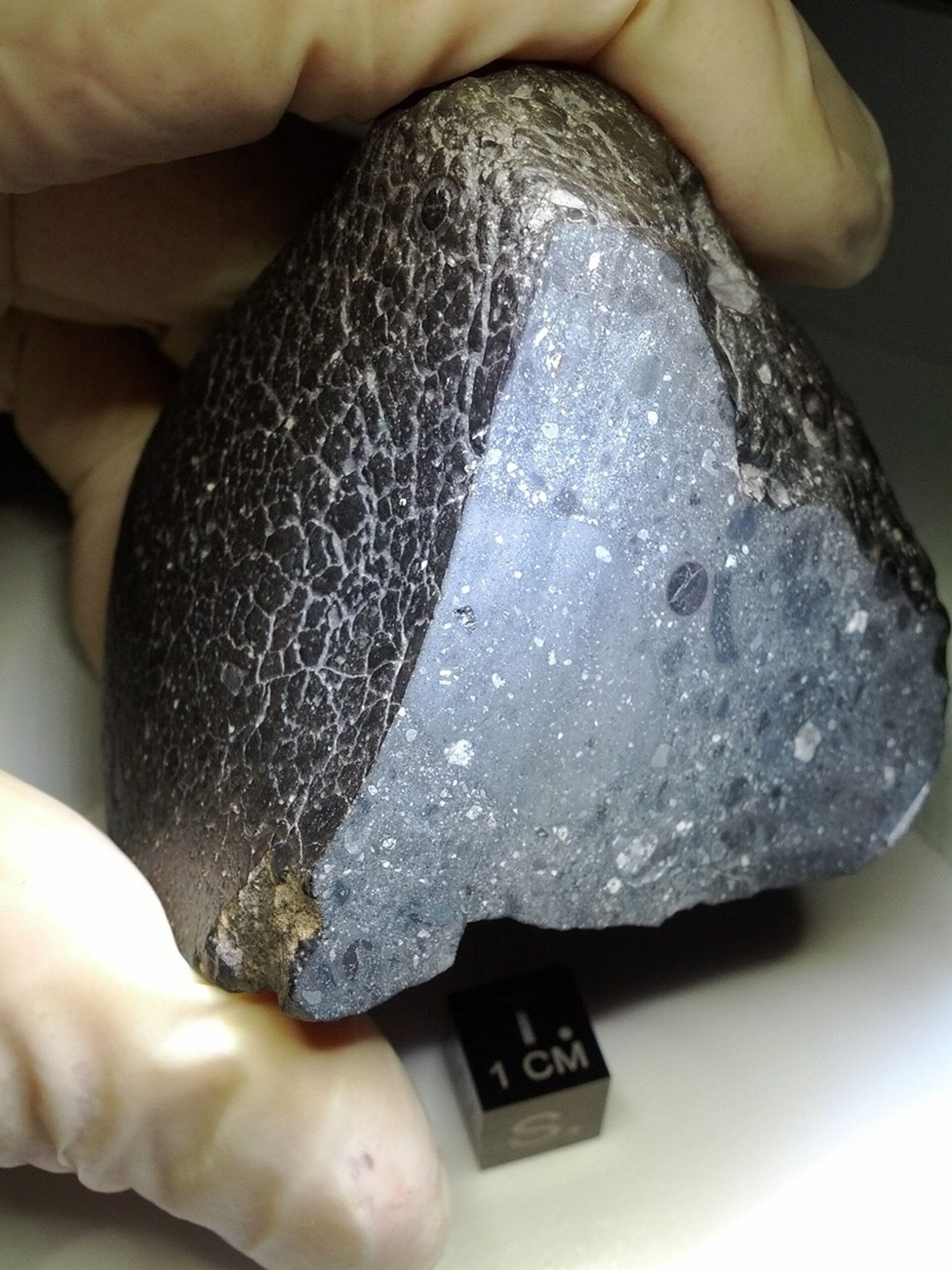
The best-known paired stone is NWA 7034, nicknamed Black Beauty. These dark, fragment-rich rocks sample Mars’s impact-battered crust. Another recent Martian-meteorite study shows how one stone can fill a gap without completing the record. Some NWA 8171 source fragments may be about 4.4 billion years old; previous dating places the assembly of the breccia at roughly 1.5 billion years ago.
Three methods confirmed the mineral
The team studied one Royal Ontario Museum grain mount, catalogue number ROMESM58935. Electron-microprobe measurements mapped elemental chemistry. Raman spectroscopy tested how the crystal vibrates, and electron backscatter diffraction measured its crystalline structure and orientation. All three identified andradite, with the formula Ca3Fe3+2(SiO4)3.
The clast contains two distinct but intergrown domains. One holds andradite grains in a fine diopside matrix. The other is rich in potassium feldspar and augite. Chlorapatite appears in both, while tiny intergrowths of garnet, pyroxene and feldspar occupy the boundary. This is a mineral assemblage, not a cut gemstone.
The chemistry points in two directions
Ratios of manganese to iron in pyroxene can help separate rocks from different planetary bodies. The augite in the potassium-feldspar-rich domain falls within Martian values. Because that domain is physically intergrown with the andradite-bearing material, the result supports a Martian origin for the whole clast.
The diopside surrounding the garnet is more ambiguous. Its ratios extend into compositional fields associated with chondritic meteorites, Earth, the Moon and Vesta. Alteration on Mars can also shift those ratios. The variation therefore admits two readings: a foreign component, or Martian rock whose original chemistry was modified. The paper says manganese-to-iron ratios alone cannot decide between them.
Four geological routes remain open
Andradite can form in several settings. Similar combinations of garnet, pyroxene and potassium feldspar occur in alkaline igneous rocks on Earth. An igneous Martian origin would imply an unfamiliar stage of alkali-rich magma differentiation or a magma source absent from the present meteorite collection.
Heat from an intrusion or an impact could instead have metamorphosed older rock. A third route is metasomatism, in which heated, chemically active fluid replaces existing minerals. The garnet lacks the water signature of hydroandradite, and much of the assemblage appears relatively anhydrous. That does not eliminate fluid: reactions at a low water-to-rock ratio can leave dry minerals behind.
The fourth possibility starts elsewhere. Asteroids have struck Mars and contributed material to its regolith. Andradite-diopside assemblages occur as secondary phases in altered carbonaceous chondrites. No physical non-Martian clast has previously been confirmed in this breccia family, but chemical estimates indicate that impactor material is present at a broader level.
A stronger test would consume rare material
The Brock University account of the study says isotope analysis could help establish the clast’s parent body. It would also require destroying part of a sample that may be the only garnet-bearing Martian rock available. The researchers therefore kept the initial characterisation non-destructive.
That restraint leaves a precise limit. Scientists know how the larger meteorite is identified as Martian: trapped gases, isotopes and mineral chemistry converge. Yet a breccia is a geological collection, so the parentage of one inclusion cannot simply be inherited from the rock around it.
One clast broadens the archive without settling it
Martian meteorites amount to an accidental sample-return programme without precise collection sites. A review of what these meteorites reveal describes both their value and their sampling gaps. NWA 8171’s source crater, and the original location of this clast on Mars, remain unknown.
The paired breccias have already yielded evidence for ancient granitic fragments. Their heterogeneity is not analytical noise; it is what allows rare pieces of crustal history to survive together. The garnet could add an unfamiliar magma, an alteration environment or a metamorphic event to that record. It could also be asteroid debris.
The featured image is NASA’s photograph of NWA 7034, a paired breccia from the same meteorite group, not the microscopic NWA 8171 clast. The distinction is deliberate. The larger family’s Martian origin is secure, while the story contained in one exceptionally small fragment remains open.