

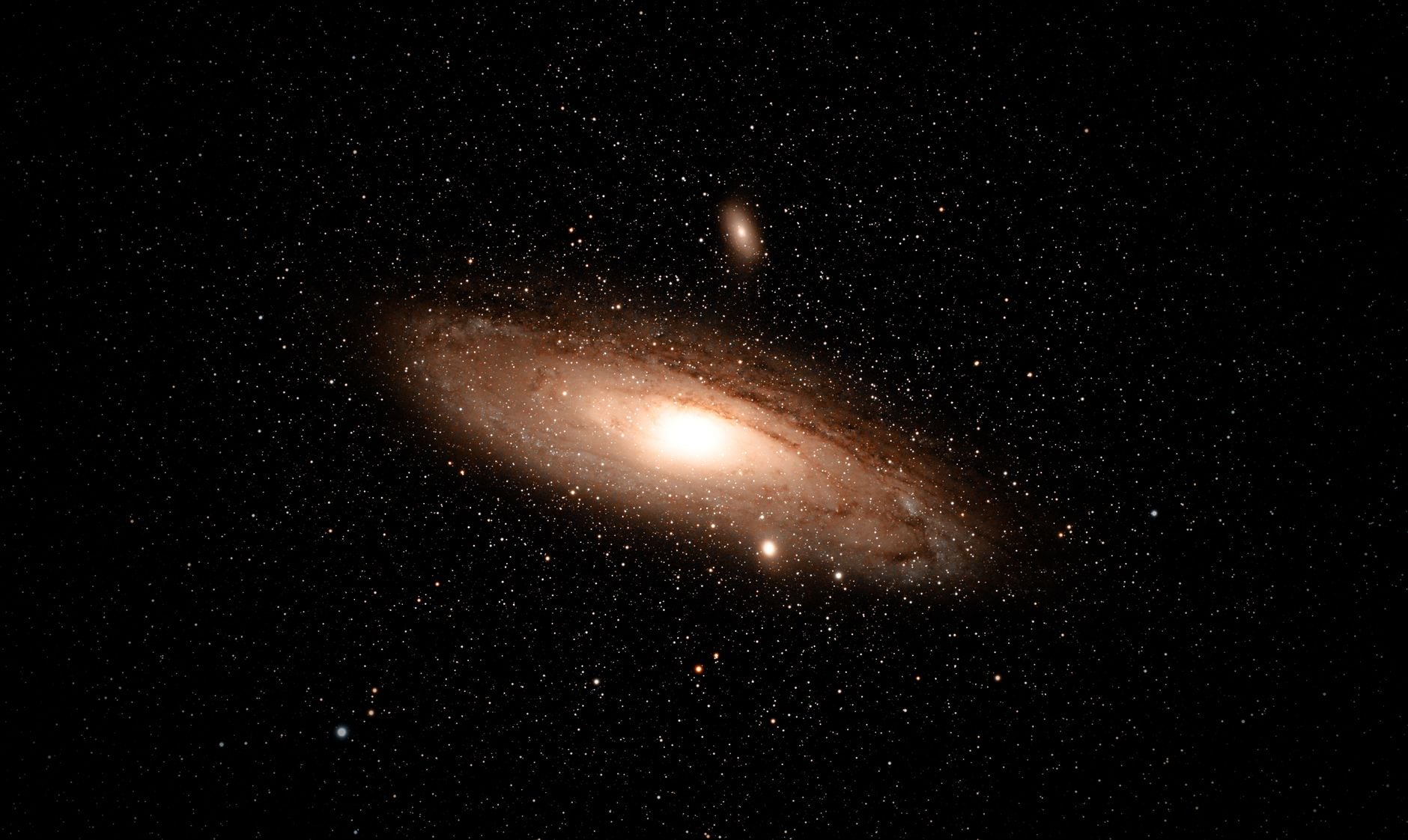
The Milky Way’s expected collision with Andromeda became considerably less certain in June 2025. In a Nature Astronomy paper led by Till Sawala, researchers using Hubble and Gaia observations estimated roughly even odds that the two galaxies would merge within the next ten billion years.
That estimate needs a date attached. A separate study published in April 2026 subsequently raised the merger probability to about 90 per cent in its preferred model. The 2025 finding is worth taking seriously, but it should not be read as the final word.
The 4.5-billion-year date described an encounter
The familiar forecast developed through successive measurements. In NASA’s 2012 announcement, Hubble observations supported a nearly head-on encounter around four billion years in the future. The galaxies were expected to need roughly another two billion years to become a single system.
Then Gaia results reported by ESA in 2019 favoured a less direct collision and shifted the first close passage to about 4.5 billion years. That work, led by Roeland van der Marel, used stellar movements to reconstruct the trajectories of Andromeda and Triangulum, also known as M31 and M33.
A first encounter and a completed merger are different events.
The distinction matters when comparing headlines. A date for the galaxies’ first approach cannot be substituted for the time when their centres finally join. Likewise, a probability covering ten billion years does not specify a single appointment somewhere inside that interval.
Approaching us does not fix the whole orbit
Our earlier explanation of the motions of Earth, the Solar System and Andromeda described the galaxies closing on each other at roughly 400,000 kilometres per hour. That figure measures their relative approach. It cannot, by itself, tell us how far to one side Andromeda will pass.
The sideways motion is much harder to measure. ESA’s 2019 account describes identifying thousands of stars in the two neighbouring galaxies and tracking their movement across the sky. Their apparent motion combines the rotation within each galaxy with the movement of the galaxy as a whole. Separating those contributions is part of the work behind an orbital prediction.
The distance helps explain the difficulty. As we explored in our article on Andromeda’s 2.5-million-year-old light, even this nearby major galaxy is far enough away that its naked-eye appearance is a faint patch. Resolving its structure and measuring its tiny displacement across the sky are different observational tasks.
Two smaller galaxies change the calculation
Sawala’s team modelled four galaxies: the Milky Way, Andromeda, Triangulum and the Large Magellanic Cloud. They varied the starting measurements within their uncertainties instead of following only one preferred trajectory.
In their calculations, Triangulum increased the likelihood of a Milky Way–Andromeda merger. The Large Magellanic Cloud pushed the result in the opposite direction, changing the Milky Way’s motion and adding movement outside the original orbital plane. Including both companions left the merger probability close to half.
These are gravitational participants, even though they are smaller than the two main galaxies. Treating a companion merely as extra mass misses the importance of where it is and how it moves.
A close pass can become a much later merger
NASA’s account of the 2025 research explains how the outcomes separate. In some simulations, the galaxies pass within roughly half a million light-years, move apart and later return. Their extended dark matter haloes interact through dynamical friction, transferring energy out of the orbit and allowing the separation to shrink over successive encounters.
Wider passages can leave that process too weak to produce a merger within the period being examined. NASA also reported only about a two per cent chance of the earlier, near-head-on encounter happening in four to five billion years under the 2025 calculation.
Even a merger would not mean stars routinely hitting other stars. NASA’s 2012 explanation stressed the enormous gaps between them. Gravity could redistribute stellar orbits and reshape the galaxies without direct stellar collisions being the usual outcome.
A 2026 study moved the odds upward again
Hao Wu and colleagues revisited the problem in The Fate of the Milky Way–Andromeda System: To Merge or Not?, published in The Astrophysical Journal Letters in April 2026. Using the earlier study’s broad modelling framework, they adopted newer Gaia-based measurements of Andromeda’s and Triangulum’s motions, corrected for systematic offsets.
Their preferred model gave a 90 per cent merger probability and a median merger time of about 6.5 billion years. Across the two-sigma region of the adopted Andromeda motion measurements, the calculated probability ranged from about 64.7 per cent to 100 per cent.
The authors still described the measurements as inconclusive.
In our reading, the comparison shows why a probability should travel with its assumptions. Revised inputs can produce a different forecast without resolving every uncertainty.
Wu’s team called for proper-motion uncertainties around two microarcseconds per year or smaller to narrow the probability range substantially. Measuring that motion more precisely remains the next test of the forecast.