
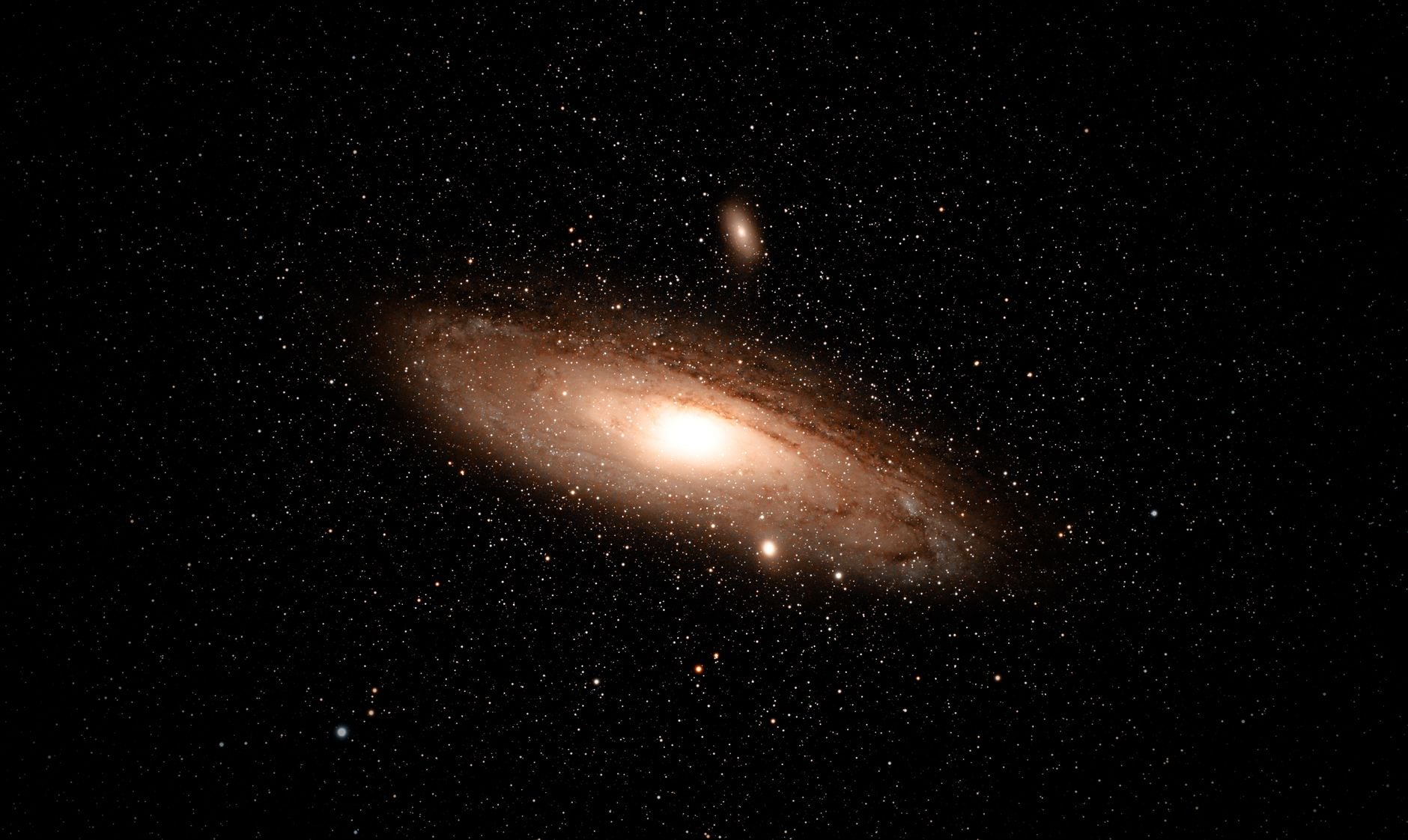
On a clear, dark night, the Andromeda galaxy does not resemble the sweeping spiral in telescope photographs. It appears as a small, pale blur, easy to mistake for a thin cloud. Andromeda is about 2.5 million light-years away, so the photons making that blur have crossed intergalactic space for about 2.5 million years before ending their journey in a human retina.
The evolutionary comparison in the headline is broadly sound. The oldest widely accepted fossil assigned to the genus Homo is around 2.8 million years old. A little later in the record, early species including Homo habilis appear. The light visible from Andromeda tonight began travelling during that formative chapter of the human lineage.
A light-year is a distance with a clock built in
A light-year is the distance light covers in one year, about 9.46 trillion kilometres. Because light has a finite speed, a distance in light-years also tells us approximately how far into the past we are seeing. NASA’s simple guide to light-years and lookback time gives Andromeda as the clearest million-year example: at 2.5 million light-years away, we see it about 2.5 million years in the past.
The figure is rounded. Distance measurements carry uncertainty, Andromeda is moving relative to the Milky Way, and the galaxy is not a flat lamp at one single distance. Its nearer and farther stars are separated by tens of thousands of light-years. “2.5-million-year-old light” is therefore a good description of the view, not a timestamp shared by every photon in the image.
Your eye mostly catches Andromeda’s crowded centre
NASA lists Messier 31, another name for Andromeda, at an apparent magnitude of about 3.1. That sounds comfortably within the usual naked-eye limit, but a galaxy is not a point like a star. Its light is spread across a broad patch of sky, lowering its surface brightness.
What most observers detect is the dense central bulge, where the combined glow of many stars is strongest. Dark adaptation helps. So does looking slightly to one side, which places the image on a more light-sensitive part of the retina. Binoculars reveal a longer oval and, under good conditions, some of the surrounding structure.
A NASA Night Sky Notes observing guide calls M31 a magnitude 3.4 patch of haze and warns that light pollution, smoke, thin cloud and haze can erase faint detail. The description “you can see with your naked eye” assumes a clear sky and a location where Andromeda rises above the horizon. It is not equally easy from every city, latitude or season.
The invisible galaxy is far larger than the smudge
Andromeda’s full apparent extent is surprisingly large. NASA says it spans about six times the apparent diameter of the full Moon. The Moon comparison refers only to angular size. It does not mean Andromeda looks six Moons wide to an unaided observer, because almost all of its outer disk is too dim to see without imaging.
Long-exposure photographs collect photons for seconds or hours instead of the eye’s brief integration time. Processing can then reveal dust lanes, star-forming regions and satellite galaxies. Hubble’s enormous mosaics go further, resolving individual stars in a galaxy whose naked-eye appearance merges their light into one soft patch.
SpaceDaily previously explained why Andromeda is usually called the most distant object visible without optical aid. The qualification matters because rare transient events can briefly become visible at much greater distances. For a steady object an ordinary observer can deliberately find, M31 is the familiar benchmark.
Early Homo existed near the start of the journey
The fossil record does not provide a single birthday for our genus. A partial lower jaw with teeth from Ledi-Geraru in Ethiopia, known as LD 350-1, was dated to between 2.80 and 2.75 million years ago. Its discoverers described it in the 2015 report of early Homo, making it the oldest widely accepted fossil assigned to our genus.
By about 2.4 million years ago, Homo habilis appears in the fossil record. The Smithsonian describes it as one of the earliest members of Homo, while noting that the earliest stone tools are older than the oldest fossil evidence of the genus. Other hominins lived alongside these populations, and scientists continue to debate which fossils belong inside Homo.
The title’s “around the time” is therefore doing honest work. The photons were not launched on a date that can be paired with one named species. Their travel time overlaps the interval in which early Homo emerged and diversified in Africa.
The comparison compresses two very different histories
While the light crossed the gap, generations of stars continued to form and die in Andromeda. On Earth, climates shifted, hominin populations evolved, and eventually Homo sapiens appeared only around 300,000 years ago. Agriculture, cities and telescopes occupy a tiny fraction at the end of the photons’ passage.
Nothing about the view is live. Even a perfect telescope cannot show Andromeda as it is at this instant, because no newer information has reached us. A larger instrument gathers more of the same delayed light and separates finer details within it.
This is not a special defect of astronomy. The Moon is seen roughly 1.3 seconds ago, the Sun about eight minutes ago and nearby stars years or centuries ago. Andromeda simply stretches the same rule to a timescale that can be compared with evolution.
A NASA Hubble guide to observing cosmic history makes the same comparison, placing Andromeda’s arriving light in Earth’s Paleolithic period.
A small patch of genuine deep time
Andromeda is the nearest major galaxy to the Milky Way, which makes 2.5 million light-years “nearby” only in the vocabulary of galaxies. Its visibility provides a rare direct experience of extragalactic distance. No detector screen is required; under the right sky, the ancient photons arrive straight from another galaxy to the eye.
The scene is more nuanced than a slogan. The whole galaxy is not viewed at exactly one age, the eye sees mainly its central glow, and the early human timeline is reconstructed from incomplete fossils. Yet the central claim survives those qualifications. The faint smudge overhead really is ancient light, and its journey began close to the dawn of our genus.