

Right now the floor feels stationary. It supports your weight, your coffee stays in its cup and nothing in the room suggests a planet covering almost 30 kilometres every second around the Sun.
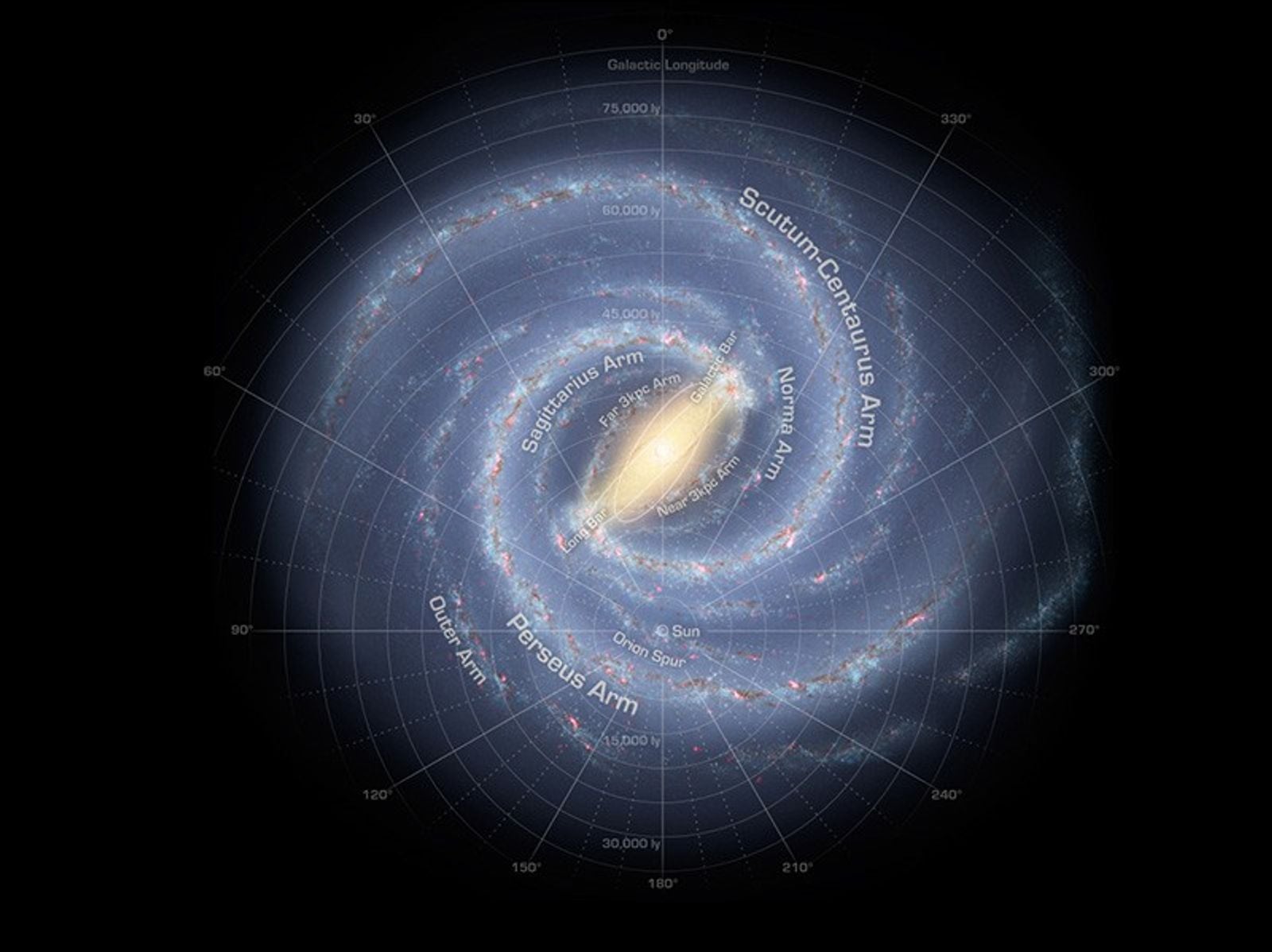
The quiet is real, but local. Measured against the Sun, Earth averages about 107,000 kilometres per hour. Measured against the Milky Way’s centre, the whole solar system moves at something like 720,000 kilometres per hour, depending on the galactic model used. And measured along the line joining our galaxy to Andromeda, the distance is closing at around 400,000 kilometres per hour.
These are not three stages of a single speed calculation. Each belongs to a different relationship. There is no meaningful universal odometer for Earth, yet you share all three motions.
A speed requires the words “relative to”
In ordinary speech we leave those words out. A car travels at 100 kilometres per hour relative to the road. A passenger sitting inside travels at zero relative to the seat. Someone walking down the aisle has one speed relative to the cabin and another relative to the ground.
Space obeys the same rule. Earth’s orbital speed is Sun-relative. The Sun’s galactic speed is centre-of-the-Milky-Way-relative. Andromeda’s approach is measured relative to the Milky Way along the line of sight. None is more fundamentally real than the others.
This point prevents the numbers from turning into empty spectacle. A velocity is not just a magnitude. It has a direction and a chosen frame. Without both, “how fast are we moving?” is incomplete.
Earth covers its orbit at about 107,000 km/h
NASA’s Ames account of Earth’s motion gives an average orbital velocity of 107,182 kilometres per hour, or about 29.8 kilometres per second.
The number follows from the size and duration of the orbit. Earth is about 150 million kilometres from the Sun on average, so a near-circular path is roughly 940 million kilometres long. Divide that distance by the hours in a year and the familiar figure appears.
“Average” matters. Earth’s orbit is an ellipse, so the planet speeds up near perihelion and slows near aphelion. Its surface is also rotating, adding another velocity whose size depends on latitude. At the equator that surface motion is roughly 1,670 kilometres per hour; at the geographic poles it falls to essentially zero. No one number captures every motion of every location on Earth.
The Galaxy number comes with a range
NASA’s Sun facts page says the solar system moves around the Milky Way at 720,000 kilometres per hour and takes about 230 million years to complete one galactic orbit. A separate, recently updated NASA solar-system page gives 829,000 kilometres per hour.
Those official numbers are a useful warning against treating the galactic figure as a speedometer reading. The Sun cannot complete a measurable fraction of its orbit during a human lifetime. Astronomers reconstruct its motion from the Galaxy’s rotation, the Sun’s distance from the centre, the movements of stars and radio sources, and the reference used to separate the Sun’s local motion from the circular flow of nearby material. Public summaries commonly use values around 200 to 230 kilometres per second, with some models higher.
Space Daily previously examined this galactic orbit through the four-million-solar-mass black hole at the centre. Sagittarius A* is an important marker, but it is not by itself what holds the whole Galaxy together. The combined visible matter and dark-matter halo dominate the gravity governing the Sun’s path at our distance.
Andromeda is approaching, but a collision is uncertain
A NASA Hubble account gives Andromeda’s approach speed as roughly 250,000 miles per hour, equivalent to about 400,000 kilometres per hour. The value comes from the Doppler shift of Andromeda’s light and describes how quickly the gap is shrinking along our line of sight.
It does not give the galaxy’s complete three-dimensional velocity. Andromeda also has a transverse, or sideways, component that is extraordinarily difficult to determine at a distance of 2.5 million light-years. A small uncertainty in that component becomes a large uncertainty when a model is run billions of years forward.
The latest major revision is therefore about the outcome, not whether Andromeda is approaching. A 2025 Nature Astronomy study using Hubble and Gaia measurements modelled Andromeda, the Milky Way, M33 and the Large Magellanic Cloud. It found close to a 50 per cent chance that the two large galaxies will not merge within ten billion years. Their radial approach is well measured; the eventual geometry remains uncertain.
Why the arithmetic cannot be a simple sum
Velocity has a direction. If Earth is travelling one way around the Sun while the Sun moves another way around the Galaxy, the two velocities combine as vectors. Six months later, Earth’s orbital direction is reversed relative to the Sun’s galactic path, so Earth’s velocity in a galactic frame has changed even though its average orbital speed around the Sun is similar.
Andromeda’s approach belongs to another pair of objects. Adding it to Earth’s solar speed would be like adding a train’s speed relative to the rails to the rate at which two distant ships approach one another. The units match, but the question does not.
At still larger scales, the Milky Way and its neighbours move relative to the cosmic microwave background. Our article on the Local Group’s motion at more than two million kilometres per hour used that broader frame. It did not reveal an absolute cosmic rest state. It selected a background against which the motion can be measured.
Your body detects acceleration, not an absolute speed
Motion becomes bodily obvious when something changes. A lift starts upward, a car rounds a corner or an aircraft meets turbulence. The inner ear responds to linear and angular acceleration. A sealed cabin moving smoothly at constant velocity offers no internal sensation that distinguishes motion from rest.
Earth’s paths are curved, so they do involve acceleration. The planet is continuously falling around the Sun, and the solar system is continuously bending around the Galaxy. But you, the atmosphere, the oceans and Earth are carried by nearly the same gravitational acceleration. There is no continuous wind or backward push caused by the speed itself.
The Sun’s pull at Earth’s orbit produces a centripetal acceleration of roughly 0.006 metres per second squared. That is small beside the roughly 9.8 metres per second squared associated with gravity at Earth’s surface. More importantly, the difference in the Sun’s pull across the height of a human body is minute. What you feel while standing is the ground supporting you against Earth’s gravity, not your shared solar free fall.
NASA’s discussion of relative motion makes the deeper point: physics provides no experiment that reveals an absolute constant velocity. Acceleration can be measured locally. Speed requires a reference.
Unfelt motion is still measurable
Lack of sensation is not lack of evidence. Orbital positions repeat. Stars and radio sources shift against more distant backgrounds. Spectral lines move through the Doppler effect. The microwave background looks slightly warmer in the direction of our motion and slightly cooler behind us. Each observation relates one physical system to another.
The same qualification applies when Space Daily reports that Parker Solar Probe reaches 692,000 kilometres per hour. That record is heliocentric, measured relative to the Sun near the closest part of Parker’s orbit. Change the frame and the number changes, while the trajectory and its physical consequences remain consistent.
You are therefore both still and in motion. Relative to the chair, still. Relative to the Sun and Galaxy, moving. The contradiction disappears as soon as the reference frame is named.