

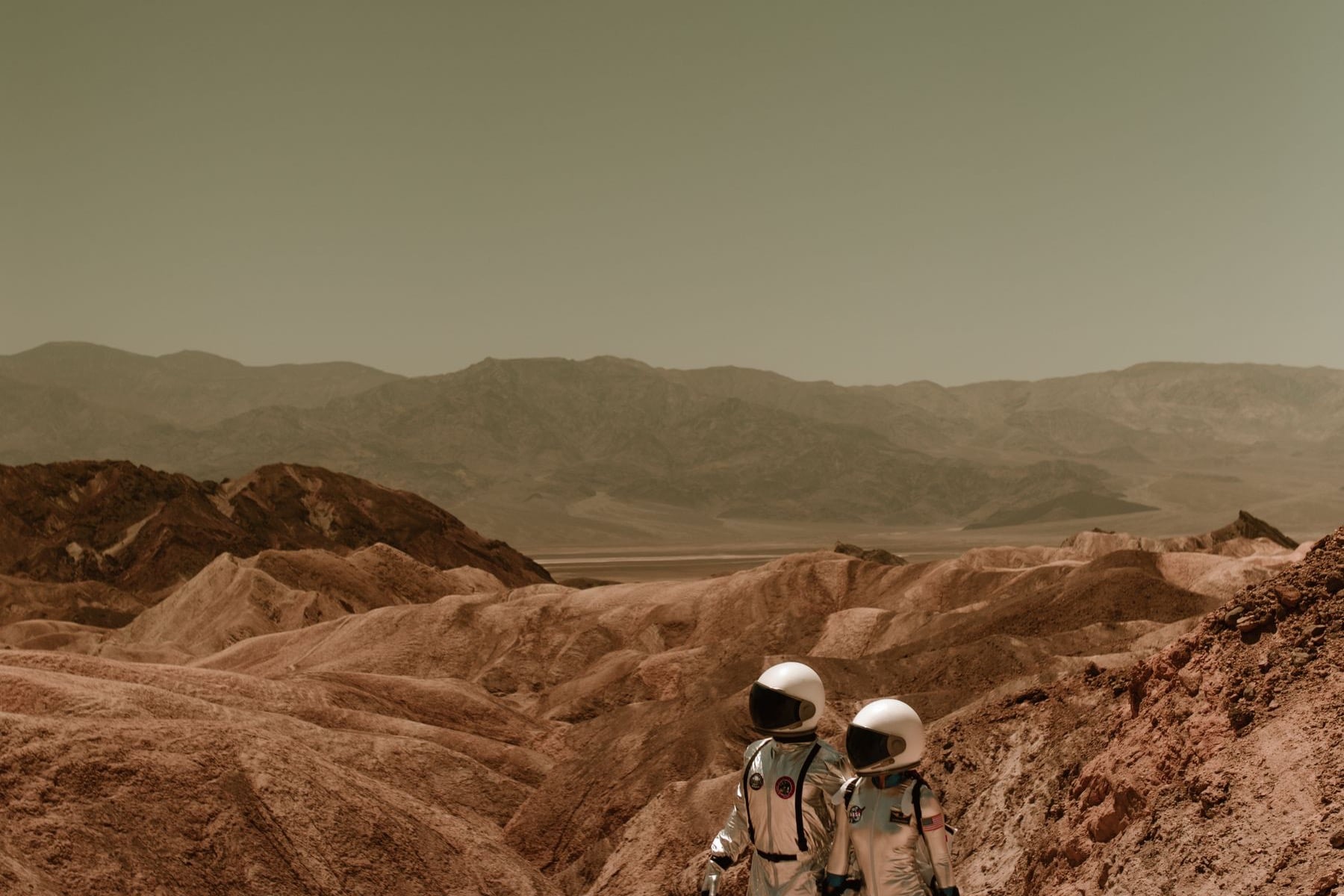
Perseverance and a crewed Mars expedition share a destination, but almost nothing else about their engineering or their accounting.
NASA’s inspector general listed the Mars 2020 mission at a planned life-cycle cost of about $2.7 billion. The Jet Propulsion Laboratory described the same scale as roughly $2.4 billion to build and launch Perseverance, plus about $300 million to land and operate it during the prime mission.
A serious human Mars campaign could require hundreds of billions of dollars across decades of development and multiple flights. The familiar $500 billion figure, however, is not NASA’s current fixed price for putting astronauts on Mars. It grew from older studies with broader scopes and very different architectures.
The gap is not created merely by replacing electronics with people. A rover can travel one way, work until it fails and remain where it stops. A crew must breathe, eat, sleep, stay healthy, survive equipment failures, leave Mars and return safely to Earth.
What Perseverance’s $2.7 billion bought
The NASA Office of Inspector General’s 2020 project summary gave Mars 2020 a planned life-cycle cost of $2.7 billion. This was not simply the price of the rover chassis.
JPL’s landing press kit broke the estimate into approximately $2.4 billion for building and launching the mission and about $300 million for landing and prime-mission operations. Ingenuity, originally carried as a separate technology demonstration, cost about $80 million to build and $5 million to operate.
The accounting represented the mission plan at the time, not every dollar that might be spent during an extended surface life. Perseverance has continued operating beyond its original prime period, so “$2.7 billion” is best treated as the planned life-cycle estimate attached to the launched project.
That money bought an interplanetary spacecraft, cruise stage, heat shield, supersonic parachute, powered descent stage, rover, science instruments, launch and years of engineering and operations. It produced a machine able to land itself, navigate Jezero Crater, drill rock cores and perform science without a human repair crew.
It did not buy a return journey. Perseverance carries no habitat, food store, medical facility, radiation shelter or Mars ascent vehicle. If a wheel, computer or power component eventually fails beyond recovery, no life depends on bringing the rover home.
A crewed expedition is really a sequence of missions
A human Mars architecture does not take a rover mission and add seats. It creates a chain in which the survival of one crew depends on equipment launched months or years earlier.
NASA’s Design Reference Architecture 5.0 envisioned a conjunction-class mission for six astronauts. The crew would spend about 180 days travelling to Mars, roughly 500 days on the surface and about 180 to 200 days returning. Total time away from Earth approached 900 days.
Cargo would leave first on slower, efficient trajectories. Surface systems could include a habitat, a nuclear power source, pressurised and unpressurised rovers, consumables and machinery to produce oxygen or ascent propellant from Martian resources. A vehicle capable of lifting the crew back into Mars orbit would need to be in place.
The crew should not depart Earth until the critical cargo had landed and demonstrated that it worked. That requirement alone turns the expedition into several launches, several interplanetary transfers and several Mars landings before people begin the journey.
Newer concepts make different trades. NASA’s 2021 architecture study examined a four-person round trip lasting roughly 760 to 850 days, with two astronauts spending only about 30 Martian days on the surface. It still required three pre-deployed descent systems, each delivering about 25 tonnes of useful cargo.
Neither design is a booked mission. They are reference architectures used to expose requirements and compare options. Their differences show why a cost cannot be settled before the mission itself is defined.
Humans turn consumables into systems
A rover does not need oxygen, water or food. People do, every day, for years.
Carrying all required water and oxygen would impose an enormous launch burden, so a crewed spacecraft would recycle them. That reduces consumables but adds pumps, filters, chemical beds, tanks, sensors, controls and power demand. It also adds spare parts and backup paths because a failure that is inconvenient aboard a robot can be fatal aboard a habitat.
NASA’s research on Mars life-support architecture shows how these choices spread through the mission. The degree of recycling affects consumable mass; maintainability affects spares; and all of that mass changes the transportation and propellant system needed to move it.
Food is harder to close into a loop. A multiyear supply must remain nutritious and acceptable, with reserves for delay. Waste management, hygiene, clothing, medical care and exercise equipment each add hardware or consumables.
The crew also needs volume. Living for nearly three years in a capsule sized for a few days would be physically and psychologically untenable. Larger pressurised habitats weigh more, require more shielding and present more equipment that must remain sealed and functioning.
Every kilogram creates more kilograms
Getting mass to Mars is only the first leg of the problem. Each added tonne can require more propellant, larger tanks and stronger structures. Those additions themselves weigh something and may force another launch.
Mars is particularly awkward for heavy landing. Its atmosphere is thick enough to create severe heating but too thin to slow a large spacecraft with parachutes alone. Perseverance’s sky crane delivered a rover of about one tonne. Human architectures discuss landing tens of tonnes at once, a capability that has never been demonstrated there.
Surface power must work through cold nights, dust and seasonal changes. The crew requires a habitat and mobility. If ascent propellant is manufactured from Martian material, the production plant must arrive first, receive power, run autonomously and fill the vehicle before people trust their return to it.
Then the ascent vehicle must launch from Mars, meet the interplanetary ship and begin the journey home. Earth return adds propulsion, navigation, thermal protection and recovery. A one-way mass estimate therefore expands through what NASA calls round-trip “gear ratios.”
Large-scale orbital refuelling may reduce the need for a single immense launch vehicle, but it creates another development programme. SpaceDaily’s earlier examination of Starship’s Mars refuelling problem described the missing demonstration: transferring hundreds of tonnes of cryogenic methane and oxygen between giant spacecraft in orbit.
Time, distance and risk all become budget lines
Efficient Mars departure opportunities recur about every 26 months. A delayed critical launch may not slide by a week; it can threaten an entire planetary window.
Once the crew departs, an emergency return is nothing like an evacuation from low Earth orbit. NASA’s current Moon to Mars architecture papers note that an abort in transit would take months, while early surface missions would have limited escape options.
That reality drives redundancy, qualification testing and conservative design. Equipment must endure launch, long dormancy, radiation, vacuum, Martian dust and repeated use without normal supply chains. Engineers must test not merely whether a component works, but how it fails and what the crew can repair.
Human health creates its own programme. Crews face galactic cosmic radiation, solar particle events, microgravity during transit, reduced gravity on Mars, isolation and a long delay before terrestrial medical help could matter.
Communication adds another kind of distance. As SpaceDaily explained in its look at the Earth-Mars radio delay, a round-trip exchange can take as long as 44 minutes and the Sun can interrupt contact near conjunction. The crew and onboard systems must diagnose and act without waiting for real-time instructions.
Confinement also changes behaviour. The 520-day Mars500 experiment found a general shift towards more sleep and rest among its six participants, described as behavioural torpor during simulated flight. A real mission would add danger, radiation and communication delay to the isolation.
Why a crewed Mars estimate can move by hundreds of billions
Cost follows scope. A short surface visit, a 500-day stay, a Phobos mission and a permanent base are not versions of the same purchase.
One study may count only hardware assigned directly to the first crew. Another may include heavy-lift rockets, lunar tests, nuclear propulsion, robotic scouts, surface-power development, later expeditions and 30 years of workforce and facilities.
Assumptions about reuse matter. So do launch price, the reliability assigned to commercial systems, the number of uncrewed demonstrations, international contributions, reserves for overruns and whether existing programmes are treated as free inherited infrastructure.
Faster transport may reduce radiation exposure and consumables but demand higher-energy propulsion. A long surface stay exploits efficient planetary geometry but requires more supplies and durable surface systems. Making one line cheaper can move cost and risk somewhere else.
NASA has an evolving Moon to Mars architecture, technology studies and objectives. It does not yet have a congressionally baselined human Mars expedition with final requirements, a launch manifest and a settled life-cycle price.
The $500 billion figure began as a much larger programme
NASA’s own history of the Space Exploration Initiative traces the famous number to 1989. President George H. W. Bush proposed Space Station Freedom, a return to the Moon and ultimately human exploration of Mars.
NASA’s 90-Day Study estimated the initiative’s long-term cost at approximately $500 billion over 20 to 30 years. That was a politically devastating number, but it was not a price quotation for one Mars landing. It covered a broad civil-space programme spanning station, lunar and Mars activity.
Technologies, vehicles and programme boundaries have changed since then. Inflation also means a nominal dollar from 1989 is not interchangeable with one today. Repeating “Mars costs $500 billion” strips away all of those qualifications.
The scale did not disappear with the old initiative. A 2015 JPL analysis, cited by NASA’s inspector general, estimated at least $430 billion from fiscal 2016 through 2046 for a minimum architecture. That campaign included a crewed Phobos mission, a month-long Mars surface stay and later one-year surface expeditions.
Again, the figure described 30 years of programme spending and several destinations, not the marginal bill for a single crew. It shows why hundreds of billions remains plausible without turning $430 billion or $500 billion into a universal answer.
“Hundreds of billions” is a scale, not a bid
The National Academies’ 2014 Pathways to Exploration assessment expressed the investment as a rough order of magnitude. It compared a Mars pathway with 75 to 150 flagship robotic spacecraft and with two to four times the roughly $150 billion US investment in the International Space Station.
Those comparisons deliberately avoid false precision. They describe a national programme sustained over decades. They do not predict what a particular reusable launcher, international partnership or surface architecture will cost in a future procurement.
Commercial launch systems and high flight rates could lower transportation prices. Reuse, orbital refuelling and manufacturing propellant on Mars could reduce the mass launched from Earth. More capable robotics may reduce precursor costs or allow a smaller crew.
None of those gains automatically removes life support, radiation protection, redundant power, heavy Mars landing, ascent or Earth return. A commercial claim may also exclude government-funded research, facilities, payloads and crew systems. Prices using different boundaries cannot be compared as if they were bids for identical work.
The fair comparison is capability, not passenger count
Perseverance shows how much science a carefully designed robot can deliver for several billion dollars. It has travelled kilometres, selected rocks, stored samples and worked for years without food, sleep or a return ticket.
Humans would bring flexible judgment, dexterity and the ability to change plans after seeing the terrain. They could maintain equipment and perform field geology at a pace no current rover can match. Those advantages arrive inside an entire survival and transport system.
The honest conclusion is not that a Mars crew will cost exactly $500 billion. No current baselined NASA expedition has a settled price, and the best-known historical numbers usually describe multidecade exploration programmes rather than one voyage.
It is reasonable to say a serious human Mars effort could cost hundreds of billions. It is not reasonable to present one old round number as an invoice. The uncertainty remains large, but so does the fundamental difference between sending a machine and promising to bring people home.