

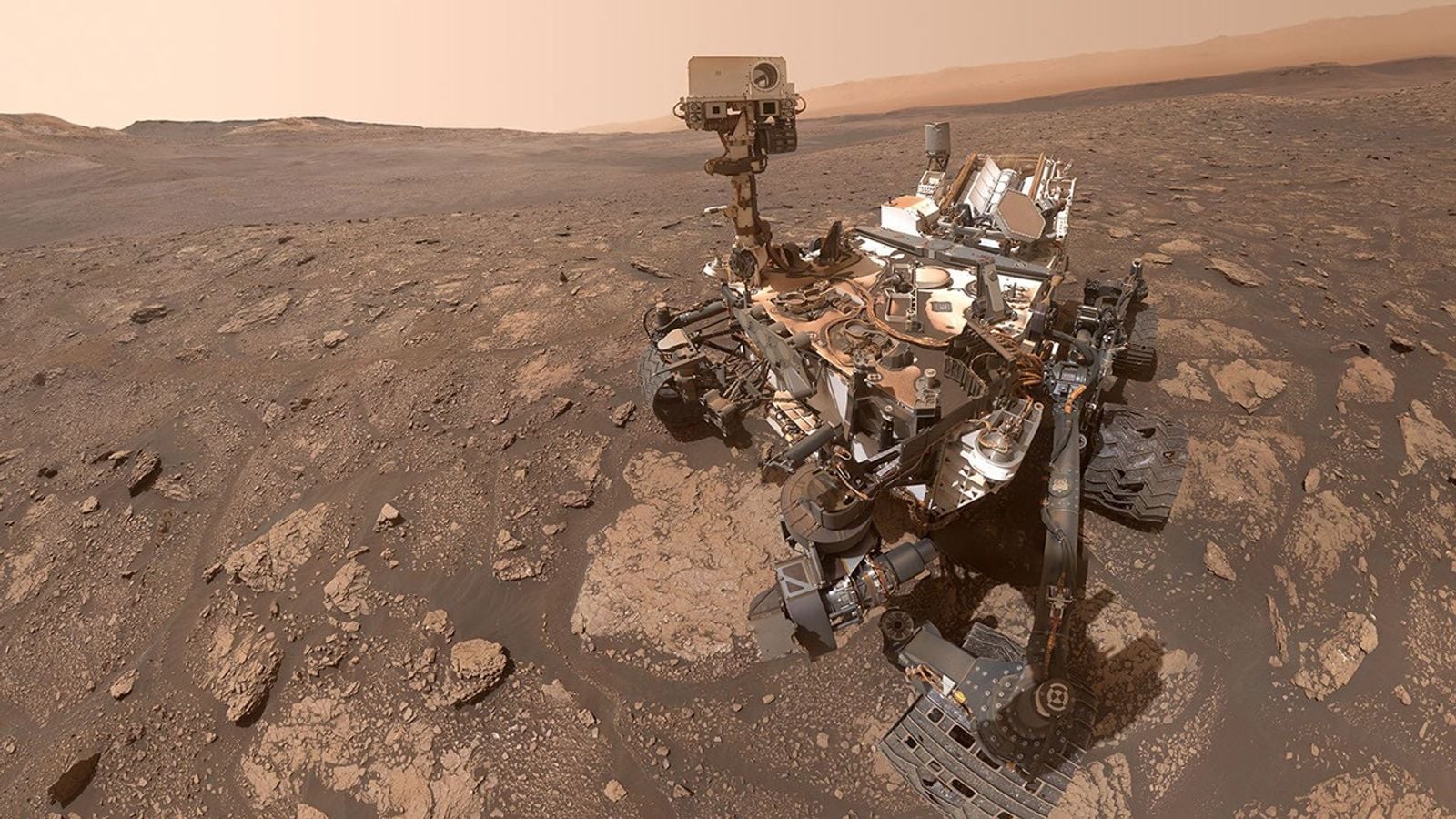
Mars did not become the cold, thin-aired planet Curiosity explores today in one clean catastrophe. Its internally generated global magnetic field faded, its atmosphere was eroded and transformed, and much of the water that once moved across its surface escaped, froze or became bound inside minerals.
Yet a clay-bearing sandstone deposited about 3.5 billion years ago retained a surprisingly readable chemical record. In a 2026 analysis, NASA’s Curiosity rover revealed more than 20 organic molecules from a drilled sample called Mary Anning 3 in Gale Crater. NASA’s public inventory counted 21 carbon-containing molecules, seven of them not previously detected on Mars.
The collection included aromatic, sulfur-bearing, oxygen-bearing and nitrogen-bearing products. One signal was consistent with a possible nitrogen heterocycle, a ring built from carbon and nitrogen. Nitrogen heterocycles belong to the broad family of structures used in RNA and DNA chemistry on Earth.
That is not the same as finding RNA, DNA or evidence of life. “Organic” means carbon-containing, not biological. The durable discovery is that a rock from a vanished wet environment kept a complex organic archive through roughly three-quarters of Mars’s history.
The rock came from a world in transition
Curiosity drilled Mary Anning 3 in October 2020 in Glen Torridon, a clay-rich region on the lower slopes of Mount Sharp. Sedimentary layers show that lakes and streams repeatedly occupied this part of Gale Crater, sometimes filling and drying as the local environment changed.
The sandstone belongs to the roughly 3.5-billion-year-old Knockfarrill Hill member. That age places it near a profound planetary transition. Remanent magnetism in old Martian crust shows that Mars once had a global dynamo generated within its interior. The field had ceased more than 3.5 billion years ago, with a commonly cited estimate near 3.7 billion years.
Losing the dynamo did not make the atmosphere disappear overnight. It removed planet-wide magnetic shielding and allowed the solar wind to interact more directly with the upper atmosphere. Measurements by NASA’s MAVEN mission show that escape to space became an important part of the loss, especially under the more active young Sun. MAVEN found that most of the gas once present has been lost, although atmospheric escape was not the only process involved.
Impacts, early hydrodynamic escape, chemical reactions with the crust, freezing and burial all helped redistribute or remove volatile material. Surface water also persisted regionally after the global climate had begun deteriorating. The planetary story is a long overlap, not a tidy sequence in which the field vanished one day and every lake vanished the next.
Clay turned a lakebed into storage
Clay minerals are valuable targets because organic material can attach to their large, reactive surfaces or become enclosed as sediment is compacted into rock. That mineral association can limit exposure to oxidants and radiation, both of which break carbon compounds apart near the Martian surface.
Preservation does not mean the original molecules remained untouched. The Mary Anning material endured burial, groundwater chemistry, rock-forming processes and billions of years of ionising radiation. What survived was more like a weathered document than a sealed time capsule.
That distinction matters. Curiosity did not recover an intact biological system or even a set of pristine molecules exactly as they existed in the ancient lake. It recovered chemical products that reveal something about larger organic material still held in the sandstone.
As SpaceDaily previously explored in tracing the fate of Martian water, “lost” does not always mean removed from the planet. Some water escaped to space, while a substantial share may remain as ice or chemically bound in the crust. The sandstone is another version of that principle: the surface environment vanished, but part of its chemistry stayed behind.
Curiosity had to dismantle the archive to read it
The rover did not pull 21 intact molecules from the rock and inspect them directly. Its Sample Analysis at Mars laboratory, known as SAM, received about 163 milligrams of powdered Mary Anning 3 material in a small cup containing tetramethylammonium hydroxide, or TMAH.
When heated to roughly 550 degrees Celsius, TMAH can cleave large, resistant organic networks and convert some products into forms that pass through a gas chromatograph. The chromatograph separates compounds by the time they take to move through a coated column. A mass spectrometer then breaks them into charged fragments and records their mass pattern.
This was the first TMAH wet-chemistry experiment conducted on another planet. It revealed molecules that had been absent or far less apparent when a related Mary Anning sample was simply heated. The result supports the interpretation that many of the small products were cut from a larger, macromolecular source preserved inside the rock.
The open-access paper in Nature Communications reported more than 20 aromatic and cyclic organic products. Robust identifications included methyl benzoate, naphthalene and benzothiophene. Benzothiophene, which contains sulfur, was confirmed on Mars for the first time and is the largest underivatised aromatic molecule yet identified there as indigenous.
Twenty-one molecules does not mean 21 equally certain names
NASA’s count is accurate as a public summary, but the signals have different confidence levels. Some compounds were confirmed by their mass spectra and chromatography. Sixteen peaks in one chromatogram remained unidentified, although their fragments allowed the researchers to describe likely features such as methylated benzene rings, alcohol or amine groups, and one-ring or two-ring aromatics.
Abundances were tiny, ranging from about 0.1 to 1.7 nanomoles for individual products. The experiment was sensitive enough to detect them, but not powerful enough to reconstruct every parent molecule from which they came.
This is why the language of a “chemical archive” is useful if handled carefully. An archive can contain missing pages, damaged words and later annotations. The Mary Anning rock retained enough structure to show chemical diversity, but not enough to supply an unambiguous history for every signal.
The nitrogen ring is possible, not fully identified
The most-discussed nitrogen-bearing signal was labelled peak 22. Its mass spectrum most closely resembled dimethyl-indole, a fused double-ring molecule containing nitrogen. The major fragment pattern offered a strong library match.
Chromatography provided an independent check, and the timing did not line up. Dimethyl-indole emerged from a comparison column after 20.7 minutes, while the Martian candidate appeared after about 17.0 minutes. The authors therefore stopped short of naming it dimethyl-indole and described the result as the first detection of a possible nitrogen heterocycle on the Martian surface.
The method adds another caution. TMAH contains nitrogen and actively reacts with the sample during heating. The nitrogen-bearing products may have formed when the reagent met a larger Martian organic precursor, rather than being pristine molecules extracted unchanged. The paper also says a contribution from SAM’s internal hydrocarbon trap cannot be completely excluded.
That does not erase the result. A reaction still requires compatible starting material in the sample, and the wider suite independently supports preserved macromolecular carbon. It does mean the detector recorded a product of sample chemistry and laboratory chemistry together.
A previous SpaceDaily analysis examined this nitrogen signal in detail. The conclusion remains deliberately narrow: it is a plausible member of a chemically important family, not a completely identified Martian nucleobase.
RNA and DNA provide context, not an identification
The nucleobases that encode genetic information in RNA and DNA contain nitrogen heterocycles. Adenine and guanine have fused rings; cytosine, thymine and uracil use single rings. This architecture makes nitrogen-bearing rings central to terrestrial biochemistry and to laboratory studies of how life’s chemistry might begin.
The Curiosity candidate is not one of those bases. It is not RNA, DNA or a fragment that uniquely points to either molecule. Its relevance is architectural: the preserved organic source could generate a nitrogen-bearing ring within the same broad chemical landscape used by biology on Earth.
“Prebiotic” can be misleading when it is read as “nearly alive.” It means chemistry relevant to stages before biology. Many prebiotic compounds form without organisms, and nitrogen heterocycles occur in carbon-rich meteorites. Finding the architecture establishes chemical possibility, not a biological source.
Meteorites and geology remain sufficient explanations
Early Mars was bombarded by carbonaceous meteorites carrying organic material formed before planets existed. To test how such matter behaves in the instrument, the team exposed a piece of the Murchison meteorite to comparable TMAH treatment. Sixteen of the 28 species confirmed or tentatively identified in the flight experiment also appeared in the Murchison work.
The overlap does not prove that meteorites supplied all of Mary Anning’s carbon. It shows that old, non-biological extraterrestrial material can yield a remarkably similar molecular mixture. Benzothiophene, for example, is known from meteoritic macromolecular carbon.
Mars can also manufacture organics through water-rock reactions, serpentinisation, electrochemical reduction of carbon dioxide and other abiotic pathways. Ancient biology remains one possible origin, but the experiment cannot distinguish it from delivery or geology. None of the reported molecules requires life.
This is the boundary that organics stories often blur. A potentially habitable environment, carbon compounds and chemistry related to life’s toolkit are necessary ingredients for a biological history. They are not, separately or together, proof that biology occurred.
What survived may matter more than what was lost
The firmest conclusion from Mary Anning 3 is preservation. Diverse organic matter, probably including a larger macromolecular network, remained detectable in shallow Martian bedrock after more than 3.5 billion years of geological alteration and radiation exposure.
That changes the practical search. If chemical information can survive a few centimetres below the surface, material reached by deeper drills may be better protected still. ESA’s Rosalind Franklin rover is designed to drill as deep as two metres and carries the Mars Organic Molecule Analyser, a next-generation instrument with wet-chemistry heritage from SAM.
Returned samples would go further. Earth laboratories could examine molecular structures, isotope ratios, chirality and microscopic associations between organics and minerals using several independent techniques on the same grains. Converging patterns, rather than one familiar-looking molecule, could begin to separate meteorite delivery, Martian geology and ancient biology.
The wet world around Gale Crater did not survive. Nor did its atmosphere, climate or magnetic shelter remain as they were. The sandstone did not preserve that world intact, but it kept a damaged chemical memory of it. Curiosity’s achievement was finding a way to open the rock and read part of what remained.