

Venus hides a rocky landscape beneath clouds bright enough to make it the most conspicuous planet in Earth’s sky. At ground level, though, there is nothing gentle about it. The atmosphere bears down at about 92 times Earth’s sea-level pressure, while the average surface temperature sits near 465°C.
Those figures are usually translated into two familiar comparisons. The pressure is close to what a diver or submersible would encounter roughly 900 metres beneath the ocean. The heat is far above the melting point of lead.
Both comparisons are sound, within the rounding used for planetary averages. They also need boundaries. The first compares pressure, not the way it would feel to move through the surrounding fluid. The second concerns pure metallic lead, not every mineral containing a lead atom. Venus becomes stranger, and more instructive, when those distinctions are kept intact.
How 92 bar becomes 900 metres of ocean
ESA describes the Venusian surface as an environment near 465°C with a pressure equivalent to being 900 metres underwater. The arithmetic comes from the weight of the material above.
In the sea, pressure rises with depth according to the density of the water, gravity and the height of the water column. Nine hundred metres of seawater adds about 90.5 bar. Add the atmosphere pressing on the ocean’s surface and the total is close to 91.5 bar, comfortably within the precision of the Venus comparison.
A small numerical wrinkle explains why reputable sources variously say 90, 92 or 93 times Earth pressure. Venus’s mean surface pressure is commonly rounded to 92 bar. One bar is 100,000 pascals, while one standard Earth atmosphere is slightly larger at 101,325 pascals. Dividing by one convention or the other, then rounding a planetary average, changes the headline number without changing the physical picture. NASA’s current Venus facts, for example, uses about 93 times and more than 900 metres underwater.
Pressure does not merely push down. In a fluid it acts in every direction. On each square metre, 92 bar corresponds to about 9.2 million newtons of force, roughly the weight of 940 tonnes under Earth gravity. A pressure vessel is not simply carrying that weight on its roof, however. What matters structurally is the pressure difference between outside and inside, applied across the entire shell.
The underwater analogy stops at the load
The image of standing on an ocean floor can mislead if it is extended too far. Seawater is about a tonne per cubic metre. Venus’s near-surface atmosphere is far less dense, so it would not produce the same buoyancy or resistance to movement as water at 900 metres.
Calling the surrounding material an ordinary gas is not quite adequate either. Carbon dioxide’s critical temperature and pressure are far below Venusian surface conditions. Once both thresholds are exceeded, there is no sharp boundary at which the substance switches between a conventional gas and liquid.
NASA describes the lower atmosphere as supercritical carbon dioxide, only about one-twelfth as dense as liquid water and behaving more like a hot liquid than a familiar gas. It is a dense, flowing fluid that fills valleys and moves around rocks, but it is not a carbon-dioxide ocean with a surface.
This distinction matters to engineering. A descent vehicle encounters growing drag as it drops, and the thick atmosphere can do much of the work of slowing it. A machine on the ground must resist enormous pressure, but wheels, arms and winds interact with a medium much less dense than seawater.
Why a bright planet becomes the hottest planet
Venus’s atmosphere is about 96 percent carbon dioxide. The pale sulphuric-acid clouds above are highly reflective, so the planet sends much of the incoming sunlight back to space. A bright planet need not be a cool one, however. What reaches and warms the lower atmosphere and surface has great difficulty escaping again as infrared radiation through the immense carbon-dioxide column.
The result is a greenhouse effect strong enough to make Venus hotter at the ground than Mercury, even though Mercury orbits much closer to the Sun. NASA gives Venus a mean surface temperature of 464°C. The familiar 465°C figure is a sensible rounded value, not a promise that every rock on the planet is at precisely the same temperature.
Altitude still matters. Higher terrain is cooler than the lowlands, and ESA measurements over parts of the southern hemisphere found differences of about 30°C between low ground and mountain tops. What Venus largely lacks is the relief offered by night. Venus Express found no day-night variation in surface temperature in its observations, despite the planet’s extraordinarily slow rotation.
The lower atmosphere stores and transports heat too effectively for sunset to bring an Earth-like cool-down. That is the important sense in which the heat is permanent for exposed surface material. A lander cannot wait for night and expect an easier environment.
Yes, pure lead would remain molten
NIST’s thermochemical tables place the melting point of pure lead at 327.426°C. A representative Venus surface temperature of 465°C is about 138 degrees higher. Give a piece of pure lead enough time to reach equilibrium with the lower atmosphere and it will be liquid.
“Hot enough to melt lead” is a thermometer comparison, not a report that spacecraft have discovered lead rivers. There is no reason to expect large exposed stocks of pure elemental lead at the surface. Rocks contain compounds and mixtures whose melting, boiling and condensation behaviour can be radically different from that of the isolated element.
This is why the comparison does not conflict with Space Daily’s earlier look at possible metallic frost on Venus’s mountains. That hypothesis concerns volatile lead- and bismuth-bearing compounds that might condense on cooler high terrain and produce bright radar reflections. It is not a claim that beads of pure lead freeze on the peaks while lead oceans spread below. Even the composition of the radar-bright coating remains unconfirmed.
Nor does every spacecraft simply melt on contact. Many structural metals and ceramics tolerate temperatures above lead’s melting point. The immediate design questions are whether a hull can resist pressure, whether seals and joints retain their properties, and how long insulation can delay heat from reaching more vulnerable components.
Why Venus landers are measured in minutes
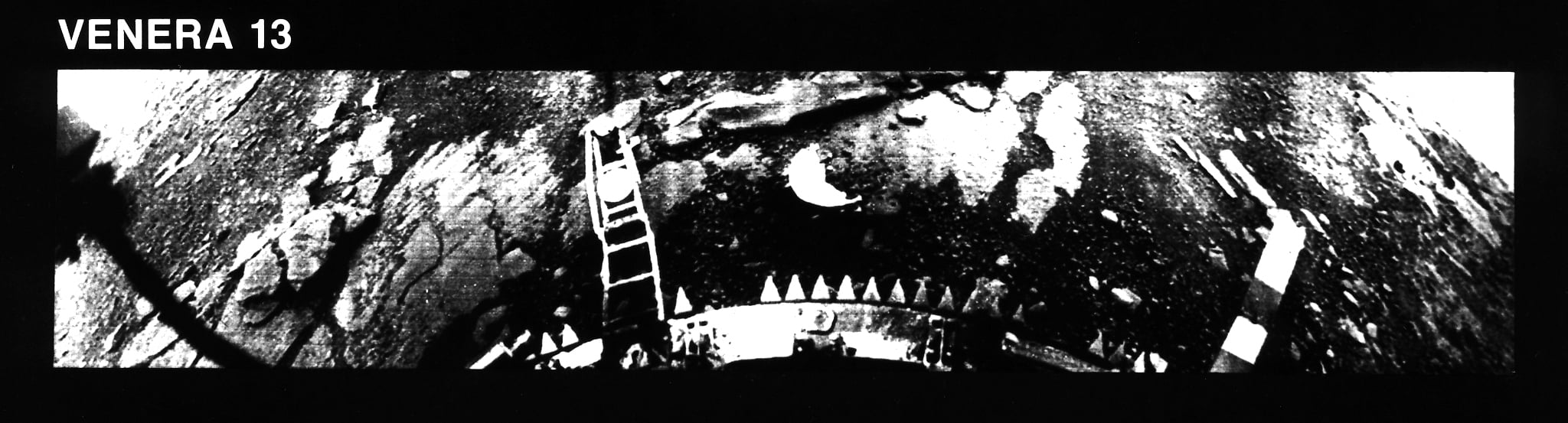
The Soviet Venera and Vega probes demonstrated that 92 bar is survivable for carefully built machinery. They returned measurements and images from the ground, including the Venera 13 panorama used with this article. Their achievement also revealed the limit of a lander that carries ordinary electronics inside a protected pressure shell.
NASA records surface operating lives of 23 to 127 minutes for the successful robust landers. Venera 13 holds the endurance record. The machines did not disappear in a puddle. Heat steadily penetrated their insulation until internal electronics could no longer function.
Pressure and temperature create different problems. A strong, often rounded vessel can distribute an external load. Heat is persistent transport of energy. It travels through the shell, along wiring and across joints. Batteries, memory, sensors, lubricants and gaskets each have their own failure temperatures. Cooling buys time, but a finite cold reservoir eventually warms unless the vehicle can reject heat into an environment already hotter than its desired interior.
That is why current Venus technology work does not rely only on stronger walls. NASA teams have tested silicon-carbide electronics, high-temperature memory, batteries, actuators and sealing materials in chambers that reproduce the planet’s pressure, temperature and reactive atmosphere. The goal is to let more of a machine operate hot rather than preserve a small room-temperature sanctuary indefinitely.
The same percentage can hide a different planet
Most of Venus’s pressure comes from the sheer mass of its carbon-dioxide atmosphere. Composition percentages alone can obscure this. As a previous Space Daily comparison of Mars and Venus noted, both atmospheres are about 96 percent carbon dioxide. Mars nevertheless has a surface pressure well below one percent of Earth’s, while Venus carries a column roughly 92 times heavier than Earth’s sea-level air.
The difference is not that a carbon-dioxide molecule behaves one way on Mars and another way on Venus. It is the inventory. Venus retained or acquired an enormous atmosphere; Mars did not. On Venus, that deep column supplies both the crushing surface pressure and the infrared opacity behind the intense greenhouse warming.
Pressure by itself is not a complete explanation for the heat. Compressing a gas can warm it temporarily, but the persistent surface climate depends on the planet’s energy balance, radiative absorption, convection and atmospheric circulation. Equally, carbon dioxide’s percentage is not enough. The total amount above each square metre is crucial.
How Venus reached this endpoint is still unsettled
The measured present is much firmer than the reconstructed past. Venus may once have held surface water, but simulations disagree over whether oceans could condense and, if they did, how long temperate conditions could persist.
Space Daily recently examined NASA climate simulations in which an assumed early ocean survived for nearly three billion years. Those runs show one physically plausible path, not a recovered weather record. Other modelling starts Venus under a steam atmosphere and finds that clouds fail to cool the dayside enough for an ocean to form.
That uncertainty does not weaken the surface measurements. Probes directly sampled the atmosphere and endured the pressure; orbiters have mapped the thermal emission and topography. The open question is the route from an early rocky planet similar in size to Earth to the dry, carbon-rich world now observed.
Two comparisons, used carefully
The ocean-depth analogy tells an engineer how serious the external pressure load is. It does not turn the lower atmosphere into seawater. The lead analogy tells a reader where 465°C sits on a familiar material scale. It does not imply a planet paved with molten metal.
Venus needs both comparisons because either number alone is incomplete. A deep terrestrial ocean is cold. A furnace on Earth usually operates under ordinary air pressure. Venus combines an ocean-depth load, industrial-furnace heat and a chemically alien supercritical fluid across almost its entire surface, without a cool night in which exposed hardware can recover.
That combination explains the planet’s peculiar status in exploration. Landing is possible, and it has been done repeatedly. Remaining functional is the frontier. The distance from 127 minutes to months is not mainly a navigation problem. It is the slow, unforgiving problem of building a machine that can become part of Venus’s hot environment without ceasing to be a machine.