

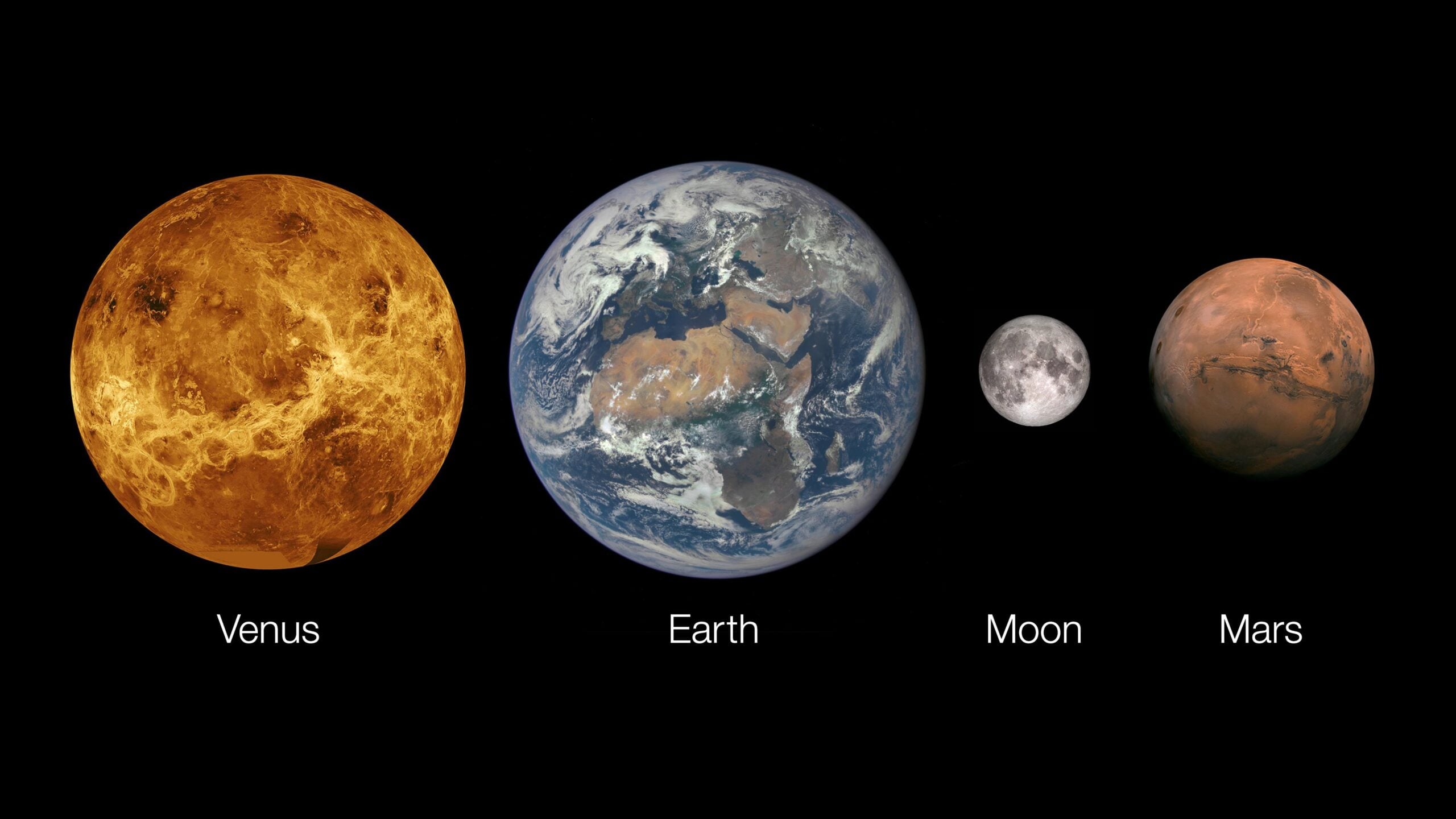
Venus now offers one of the Solar System’s sharpest warnings about the power of an atmosphere. Carbon dioxide presses down at roughly 93 times Earth’s sea-level pressure, while the average surface temperature reaches about 467°C. Yet one family of NASA climate simulations produces a radically different earlier world: oceans under a bright cloud shield, with global mean temperatures in representative cases falling roughly between 20 and 50°C.
The result is compelling because it gives that temperate phase extraordinary longevity. It is also easy to overread. The model does not establish that Venus had an ocean. It asks whether an ocean-bearing Venus could remain clement if liquid water formed early, and it finds that such a climate could be viable for nearly three billion years.
That conditional result comes from a broad modeling program, not a geological record. No lander has drilled an ancient Venusian seafloor, no returned rock has been dated, and no climate model can choose its own initial conditions from observations that do not yet exist. This is one modeling family, not settled history.
The experiment begins by giving Venus water
Michael Way and Anthony Del Genio used NASA’s ROCKE-3D general circulation model to run 45 experiments across hypothetical stages of Venusian history. The NASA Goddard Institute for Space Studies account describes variations in surface pressure, atmospheric composition, land and sea arrangement, topography, soil, rotation and the amount of sunlight reaching the planet at different ages.
The decisive assumption comes before those simulated climates begin. In the optimistic path, Venus’s primordial magma ocean cools in only a few million years. Steam condenses as rain, and liquid water collects at the surface. In the pessimistic path, the molten phase lasts perhaps 100 million years. Water remains aloft, ultraviolet light separates it into hydrogen and oxygen, much of the hydrogen escapes, and an enduring ocean may never appear.
The published 2020 study in JGR: Planets tests the first path. Its key result is therefore about persistence, not origin: once surface liquid water is supplied, the increasing brightness of the Sun does not automatically sterilize a slowly rotating Venus.
Some runs used Magellan-based Venus topography, while others tested an Earth-like arrangement or an idealized water world. Oceans ranged from shallow water distributed across low ground to much deeper reservoirs. Nitrogen-dominated atmospheres, different pressures and small amounts of carbon dioxide helped reveal which combinations remained stable rather than prescribing a single lost Venus.
A 117-day solar day builds a bright cloud shield
Venus rotates once relative to the stars in 243 Earth days and does so backwards compared with most planets. Because it also moves around the Sun, noon to noon lasts about 117 Earth days. One place can face daylight for nearly two months before night arrives.
That slow rhythm changes the climate response. Long heating over the dayside drives warm, wet air upward. As it rises and cools, water condenses into a persistent bank of thick clouds near the point facing the Sun. Those clouds reflect a substantial fraction of incoming energy back to space before it can heat the ground and ocean.
This dayside cloud feedback allows an imagined wet Venus to handle more sunlight than a faster-spinning world with a less organized cloud cover. The same slow planet nevertheless has an atmosphere that races around it today. SpaceDaily’s look at Venus’s long day and four-day cloud circulation explains why rotation of the solid planet and motion of its modern clouds are different clocks.
The model does not claim that today’s sulfuric-acid cloud deck once behaved exactly like water clouds. It calculates an earlier atmosphere whose ocean supplies abundant water vapor. The protective cloud shield is an output of that assumed wet system.
What the temperature and timespan actually mean
The headline’s 20 to 50°C range is a rounded description of global mean surface temperatures in representative modeled scenarios. It is not a thermometer record, and it does not mean that every location stayed within that band. Individual grid cells, seasons and atmospheric choices can be cooler or hotter than the planetary average.
Nor did one simulation march continuously through three billion years of evolving geology and chemistry. The team modeled climate snapshots under solar brightness appropriate to selected epochs, including conditions billions of years ago and a case around 715 million years ago. Stable results at those separated ages support a potentially long-lived interval between them.
“Potentially habitable” has a similarly bounded meaning. In this work it means temperatures and pressures permitted liquid water at the surface. It does not mean Venus was inhabited, that nutrients were available, or that any organism survived there. The simulation concerns climate habitability, not a biological detection.
These distinctions also sharpen the larger planetary comparison. As SpaceDaily reported in its examination of how Earth and Venus took different paths, the neighboring worlds are close in size and bulk composition, yet sparse evidence leaves the timing and cause of their climatic split unresolved.
The volcanic catastrophe is a proposed ending
A stable ocean still needs an exit route to reach modern Venus. Way and Del Genio suggested that immense volcanic outpourings could supply it. If several large igneous provinces erupted within a geologically short interval, they could release carbon dioxide faster than silicate weathering and other surface sinks removed it.
As the atmosphere thickened, greenhouse warming would accelerate evaporation. Water vapor would add more warming, sunlight would break molecules high in the atmosphere, and hydrogen could escape to space. With liquid water disappearing, the rock-weathering process that had helped regulate carbon dioxide would weaken. The climate could then cross into the hot, dry state seen today.
The date near 700 million years is tied to the approximately 715-million-year climate snapshot and to older estimates that much of Venus was resurfaced around that era. It is not a precisely dated planetary eruption. Modern interpretations increasingly allow a patchwork of surface ages and continuing volcanism rather than one instantaneous global repaving.
The volcanic ending is a hypothesis attached to the climate scenario, not an eruption reproduced by the climate model. A later NASA study found that clusters of very large eruptions could plausibly destabilize a wet climate, but plausibility is not proof that this sequence occurred on Venus.
A different model never makes the ocean
The strongest challenge begins earlier. A 2021 Nature study led by Martin Turbet started with the hot steam atmosphere expected after a magma ocean rather than placing liquid water on the surface. In those simulations, water vapor moved toward the nightside and formed high clouds there.
Cloud location reversed the effect. Instead of creating a bright dayside shield, the nightside clouds trapped outgoing infrared energy. Even under the fainter young Sun, the surface did not cool enough for steam to condense into rainfall and oceans. Venus remained too hot from the beginning.
The two studies are not simply numerical votes on the same experiment. The NASA work asks whether an ocean, once formed, could persist. The later work asks whether a hot young Venus could cross the condensation threshold required to form that ocean. Their opposing results show why the planet’s poorly known first tens of millions of years matter so much.
A dry interior adds a newer constraint
Atmospheric chemistry now supplies another argument against an ocean-bearing past. A 2025 Nature Astronomy analysis estimated the gases modern volcanism must restore after sunlight and chemical reactions destroy them. The inferred volcanic mixture contained at most about 6 percent water by mole, far drier than typical terrestrial volcanic gases.
If present Venusian magma is representative of the deep interior, such dryness is easier to reconcile with a planet that lost water before it could be incorporated into the mantle. That would favor the never-ocean path. It is a serious constraint, but it is indirect: no instrument has sampled fresh Venusian magma and measured its water content in place.
The inference depends on atmospheric lifetimes, chemical replenishment and the assumed relationship between modern gases and long-term interior history. An interior can also evolve. The result narrows the plausible stories without converting one of them into an observation.
Modern Venus preserves effects, not a full timeline
Present conditions prove that Venus experienced enormous atmospheric change relative to any temperate scenario. Its carbon dioxide blanket, sulfuric-acid clouds and lead-melting surface are real measurements. The enhanced ratio of heavy hydrogen to ordinary hydrogen also indicates substantial water loss because lighter hydrogen escapes more readily.
Those clues do not uniquely reveal how much water existed, whether it was an ocean or steam, or when it was lost. A high deuterium-to-hydrogen ratio can be compatible with an ancient ocean, but it can also record escape from the primordial steam phase before condensation.
Atmospheric escape alone does not explain every contrast among rocky planets. SpaceDaily’s comparison of the carbon-dioxide atmospheres of Mars and Venus shows how gravity, interior outgassing, surface reactions and solar forcing shape the amount of gas that remains as well as its composition.
Radar has revealed young-looking lava flows, deformed highlands and possible recent volcanic changes, but radar brightness is not a chemical assay and crater counts are not laboratory dates. The geological evidence has not yet fixed the moment when any hypothetical ocean vanished.
Future measurements can distinguish the histories
NASA’s DAVINCI mission is designed to descend through the atmosphere while measuring noble gases, isotopes, chemistry, pressure, temperature and winds. Noble gases can retain information about formation and escape that reactive molecules lose. The probe is also intended to image Alpha Regio, an ancient-looking highland whose rocks may preserve clues to interactions with water.
Global radar and spectroscopy from future orbiters can test whether Venus was resurfaced in one catastrophic interval or through prolonged regional activity. Surface mineralogy could identify rocks altered by water, while better topography and gravity data can constrain crustal history. None is a simple ocean detector, but together they can eliminate combinations of assumptions that current models leave open.
For now, the NASA result remains both striking and carefully limited. A wet early Venus can stay temperate in a physically sophisticated climate model despite intense sunlight, and its slow rotation provides a credible cooling mechanism. The missing step is evidence that the planet ever entered that wet state. Until measurements settle that question, the three-billion-year ocean is a viable Venus, not yet the known Venus.