

NASA has funded work on the Helicity Drive, but it has not ordered a fusion rocket, approved a crewed mission or concluded that Mars can be reached and left again in four months.
What the agency awarded was a Phase I grant through NASA Innovative Advanced Concepts, known as NIAC. The programme exists to test unusually ambitious ideas while they are still cheap enough to question. In this case, the idea is a compact, pulsed fusion system that would produce both propulsion and electrical power.
The distinction is easy to lose because the developer’s performance claim is extraordinary. Helicity Space says a large version of its drive could carry 450 tonnes of payload to Mars and back in less than four months. That is shorter than the upper end of the time NASA commonly gives for a one-way Mars transit. It is also a theoretical mission result from the company, not a journey time validated by NASA.
NASA bought a nine-month study, not an engine
NASA announced the 2025 NIAC selections on 10 January 2025. Fifteen Phase I concepts shared a combined maximum of $2.625 million. Setthivoine You of Helicity Space led the selected proposal, titled Fusion-Enabled Comprehensive Exploration of the Heliosphere.
A NASA technical overview describes Phase I as a nine-month investigation of overall viability. Researchers examine the physics, identify limitations, define a reference mission and decide what development would have to follow. Later NIAC phases are separately competed; advancing from one phase to another is not automatic.
NASA’s language is unusually helpful here. The agency says all NIAC studies are at an early conceptual stage and are not official NASA missions. That applies to the Helicity work as directly as it applies to the other ideas in the same cohort.
The funded mission is aimed beyond the planets
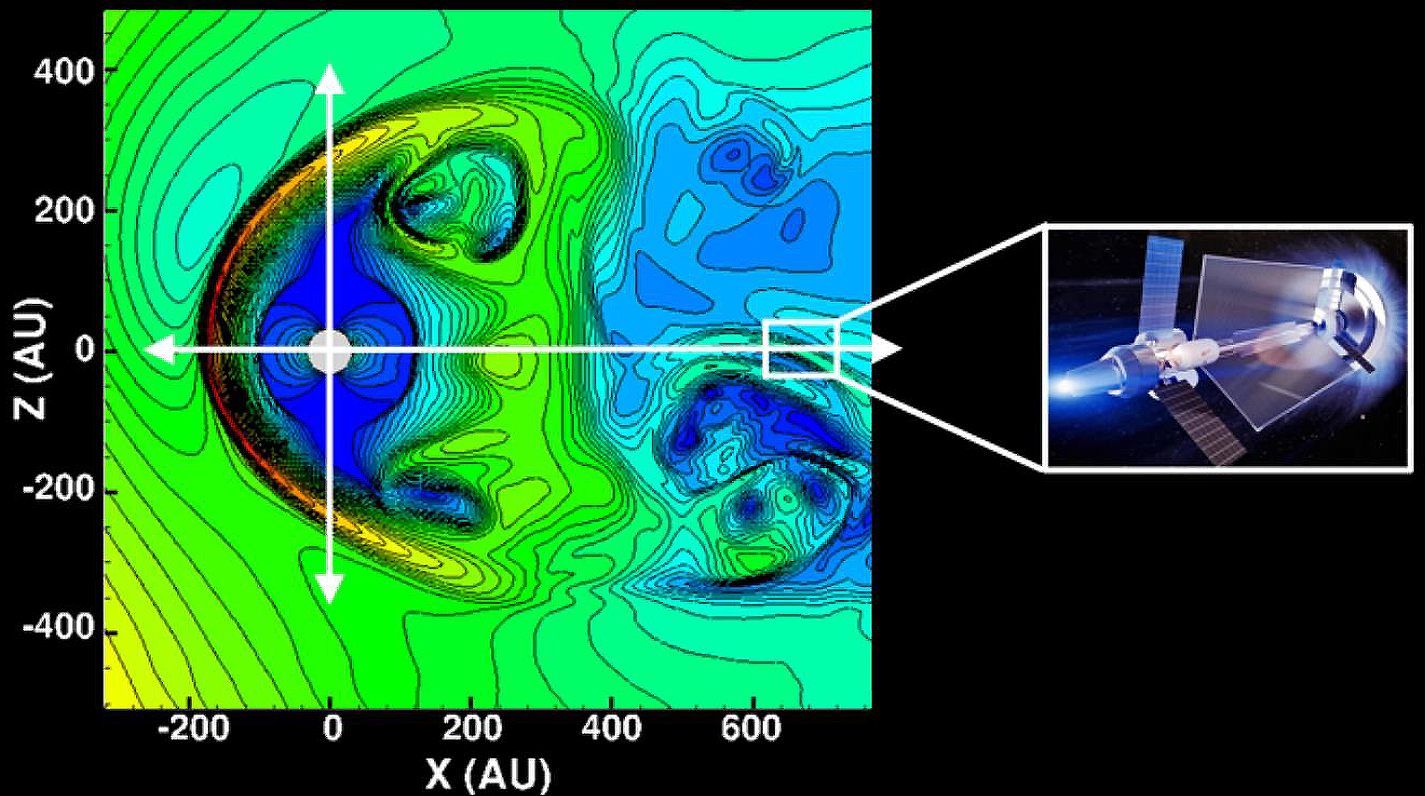
The reference mission is not actually a rapid crewed round trip to Mars. In the NASA description of the study, Helicity Space proposes a constellation of six robotic spacecraft travelling in different directions through the heliosphere, the bubble shaped by the solar wind, and eventually into the local interstellar medium.
The study includes modelling, experimental validation of thrust and power, a spacecraft architecture, scientific instruments and mission operations. A high-delta-v drive would let the probes accelerate, slow near regions of interest and accelerate again. Mars is mentioned as a later application that might benefit if the propulsion physics and engineering prove workable.
That choice of reference mission is sensible. A fusion drive is potentially most valuable where chemical propulsion and low-thrust electric systems make travel slow or operationally restrictive. It also means the grant should not be described as NASA funding a four-month Mars mission. NASA is funding a feasibility study whose results may inform deep-space propulsion.
A four-stage route from plasma to thrust
The Helicity Drive is a magneto-inertial fusion concept. It sits between large, continuously confined plasmas such as those in tokamaks and the tiny, rapidly compressed targets used in inertial fusion experiments.
An American Physical Society conference abstract lays out four intended stages. Plasma guns first produce several twisted, magnetised structures called plectonemic Taylor states inside helical jets. Those structures merge into one jet, releasing magnetic energy as heat through reconnection. A sequence of magnetic coils then compresses the plasma toward fusion conditions. Finally, the hot plasma expands through a magnetic nozzle, producing thrust and potentially electricity.
Helicity Space argues that a pulsed system could begin producing some thrust before it reaches the net-gain conditions expected of a terrestrial power plant. That is plausible as a design objective because a rocket values directed momentum as well as recoverable electricity. It does not remove the need to account for the energy supplied to each pulse, the efficiency of the system or the mass of the equipment that creates it.
ECLAIR is a plasma experiment, not a Mars engine
The company’s present hardware is ECLAIR, a subscale proof-of-principle experiment. Its four plasma guns aim toward a common point at the inlet of a magnetic compressor-expander nozzle. The 2023 APS report said first plasma had been achieved that April, with two guns commissioned and simulations studying how four jets might merge and compress.
A poster presented at the 2025 NIAC symposium shows a later shot in which four collimated jets merge and travel inside ECLAIR’s nozzle. It also labels the machine plainly as a subscale prototype.
Those shots test pieces of the proposed sequence. They are not evidence of a reactor producing useful fusion energy, a thruster delivering mission-scale impulse or an engine operating at flight weight. The untested chain still includes reaching the required temperature and density, sustaining repeatable pulses, directing the exhaust efficiently and keeping the hardware intact.
The same boundary applied when SpaceDaily examined the much larger Chrysalis generation-ship concept: fusion propulsion can be physically motivated and still remain a design assumption rather than available spacecraft hardware.
Where the four-month Mars claim comes from
Chemical rockets release energy by rearranging electrons in molecules. Fusion releases energy by joining light atomic nuclei. The enormous difference in energy available per unit fuel is why fusion propulsion appears so often in serious long-range mission studies.
A drive with very high exhaust velocity and enough power could keep accelerating after departure, turn the vehicle, brake on approach and depart Mars without waiting for the most economical return alignment. That combination of efficiency and power is difficult. Chemical rockets offer high thrust but carry large quantities of propellant. Solar-electric engines use propellant efficiently but generally provide low thrust. Fusion is attractive because it might eventually offer both.
On its applications page, Helicity Space says a larger drive could complete the round trip in under four months while carrying 450 tonnes. It also contrasts that trajectory with a roughly 30-month chemical mission: about nine months outbound, a long wait for favourable planetary alignment and about nine months home.
The company does not publish enough mission detail on that page to independently reconstruct the result. A transit number depends on the assumed engine power, specific mass, thrust, exhaust velocity, propellant fraction, starting orbit, arrival orbit, planetary geometry and how much time is allocated at Mars. Change those inputs and the duration changes with them.
Nine months is a useful range, not a law
NASA’s own public explanation says a relatively direct journey to Mars generally takes seven to ten months. Human mission discussions often use six to nine months each way. Mars Reconnaissance Orbiter made the crossing in about seven and a half months, while other spacecraft have taken longer or shorter paths.
Calling nine months the chemical travel time is therefore reasonable as an upper-end comparison, but not as a universal schedule. Earth and Mars are moving targets. The fastest theoretical path is not necessarily the one that a heavy crewed vehicle can afford, survive or brake from. A conventional mission also cannot usually return immediately because the propellant-efficient geometry favours a long surface stay.
The under-four-month claim is more ambitious than merely halving a familiar cruise. It proposes changing the whole mission architecture: launch windows would be less restrictive, the vehicle could brake rather than simply coast to an encounter, and an abort return might be possible. Each benefit depends on the drive providing its projected performance after the mass of the complete spacecraft is included.
The spacecraft around the plasma matters
A practical fusion rocket would be more than its reacting plasma. It would need plasma sources, pulsed-power equipment, magnetic coils, switching hardware, a nozzle, propellant storage, radiators, shielding, controls and a structure capable of surviving repeated loads.
Waste heat is particularly unforgiving in space. Without air or water flowing past the vehicle, heat must be radiated away. Radiator area and mass rise rapidly as the power level climbs. Neutrons and other energetic particles can damage magnets, electronics and structural materials, depending on the fuel cycle and reaction products. Crewed spacecraft add a separate shielding problem.
Reliability would have to be demonstrated across a very large number of pulses. A laboratory apparatus can be maintained between campaigns. A Mars vehicle must keep working after launch vibration, months in vacuum and whatever faults occur far from a repair facility. It must also start, throttle, stop and restart when navigation requires it.
A useful grant can end with a smaller answer
The value of a NIAC study is not that it certifies an engine. It gives an unusual concept enough time and money to become more specific. A credible model may show that the proposed plasma physics closes but the radiator mass does not. An experiment may expose an instability. A mission study may find that a smaller robotic drive is achievable long before a crewed gigawatt-scale system.
Any of those outcomes would be useful. The next meaningful milestones are measured quantities: plasma temperature and density, compression, neutron or charged-particle yield, energy balance, directed exhaust, pulse rate, component life and total system mass. A four-month itinerary cannot substitute for them.
NASA has made a modest bet on learning whether the Helicity Drive deserves further work. Helicity Space has built hardware that can test parts of its idea. Between that experiment and a crew returning from Mars in under four months lies fusion performance, a flight-weight engine, a complete vehicle and an entire certification programme. The grant begins that argument. It does not settle it.