
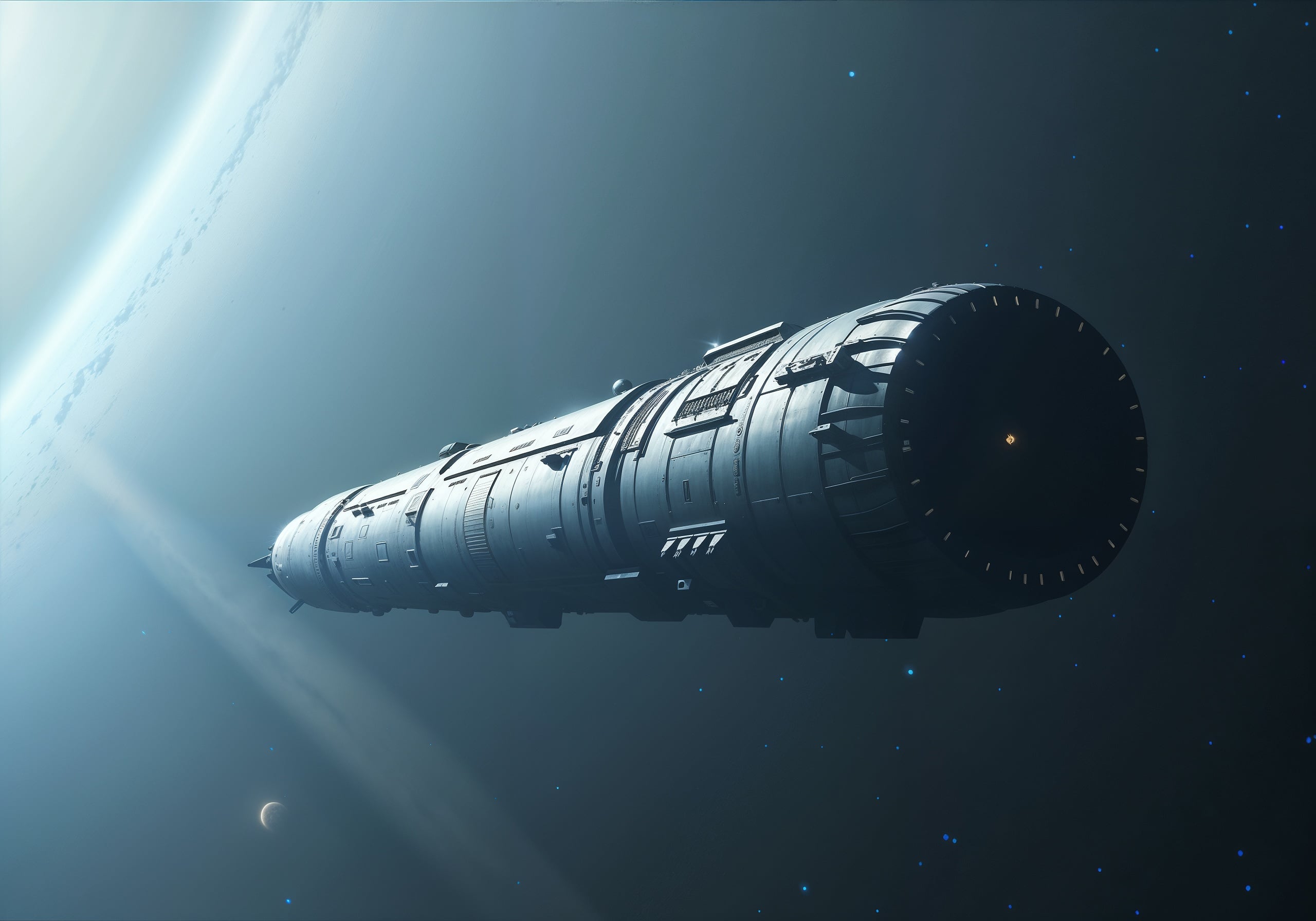
Chrysalis is easy to mistake for a space mission. It has a destination, a population plan, rotating habitats, farms, factories, schools, hospitals, artificial intelligence and a construction sequence. Its designers even proposed how the first inhabitants might prepare psychologically before departure.
But no 58-kilometre ship is being built. Chrysalis is the first-place concept from the 2025 Project Hyperion Design Competition, an international exercise organized by the Initiative for Interstellar Studies. Its achievement was to make one speculative question unusually concrete: what would have to travel with 2,400 people if Earth could never send help and the destination lay four centuries away?
The contest asked teams to design a civilization
Project Hyperion’s official results describe a generation ship as a craft whose original crew lives, reproduces and dies during the journey, leaving descendants to complete it. The competition required more than a hull. Architects, engineers and social scientists had to integrate artificial gravity, food, water, waste, atmosphere, shelter, social organization and mechanisms for preserving knowledge.
The general competition brief used a 250-year reference journey and habitability for 1,000 people, with a permitted range of 500 to 1,500. Chrysalis developed a larger scenario of roughly 400 years and capacity for about 2,400. Those are design choices inside the winning entry, not universal Project Hyperion requirements.
The team comprised Guido Sbrogio, Giacomo Infelise, Veronica Magli, Nevenka Martinello and Federica Chiara Serpe. The jury praised its system-level coherence, modular habitat, radiation protection, in-space manufacturing and attempt to plan crew preparation before launch. The official competition results in Principium also show why it stood out: the proposal linked diagrams of machinery to population policy and everyday life.
A four-century crossing turns a ship into a world
Proxima Centauri is about 4.24 light-years away. A 400-year crossing corresponds to an average cruise speed a little above one percent of light speed before acceleration and deceleration are included, roughly 3,000 kilometres per second. For comparison, a previous SpaceDaily analysis of the nearest star showed that even one percent of light speed remains far beyond any crewed vehicle.
Chrysalis proposed a fusion propulsion system using helium-3 and deuterium. Fusion is physically real, but no fusion rocket has propelled a spacecraft, and no operational reactor on Earth supplies the kind of sustained power this vessel would demand. The engine is therefore a design assumption rather than hardware waiting for assembly.
The scale followed from everything the ship had to carry. The concept measured 58 kilometres long and roughly six kilometres across, with a mass discussed in billions of tonnes. Its cylindrical habitats would rotate to create an apparent downward force, sparing generations from permanent microgravity. A forward observation space called the Cosmo Dome offered a rare view beyond the enclosed world.
The team imagined assembling Chrysalis near an Earth-Moon Lagrange point in 20 to 25 years, drawing on space-derived materials and automated manufacturing. That schedule begins only after an industrial capacity that does not exist has been created. No current launch system could lift the structure from Earth, and no existing orbital yard can build at this scale.
Five layers carried everything a city needs
The design resembled nested cylinders around a central axis. One major layer supported food production, including crops, fungi, microbes, insects and livestock. Managed ecosystems representing environments such as tropical and boreal forests were intended to preserve biodiversity, support air and nutrient cycles and give people contact with living landscapes.
Another layer held shared institutions: schools, hospitals, libraries, parks and meeting places. Residential modules occupied a separate zone, with controllable ventilation and heating. Industrial space provided workshops and manufacturing, while an outer automated layer stored equipment and allowed robots to perform hazardous maintenance. The central core held communications and vehicles intended for operations after arrival.
The arrangement treated redundancy as survival. A leak, crop disease or factory failure cannot become a civilization-ending event. Air, water, food and waste streams would need multiple paths, while parts must be inspected, remade and upgraded continuously. A review of world-ship feasibility identifies precisely this maintenance burden as a central obstacle: a vessel containing vast numbers of components may need to detect and replace failures constantly for centuries.
No closed human ecosystem has demonstrated that performance. Space stations depend on resupply, and even carefully controlled terrestrial ecological experiments have required outside intervention. Chrysalis maps the functions a closed biosphere needs; it does not prove the biological loops will remain stable for 400 years.
The 2,400 berths conceal a reproductive constitution
Capacity and planned population were not the same. Chrysalis could hold roughly 2,400 people, but the proposal aimed to stabilize the community nearer 1,500, leaving margin for fluctuations and emergencies. Births would be scheduled to balance population size, age structure, genetic diversity and the ship’s finite food and housing capacity. Presentation material described a three-year reproductive window between ages 28 and 31.
This is where engineering becomes politics. A closed population cannot grow indefinitely, yet compulsory reproductive timing would reach into the most private decisions people make. The first passengers might consent to those rules. Their grandchildren and great-great-grandchildren did not choose the ship, destination or constitution.
Even the minimum safe population is unsettled. One computer model of a 6,300-year Proxima voyage found that 98 founders could succeed under tightly managed reproductive rules and favorable assumptions. Other researchers argue for far larger populations once disease, accidents, infertility and rare catastrophes are included. Stored embryos and genetic screening alter the arithmetic again. Chrysalis’s 1,500-person target is a scenario, not a biological guarantee.
Government and memory become life-support systems
The team did not assume that hardware alone would hold society together. In its published statement, it described humans, robots and AI agents sharing information, experience and decision-making. The design gave education, health care, communal rituals, private space and cultural memory physical places inside the ship.
That creates difficult governance questions. Who can change the mission? Can a later generation decide not to settle the destination? Who audits an AI system centuries after its creators are dead? How are dissent, unequal access to scarce resources and conflicts between habitat sections handled without an outside court or refuge?
Chrysalis proposed that the founding community spend 70 to 80 years in an isolated Antarctic settlement before launch, using multiple generations to develop self-sufficiency and a common identity. The literal timetable is speculative, but the premise is serious. A society expected to survive deep space must test social institutions as aggressively as pressure vessels.
Knowledge transfer is equally fragile. Manuals can be copied, but expertise lives in practice. Every generation would need enough doctors, agronomists, engineers, teachers and machinists to train the next, including specialists for failures that may occur only once in a lifetime. Losing the ability to repair one obscure subsystem could matter more than losing a library.
The ship could arrive before knowing whether it can land
The proposed destination was Proxima Centauri b, a probably rocky planet in its star’s habitable zone. “Habitable zone” means temperatures could permit liquid water under suitable conditions; it does not confirm oceans, breathable air or life. NASA notes that Proxima b’s actual habitability remains unknown, and its active red-dwarf star produces intense ultraviolet flares that may strip or damage an atmosphere.
A generation ship could therefore work perfectly and reach a planet hostile to settlement. Chrysalis included communications, shuttles and an arrival sequence, but no design can replace missing observations of the destination. Future astronomers would need to establish whether Proxima b has an atmosphere and surface conditions worth a one-way civilizational gamble.
That boundary is the right way to understand the competition winner. Chrysalis is not evidence that a 58-kilometre spacecraft can be launched soon. It is a research baseline that forces propulsion, ecology, reproduction, education and political legitimacy into the same drawing. The people who reached Proxima would have no memory of Earth except what the ship preserved, while Earth would know them only through messages taking more than four years each way.
The design’s deepest insight is that a 400-year spacecraft cannot carry passengers in the ordinary sense. It must carry a society capable of replacing every original passenger, then deciding for itself whether the promise made by its ancestors is still a future worth reaching.
