

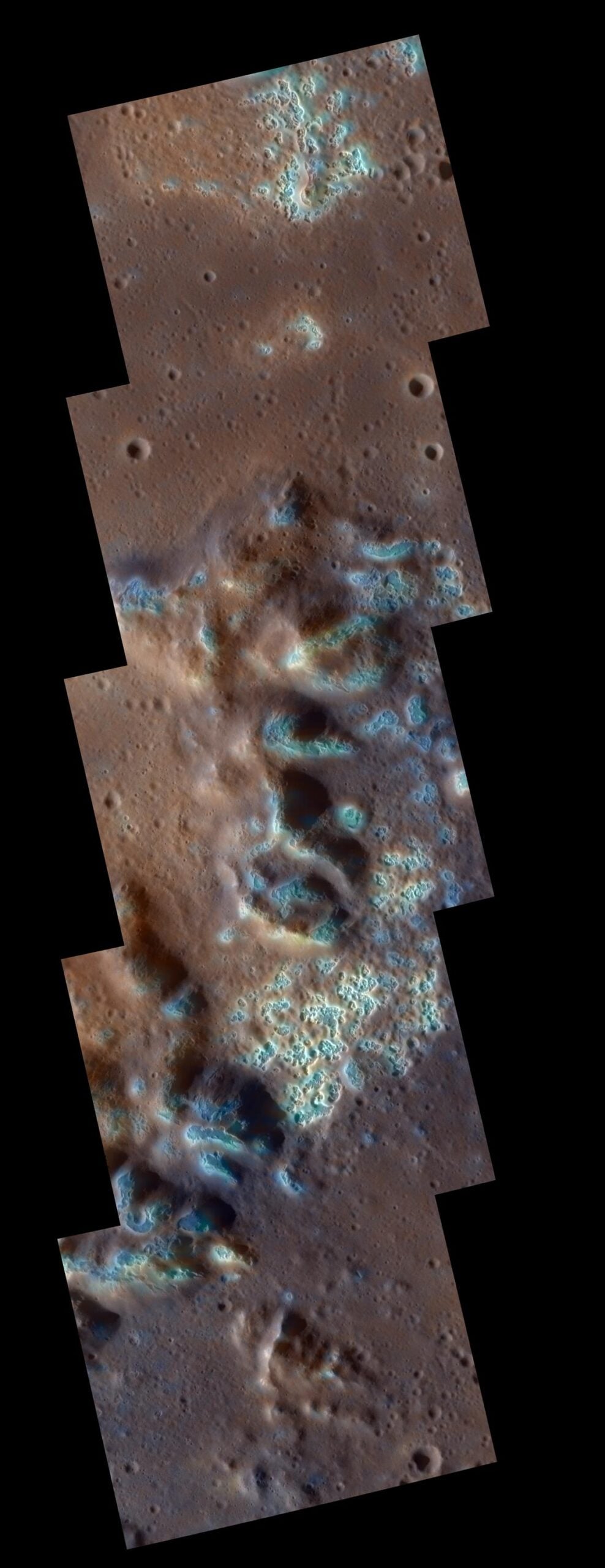
Mercury looks like the last place to search for a glacier. Sunlit ground can reach about 430°C, the planet has almost no atmosphere, and volatile compounds exposed at the surface face intense heat and radiation. Yet MESSENGER images of two impact craters show lobate runouts, flow fronts and lineations that resemble the landforms made by glaciers on Earth and Mars.
The resemblance led a research team to propose something unfamiliar: glaciers dominated not by water ice, but by salts and other volatile-rich material excavated from Mercury’s crust. Thermal and flow models indicate that such deposits could retain volatile material for more than a billion years under a protective cover.
Each part of that description needs a boundary. “Glacier-like” describes morphology and inferred flow, not a chemical detection of sodium chloride. “More than a billion years” is a modelled survival interval, not a radiometric date from a collected sample. The Atacama comparison shows that salt can shelter terrestrial microorganisms when liquid brine is available; it is not evidence that Mercury has life or even a habitable deposit.
MESSENGER saw flows beside crater peak rings
NASA’s MESSENGER spacecraft orbited Mercury from 2011 until 2015 and mapped the surface with its Mercury Dual Imaging System. In Raditladi and Eminescu craters, researchers identified broad lobate deposits extending from parts of the central peak rings. The surfaces include runout margins, curved ridges and lineations consistent with material that moved downslope and spread laterally.
The 2023 Planetary Science Journal study compared these forms with terrestrial salt glaciers and with lobate debris aprons on Mars. Ordinary rockfalls offer a useful control: nearby landslide deposits tend to have different profiles and lack the same association with bright, shallow pits.
Those pits are Mercury’s hollows, irregular rimless depressions often surrounded by bright material. A NASA review of MESSENGER’s hollow observations emphasizes that their composition remains unknown. The leading family of explanations involves an unstable component escaping after an impact or other process exposes volatile-bearing rock.
Raditladi’s peak ring is especially rich in hollows and bluish material in enhanced-colour imagery. “Bluish” is a relative spectral colour produced by combining camera filters; it is not how an astronaut’s eye would necessarily see the deposit, and it is not a unique fingerprint for salt.
The impacts may have opened a buried volatile layer
A large impact does more than excavate a bowl. The compressed floor rebounds, lifting material from depth into a central peak or ring. The new interpretation argues that the Raditladi and Eminescu impacts raised parts of a volatile-rich layer, exposing it on steep slopes where it became mobile.
Material could then deform and move away from the peak-ring massifs before a less volatile crust formed over it. Later loss of exposed components would leave hollows and a refractory residue. The shared location of flows, hollows and peak-ring exposures is the main geological link among these stages.
The proposed layer is on the order of kilometres thick in the team’s stratigraphic reconstruction. That is an inference from landforms, crater geometry, topography and modelling, not a layer directly sounded from top to bottom. MESSENGER had no drill and did not land.
This volatile-rich Mercury is less surprising than it once would have been. In SpaceDaily’s review of MESSENGER’s major discoveries, one of the mission’s central reversals was that Mercury is not strongly depleted in moderately volatile elements. Its surface holds notable potassium, sodium, chlorine, sulfur and carbon despite forming close to the Sun.
These are not ordinary water-ice glaciers
A glacier is a body of solid material that deforms and flows under its own weight over time. On Earth the material is normally water ice, but the physical category is broader. Nitrogen ice flows across Pluto, and salt masses on Earth can creep outward from buried evaporite layers to form glacier-like tongues.
The Mercury team tested halite, sodium chloride, because its rheology can permit slow deformation under relevant temperatures and loads. Other semivolatile salts, sulfur-bearing compounds and organic-rich material could be mixed into the proposed layer. The exact recipe remains open.
The team’s models supported salt flow as a way to reproduce the observed forms and suggested that the emplaced material could preserve volatiles for over one billion years. Raditladi itself has a crater-count model age of roughly 1.1 billion years. Those two numbers are compatible, but they are not the same measurement.
The Planetary Science Institute’s account of the work attributes the billion-year result to thermal modelling by the research team. Burial is central to that longevity: a refractory cover can slow volatile loss even while material nearer the exposed surface disappears. The calculation supports preservation under specified conditions; it does not show that every part of each flow retained its original inventory.
Crater counting estimates age from the number and sizes of later impacts superposed on a surface. It depends on a model of Mercury’s impact rate. The survival calculation instead asks how heat travels through and removes volatile material from a deposit. No sample has supplied a laboratory formation age or composition.
Hollows connect flow to volatile loss
Hollows were among MESSENGER’s most distinctive discoveries. They are shallow, sharp-edged and often bright, with no raised rims or ejecta blankets like fresh impact craters. Many occur where large impacts excavated dark material from below the surface.
Sublimation is one proposed mechanism: a solid component can pass directly into gas when newly exposed to Mercury’s surface environment, undermining the ground and leaving a depression. Other chemical or physical loss processes may contribute. Images show the landform but do not identify the escaping substance.
SpaceDaily’s account of Mercury’s 176-Earth-day solar day explains why exposed terrain experiences extraordinarily long heating and cooling intervals. That slow cycle matters to volatile loss and the depth at which a deposit can remain stable, but thermal behaviour alone cannot identify the chemistry.
The proposed salt glaciers must also be kept separate from Mercury’s polar water. As SpaceDaily reported on the planet’s cold traps, water ice survives where crater floors remain in permanent shadow. Raditladi and Eminescu are sunlit, lower-latitude settings. Their candidate flows are neither mapped polar ice nor evidence that frozen water crossed a hot crater floor.
Borealis Chaos suggests a larger volatile reservoir
The crater flows are one part of a broader argument. In Mercury’s north polar region, Borealis Chaos contains a fragmented landscape that lost substantial material without leaving the deep basin expected from a conventional impact. The same team has interpreted this collapse as the removal of a thick volatile-rich crustal unit.
A 2020 study of Mercury’s chaotic terrains found that some collapse continued far later than the ancient Caloris impact once blamed for all such disruption. It also identified chaotic terrain away from the point opposite Caloris, weakening a single impact-shaking explanation.
Connecting Borealis Chaos with the crater flows suggests that volatile-rich layers may be regional or even widespread rather than isolated pockets. The team has proposed that salts accumulated from a short-lived primordial atmosphere, perhaps during long nights when surfaces cooled enough for compounds to condense. Other origins, including magmatic gases and volcanic deposits later buried by lava, remain possible.
That origin story is more speculative than the mapped morphology. Images can establish where collapse and flow-like landforms occur. They cannot by themselves reconstruct a global early atmosphere or show that all volatile deposits formed in one episode.
The Atacama analogy needs liquid brine
In the hyperarid core of Chile’s Atacama Desert, halite nodules host communities of cyanobacteria, archaea and other microorganisms. The organisms live inside pores rather than on the exposed salt surface. The translucent mineral admits useful light while reducing damaging ultraviolet exposure.
Salt also supplies the decisive water mechanism. When humidity rises enough, halite absorbs water vapour and forms microscopic liquid brines through deliquescence. A field study of Atacama halite communities measured active metabolism linked to moisture availability, including photosynthesis and respiration in salt-saturated conditions.
Mercury has not supplied the matching environment. Its exosphere is far too thin to act like humid desert air, no brine has been detected in Raditladi or Eminescu, and exposed daytime temperatures are punishing. A salt deposit alone is not a habitat.
The astrobiological suggestion instead concerns depth. A buried layer can moderate temperature swings and shield material from radiation. If a suitable liquid and chemical energy source existed at some depth, salt might help maintain a microscopic niche. Every “if” in that chain is unresolved, and no organism, organic biosignature or habitable temperature profile has been observed there.
MESSENGER could map shape better than chemistry
MESSENGER’s images are strong evidence that unusual material moved and was later modified. Its colour filters and spectrometers also established broad compositional differences across Mercury. They could not uniquely distinguish halite from all other plausible volatile-bearing mixtures at the scale of the flows.
That limitation is why “may consist” carries so much weight. A convincing test would find spectral features compatible with specific chlorides or other salts, show that their distribution follows the mapped flow units, and demonstrate thermal and mechanical properties consistent with the observed runout.
Some hollows may still be evolving, which creates another test. Repeated high-resolution imaging could reveal fresh collapse or changing bright deposits. Measuring gases above active terrain might connect a disappearing volatile to a particular surface unit, though Mercury’s exosphere and solar-wind environment make attribution difficult.
BepiColombo will return with different instruments
ESA and JAXA’s BepiColombo mission is due to enter Mercury orbit in November 2026, with routine science beginning in 2027. Its two orbiters and complementary instruments will add thermal-infrared mineral mapping, X-ray spectroscopy, neutron and gamma-ray measurements, laser topography and higher-resolution imaging.
SpaceDaily has followed the mission’s eight-year, nine-flyby route to Mercury. Once in its science orbit, the European Mercury Planetary Orbiter can revisit the peak rings and compare composition, temperature and landform at scales MESSENGER could not combine.
The immediate question is geological, not biological: are the runouts actually salt-rich, and do they share a source with nearby hollows and the larger volatile-rich layer proposed from chaotic terrain? A positive answer would reveal a Mercury that stored mobile volatiles in its crust for extraordinary spans of time.
It would still not demonstrate a buried ecosystem. The MESSENGER record supports glacier-like flow and volatile loss; modelling makes salt and billion-year preservation plausible; Earth shows that wet salt can host extremophiles. Life on Mercury requires evidence from an additional chain that no spacecraft has yet found.