

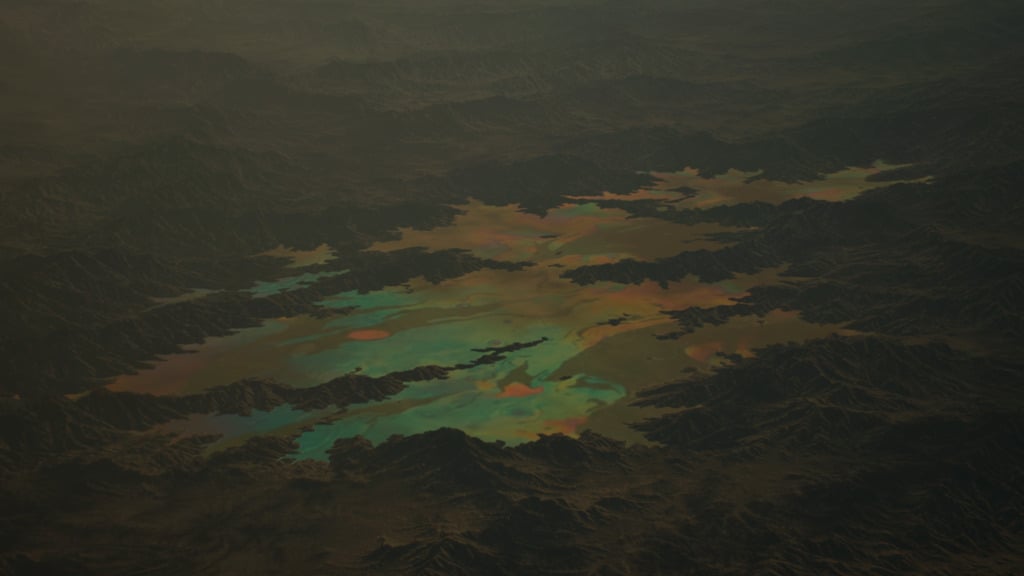
A lake on Titan does not need to behave like a warm terrestrial pond for its surface to become chemically useful. It needs an interface, material capable of arranging itself at that interface, and some repeated disturbance that folds one surface over another. On Saturn’s largest moon, the disturbance may be rain.
Christian Mayer of the University of Duisburg-Essen and Conor Nixon of NASA Goddard set out this possibility in a 2025 paper in the International Journal of Astrobiology. Their proposal is geometric as much as chemical. A surface film coats droplets thrown from a hydrocarbon lake; when a droplet returns through the film, it gains another layer and becomes a closed compartment.
This is a proposed pathway, not a detection or a completed laboratory demonstration. SpaceDaily has examined the idea twice before, first in a detailed account of the rain-splash sequence and then in a separate analysis of what a membrane without water would mean. The useful next question is narrower: what exactly must happen at the two interfaces, and which links in that chain remain assumptions?
On Earth, the solvent helps build the boundary
Every known cell separates itself from its surroundings with a membrane. The boundary concentrates some substances, excludes others and allows chemical conditions inside to diverge from those outside. Without that separation, useful molecules disperse and reaction products are easily lost.
Many terrestrial membranes are built from amphiphiles, molecules with regions that respond differently to water. A water-compatible head can remain exposed while water-avoiding tails gather together. Two molecular sheets can align tail to tail, leaving their heads facing the watery interior and exterior. If the sheet closes, it forms a vesicle.
That arrangement is not alive by itself. It contains no metabolism, genetic system or controlled reproduction. Yet a durable inside and outside is one of the physical prerequisites for cellular life. Compartments may have helped prebiotic reactions persist, interact and become subject to selection before recognisable cells existed.
Titan reverses the solvent problem. Its exposed liquids are non-polar hydrocarbons rather than water. Any membrane-like structure would need a chemistry and orientation appropriate to liquid methane and ethane at cryogenic temperature. The topology could resemble an Earth vesicle while the substances and molecular direction are different.
Titan supplies lakes, weather and organic material
Cassini radar mapped seas and smaller lakes near Titan’s poles, while the Huygens probe saw rounded cobbles, channels and a landscape shaped by flowing liquid. Methane evaporates, forms clouds, falls as rain and returns through rivers. SpaceDaily’s earlier guide to Titan’s hydrocarbon weather cycle describes a moon whose surface hydrology is familiar in outline and chemically alien in detail.
Surface temperatures are around 90 to 94 kelvin, close to minus 180 degrees Celsius. Water ice is rock-hard there. Methane, ethane and dissolved nitrogen make up the working lake fluid, with the proportions expected to vary between basins, depth, weather and season.
High in the atmosphere, sunlight and energetic particles split nitrogen and methane. The fragments recombine into hydrocarbons, nitriles and larger organic aerosols. Haze particles settle across the moon and can be carried into drainage systems. This provides a supply route for complex carbon-bearing material, although complexity alone does not guarantee the particular surface-active molecules the proposal requires.
The candidate amphiphiles are expected to have a relatively polar group, such as a nitrile, attached to a less polar hydrocarbon body. At a lake surface they could prefer an ordered orientation rather than remaining evenly dissolved. The paper assumes that a suitable mixture can accumulate into a stable, repairable monolayer. No instrument has yet measured such a film on Kraken Mare, Ligeia Mare or any smaller lake.
The first layer leaves with the splash
The mechanism begins before a storm. Atmospheric organics arrive at the lake and some fraction collects at the liquid-atmosphere boundary. Molecular attraction and surface-energy effects arrange those amphiphiles into a coating one molecule thick.
A large raindrop, or perhaps a hail particle, then strikes the surface. The impact excavates a shallow crown and launches much smaller drops into Titan’s dense air. Each secondary droplet is made from lake liquid, so it takes a patch of the surface coating with it as it separates.
The result is a methane-and-ethane droplet wearing one molecular layer. In Titan’s weak gravity and thick atmosphere, fine spray would settle more slowly than comparable spray on Earth. That extra time does not create a membrane, but it may allow the coating to reorganise and close gaps before the droplet returns.
Rain intensity, drop size and wind all matter. A gentle shower may not eject enough spray; a violent impact might shred a fragile film; evaporation could change the droplet composition in flight. The 2025 paper establishes a possible sequence from known physical processes. It does not show that real Titan storms routinely occupy the required range.
The second interface performs the closure
The decisive event occurs when the coated drop meets the coated lake. The droplet already carries one molecular sheet. The bulk surface supplies another. As the drop crosses the interface and sinks, the two films are brought together around a pocket of the original liquid.
That creates a bilayer shell: two organised molecular layers enclosing hydrocarbon solvent. The authors draw on a terrestrial technique in which droplets passing through a prepared interface acquire a second coating. Titan’s weather would provide the mechanical action rather than a laboratory pipette or mixing device.
The distinction between self-assembly and forced assembly is important. A candidate membrane might not spontaneously form from molecules dispersed in cold methane because crystals or aggregates are energetically preferred. Repeated splashing could still drive the molecules through a temporary configuration that closes into a longer-lived object. Stability after formation is a separate question from how formation begins.
This emphasis on interfaces is why the proposal is more specific than saying Titan contains organics and liquid. The lake must sustain a surface film, impacts must transfer it intact, airborne drops must survive, and the returning drop must cross the second film in a way that closes rather than ruptures. Each step offers an experimental point of failure.
A bilayer shape does not require Earth-like chemistry
Calling the proposed object the same kind of compartment as a primitive terrestrial vesicle refers to its architecture, not its composition. Both have a liquid interior, an exterior solvent and a double molecular boundary between them. The molecular heads on Titan would point toward the relatively polar interior of the membrane, with less polar portions facing the surrounding hydrocarbon. That orientation is effectively inverted from a familiar phospholipid membrane in water.
Earlier azotosome models explored acrylonitrile as one possible nitrogen-bearing membrane material. Astronomers later detected vinyl cyanide, another name for acrylonitrile, in Titan’s atmosphere, but detection in the gas does not establish a lake membrane. A 2020 molecular-dynamics study reported in Science Advances found that proposed acrylonitrile membranes would not self-assemble as previously suggested under Titan-like conditions.
That negative result does not validate the rain route, but it explains why a kinetic mechanism is interesting. If free molecules prefer a crystal, an interface-driven folding step offers a different route to a closed structure. Whether the resulting shell persists or promptly crystallises remains an experimental question.
Recent cryogenic work also warns against importing room-temperature intuition. SpaceDaily reported that hydrogen cyanide can share stable crystals with methane or ethane under carefully controlled cold conditions. That finding concerns solid cocrystals, not flexible bilayers, but it demonstrates how molecular packing at Titan temperatures can frustrate simple expectations.
Sorting for stability is not yet evolution
Mayer and Nixon suggest that a population of vesicles could change composition as molecules enter and leave the boundary. Less stable combinations would disappear sooner; more stable mixtures would persist and become more common. Repeated storms could continually generate new populations for that physical sorting process.
The word evolution needs discipline here. Thermodynamic selection among membrane mixtures is not biological evolution unless structures also reproduce with variation and transmit some information. A shell surviving longer than its neighbours has been filtered by the environment, but it has not inherited a genome or built a copy of itself.
Even a confirmed Titan vesicle would therefore establish increasing organisation, not life. It might concentrate organics, create a distinct solvent pocket and support gradients across its boundary. None of those capabilities supplies metabolism, heredity or open-ended Darwinian change on its own.
The distinction protects the genuinely interesting result. Finding a non-water environment that repeatedly makes compartments would show that a useful piece of prebiotic organisation is not exclusive to aqueous chemistry. That would expand the range of planetary settings worth testing without pretending the remaining steps are small.
The proposal can be tested in a cold laboratory
The strongest feature of the paper is that it describes an experiment. A cryogenic chamber could hold a realistic methane-ethane-nitrogen mixture beneath Titan-like pressure. Researchers could apply candidate surface films, generate rain or impact spray and measure whether returning droplets close into hollow bilayers.
Several outcomes would be informative. The film might refuse to form, fragment during impact or coat droplets unevenly. Droplets might evaporate, coalesce at the surface or acquire a second layer without producing a sealed sphere. Closed objects might appear but collapse quickly, freeze into crystals or exclude the molecules needed for further chemistry.
The authors discuss optical detection because vesicles scatter light in ways related to their size and concentration. They propose combining laser light scattering with surface-enhanced Raman spectroscopy, which could identify chemical groups while looking for dispersed structures. Expected sizes span roughly 100 nanometres to tens of micrometres, a broad range requiring more than an ordinary camera.
A laboratory success would still show possibility rather than abundance on Titan. A null result under many plausible mixtures would be equally valuable because it would close one route and identify which physical step fails. At present, the central mechanism has a diagram, candidate ingredients and measurable consequences, but not an observed vesicle.
Dragonfly will approach the question from dry land
NASA’s Dragonfly rotorcraft is designed to investigate Titan’s surface composition, atmosphere and habitability at equatorial sites. It will not visit the northern seas, and it does not carry the specialised lake light-scattering system proposed in the paper. SpaceDaily’s mission overview explains how the nuclear-powered aircraft will move between dunes and impact terrain rather than operate as a boat.
Dragonfly can still improve the starting chemistry. Measurements of organics, surface materials, meteorology and possible transient liquid environments will constrain what the atmosphere makes and what reaches the ground. Those data can sharpen laboratory recipes and show whether candidate amphiphiles are realistic components of Titan material.
A future lake mission would need to sample the topmost surface as carefully as the bulk liquid. The proposal places its critical chemistry in a molecular skin, a layer easy to disturb or contaminate. An instrument that descends too aggressively could destroy the feature it was sent to measure.
NASA’s account of the 2025 study is careful to call vesicle formation a possible step toward protocells. That is the appropriate scale of the claim. Rain may turn two prepared interfaces into a compartment without water. Whether Titan supplies the right films, whether the compartments last and whether their chemistry can progress remain open questions that experiments can now address directly.