
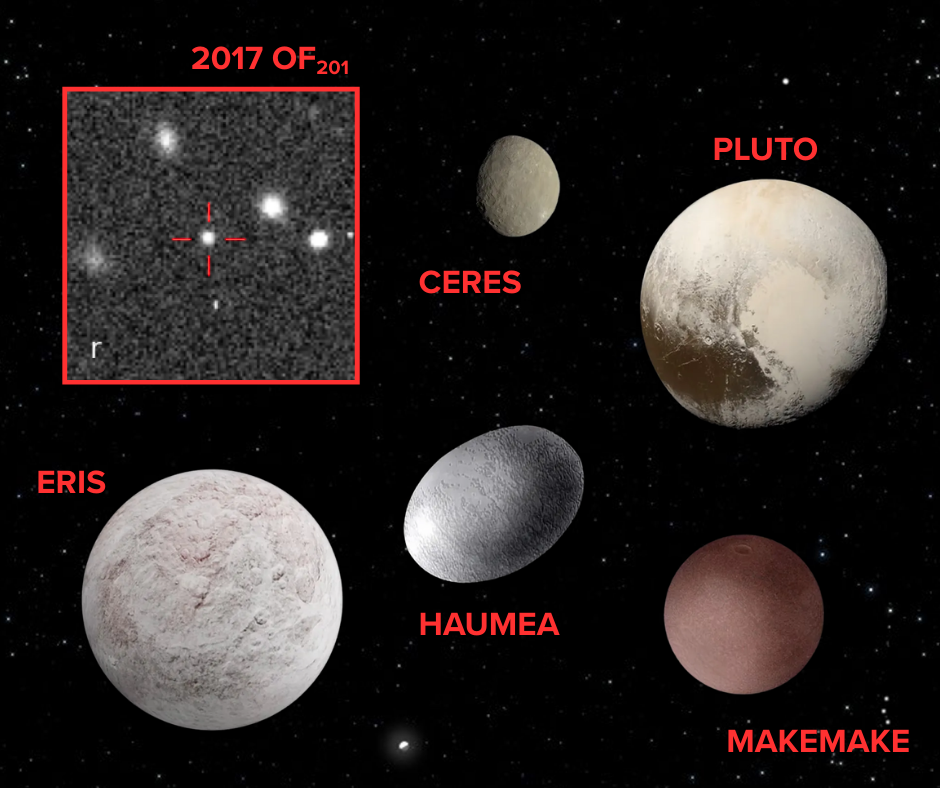
2017 OF201 is easy to describe as one more distant object in a steadily growing catalogue. That misses the most consequential part of the discovery.
Astronomers found it during the tiny fraction of a 25,000-year orbit when a survey of this depth had much chance of seeing it at all. For the remaining 99.5 percent of its journey, the same body would probably sit beyond the reach of the archival images in which it was identified.
That turns one faint moving point into a population argument. The new object is not direct evidence that hundreds of companions have already been located. It is evidence that a census based only on what is bright enough to see near perihelion can miss almost the entire population.
A discovery assembled backwards through time
The provisional name 2017 OF201 makes the result sound like a normal discovery made in 2017. The chronology is more interesting. Sihao Cheng, Jiaxuan Li and Eritas Yang identified the object in 2025 by connecting faint points recorded years earlier in public telescope archives. The year in the designation refers to the observation on which the formal designation was based, not the moment someone first understood what the dot represented.
The Institute for Advanced Study’s original account described an initial set of 19 exposures from the Dark Energy Camera on the Víctor M. Blanco Telescope and MegaCam on the Canada-France-Hawaii Telescope. After the announcement, still earlier appearances were identified in Sloan Digital Sky Survey material.
The peer-reviewed version, published in The Astrophysical Journal Letters, uses 24 observations spanning 20 years. That update matters because a faint, distant body moves very slowly against the background stars. A longer observational arc gives astronomers far more leverage to distinguish one extreme orbit from several slightly different possibilities. The Minor Planet Center’s announcement established the object’s official provisional identity.
The numbers describe an extraordinarily stretched orbit
2017 OF201 is currently about 90 astronomical units from the Sun. One astronomical unit is the average Earth-Sun distance, so the object is now roughly three times farther out than Neptune and well beyond Pluto’s present position.
Its nearest point to the Sun, or perihelion, is about 45 astronomical units. Its farthest point is around 1,600 astronomical units. The semimajor axis, the size parameter commonly used to describe an orbit, is approximately 830 astronomical units. Kepler’s relationship between distance and orbital period then gives a circuit of roughly 24,000 to 25,000 years.
The object last passed perihelion in November 1930, coincidentally the same year Clyde Tombaugh discovered Pluto. It is now travelling outward. Space Daily recently explored the blue atmospheric haze that New Horizons saw around Pluto, but 2017 OF201 offers nothing like that level of detail. It is a point source. Almost everything known about it comes from its position, motion, brightness and colour.
Calling it “beyond Pluto” is therefore true in two senses but needs care. It is presently farther from the Sun, and its orbit extends enormously farther out. It is not beyond the solar system, nor does it remain outside Pluto’s orbital region at all times. At perihelion it returns to the broad trans-Neptunian domain before beginning another very long outward passage.
Why 0.5 percent is physically plausible
A distant body seen by reflected sunlight pays a double distance penalty. The sunlight illuminating it weakens as the inverse square of its distance from the Sun. The fraction reflected back toward telescopes near Earth then weakens by roughly another inverse-square factor. In the simplified distant-object case, observed brightness falls approximately with the fourth power of distance.
Move the object twice as far away and it can become about 16 times fainter, before allowing for geometry, surface properties and the observing instrument. Carry it from roughly 45 astronomical units to an aphelion near 1,600, and the practical problem becomes overwhelming. The body still exists, but sunlight no longer makes it accessible to an optical survey of finite depth.
Cheng and colleagues modelled that selection effect and calculated that 2017 OF201 would be detectable in a survey like the Dark Energy Camera Legacy Survey for only about 0.5 percent of its orbit. Half a percent of 25,000 years is about 125 years. That is not necessarily a sharply bounded century with equal visibility every night. Survey footprint, weather, sky background and the object’s position all matter. It is a useful way of expressing how narrow the discoverable interval is.
The original institutional release used a rounded one-percent figure and spoke of about a hundred counterparts. The paper gives the more restrictive 0.5-percent estimate and consequently discusses hundreds. The two statements are successive levels of approximation, not two separately observed populations.
How one detection can imply hundreds without counting them
If every member of a hypothetical population followed a broadly similar orbit, and each were visible for only one part in 200 of that orbit, catching one near enough to see would suggest many more occupy the other 199 parts. This is the intuition behind the claim in the title.
It is not a simple multiplication table masquerading as a census. The inference must account for the portion of the sky surveyed, the observing cadence, limiting magnitude and the distribution of orbital orientations. It also depends on a population of broadly comparable size and reflectivity. Small dark bodies are harder to find than large bright ones; orbits pointed away from the survey footprint can be missed even at favourable distances.
The paper therefore treats “hundreds” as a population estimate conditioned on a model. Its accompanying suggestion that this unseen population could total roughly one percent of Earth’s mass is conditional too. The researchers assumed a diameter near 700 kilometres and a representative density to estimate one object’s mass, then extended that estimate to the population.
Even with those caveats, the selection effect is difficult to ignore. A survey did not see an object chosen randomly from every point in its orbit. It found one while that object occupied an exceptionally short observable phase. The reasonable lesson is not that exactly 200 twins exist. It is that one detection is unlikely to represent the whole class.
Why this remains a dwarf-planet candidate
The estimated diameter of about 700 kilometres is not a direct measurement. The team derived it from absolute brightness while assuming a geometric albedo of 0.13, a plausible reflectivity for this kind of outer-solar-system body. A darker surface must be larger to return the same amount of light. A brighter surface permits a smaller object.
Thermal-infrared or millimetre observations could measure emitted heat and help break that size-albedo degeneracy. A well-observed stellar occultation, in which the object passes in front of a background star, could also reveal its silhouette. Space Daily covered the same underlying measurement problem in the case of the distant object DeeDee, whose faint thermal emission allowed astronomers to constrain a diameter that visible light alone could not supply.
At approximately 700 kilometres, 2017 OF201 may be massive enough for self-gravity to pull it toward a rounded shape. The team also found no brightness variation above about 0.1 magnitude in the available observations, which is consistent with a fairly rounded body but does not prove one. Rotation geometry, surface markings and sparse cadence can all hide shape-related variation.
Under the International Astronomical Union definition, a dwarf planet must orbit the Sun, not be a satellite, not have cleared its orbital neighbourhood, and have enough mass for a nearly round shape. The last criterion is the unresolved one here. “Candidate” is not timidity. It is the accurate label for an object whose likely size is promising but whose physical shape has not been established.
The archive was part of the observing instrument
No telescope was pointed at a known 2017 OF201 and asked to follow it for 20 years. The team instead treated stored surveys as a distributed time machine. A source that looked like an ordinary dot in one frame became meaningful when an algorithm connected it to dots in other frames along the path permitted by orbital motion.
The Dark Energy Camera images were originally gathered for work far beyond small-body science. Their reuse shows why open, well-calibrated archives can produce discoveries after the observing programme that created them has moved on. A telescope supplies photons; preservation, metadata and computation can turn those photons into a new experiment years later.
Outer-solar-system science is unusually suited to this approach. The targets move slowly, observation arcs need to be long, and a promising candidate may already have appeared in older surveys without being recognised. A related combination of search and patience enabled New Horizons to acquire an onward target after Pluto. Space Daily’s account of the Arrokoth flyby describes how Hubble observations found the small world in time for a spacecraft already heading outward to reach it.
Calling 2017 OF201 a “chance discovery” should not erase the work involved. Chance placed a large body inside a narrow visibility window while suitable surveys were operating. Systematic computation, cross-matching and archival stewardship converted that opportunity into evidence.
Planet Nine is constrained here, not decided
The new orbit also enters a longer-running argument about the outer solar system. Several extreme trans-Neptunian objects appear to have similarly oriented elongated orbits. One proposed explanation is that the gravity of an unseen massive planet shepherds them into that apparent clustering.
2017 OF201 does not point with the group. Its longitude of perihelion lies well outside the concentration used in some Planet Nine arguments. In the authors’ numerical experiments, one particular proposed planet configuration destabilised 2017 OF201 much faster than simulations containing only the known giant planets and the Galactic tide.
That is a constraint on a model, not a clean disproof of every possible Planet Nine. The sample of extreme objects remains small, surveys do not observe all directions equally, and different proposed planet masses and orbits can produce different dynamics. The paper itself is appropriately narrower: this orbit poses a challenge to the claimed clustering and to specific versions of the distant-planet hypothesis.
The object’s own history may already require more than the familiar planets acting in a simple way. One plausible route begins with scattering by Neptune, followed by effects from stellar encounters or the Milky Way’s tidal field when the body travelled far from the Sun. Those influences can raise or lower perihelion over immense spans of time. The current orbit may sit at the boundary between the scattered disc and inner Oort cloud rather than belonging neatly to one box.
The deepest result is therefore not the addition of another possible round world beside Pluto. It is an exposure of the census problem. 2017 OF201 was present for billions of years before an archive gave it a name, and it will spend almost all of its next 25,000-year circuit too faint for the survey that revealed it. The hidden population is an inference, but the blindness that produces that inference is real and measurable.