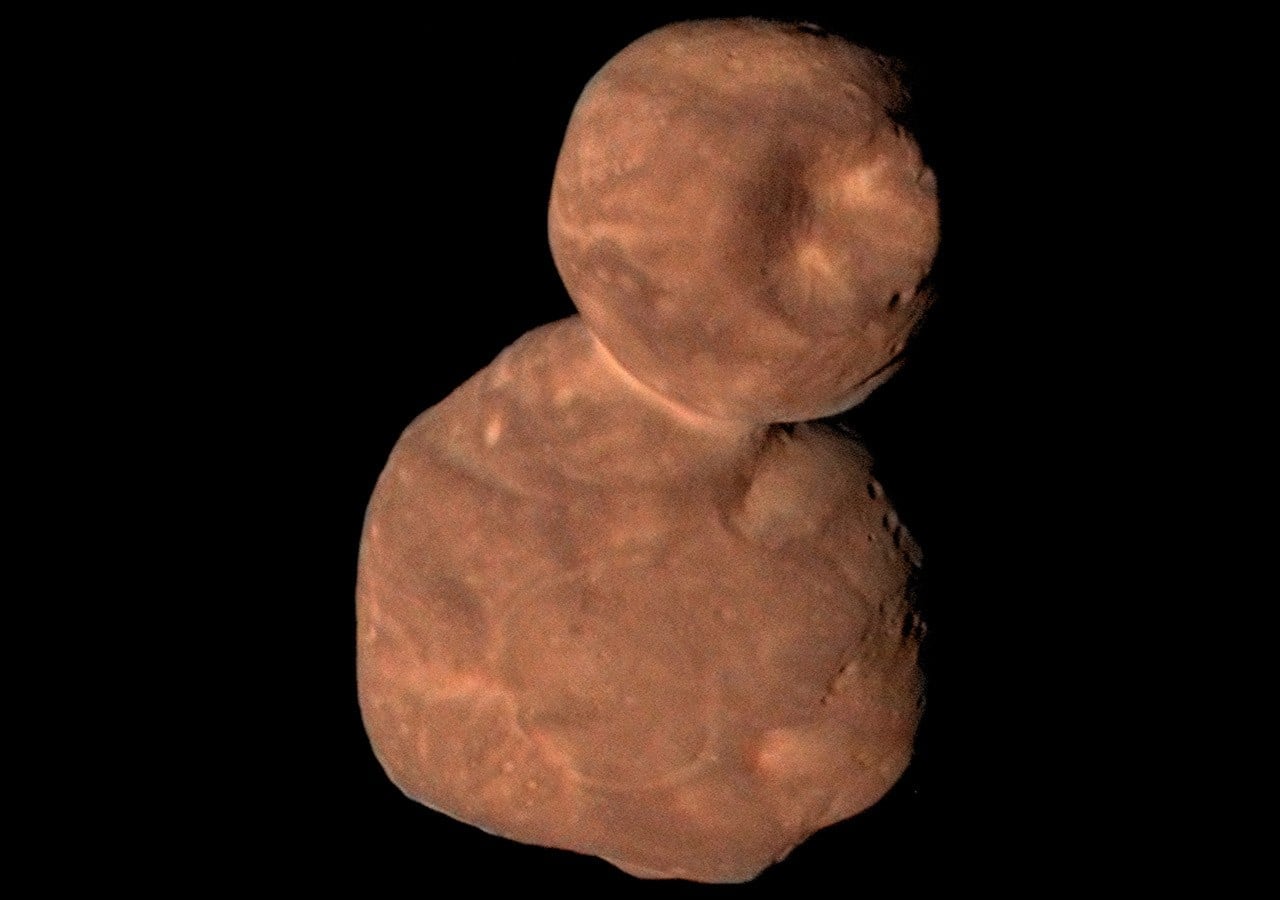
At 5:33 UTC on 1 January 2019, NASA’s New Horizons spacecraft passed roughly 3,500 kilometres from a small Kuiper Belt object then known as 2014 MU69. The target was so distant that radio signals needed about six hours to cross the gap back to Earth.
The first close images revealed two reddish lobes touching at a narrow, bright neck. Mission scientists initially compared the shape to a snowman. The object was later named Arrokoth, and better data showed that the analogy was only partly right: its two halves are not round snowballs but flattened, gently joined bodies.
Arrokoth became the most distant object ever explored up close. It also gave researchers an unusually well-preserved example of how small worlds may have assembled near the Solar System’s beginning.
The record needs the words “explored up close”
Arrokoth was about 4.01 billion miles, or 6.47 billion kilometres, from the Sun shortly before the encounter. It was also roughly four billion miles from Earth. New Horizons had travelled about a billion miles beyond Pluto since its July 2015 flyby.
Calling Arrokoth the most distant object ever visited is accurate in the spacecraft-flyby sense. Voyager 1 and Voyager 2 were already much farther from Earth, but they were travelling through open space rather than making a targeted close pass of another body.
The qualification also separates a visit from ordinary astronomical imaging. Telescopes routinely photograph galaxies billions of light-years away. New Horizons approached closely enough to map a 35-kilometre object whose apparent size from Earth was far below a single Hubble image pixel.
Arrokoth was found after New Horizons had launched
New Horizons left Earth in January 2006 with Pluto as its primary destination. It used Jupiter for a gravity assist in 2007 and crossed the Pluto system on 14 July 2015.
As I wrote in my earlier article about Pluto’s nitrogen glaciers, water-ice mountains and possible buried ocean, that first encounter overturned the expectation of a uniformly old, inactive world. The spacecraft still had fuel after Pluto, but it needed a second target lying inside the narrow cone its remaining propellant could reach.
Arrokoth was not known when the mission launched. The New Horizons team discovered it in 2014 using the Hubble Space Telescope, after a dedicated search for faint Kuiper Belt objects along the spacecraft’s possible onward paths. Course corrections after the Pluto flyby then steered New Horizons towards a point where the object would arrive three and a half years later.
The snowman was flatter than it first appeared
Early images suggested two nearly spherical pieces. Departure photographs, including frames in which Arrokoth blocked background stars, revealed a different outline. The larger lobe is broad and lentil-shaped, while the smaller one is more rounded but still flattened.
NASA’s current dimensions put the whole object at about 35 kilometres long, 20 kilometres wide and only 10 kilometres thick. The larger lobe is roughly 22 by 20 by 7 kilometres; the smaller is about 14 by 14 by 10.
“Two snowballs stuck together” remains a useful first description because it captures the contact binary structure. It should not be mistaken for an exact model of the lobes. Arrokoth looks more like two compressed, irregular discs resting against each other.
The narrow neck records a gentle meeting
A violent collision would have crushed, fractured or dispersed two bodies this small. Arrokoth instead preserves two distinct lobes, closely aligned around a narrow contact region. Their surfaces also have similar colour and composition.
In a 2020 paper in Science, William McKinnon and colleagues concluded that Arrokoth formed through a gentle, low-speed merger in the early Solar System. The two lobes probably accumulated from material in the same local cloud, became a binary pair and slowly lost orbital energy until they touched.
Later impact simulations put useful numbers around “gentle”. For loosely bound rubble-pile lobes to survive intact, the final contact was probably slower than about five metres per second and occurred at a grazing angle. That is jogging or cycling speed, not the hypervelocity collision usually imagined when discussing craters.
Why a small frozen body matters
Arrokoth belongs to the cold classical Kuiper Belt, a population beyond Neptune with relatively undisturbed orbits. It receives so little solar energy that it has experienced far less heating and geological reworking than larger worlds closer to the Sun.
This does not mean every atom has sat unchanged for 4.5 billion years. Radiation alters the surface, impacts leave marks and volatile ices can evolve. The useful claim is narrower: the object’s overall structure appears to preserve the low-speed assembly of a planetesimal, one of the building blocks from which planets grew.
I find that more compelling than the snowman resemblance. New Horizons did not merely photograph a curious shape. It found two ancient lobes whose survival argues that at least some early growth happened through local collapse and soft contact rather than an uninterrupted sequence of destructive impacts.
New Horizons kept going again
The spacecraft did not stop at Arrokoth. NASA reported in July 2026 that New Horizons was about 5.9 billion miles from Earth and had awakened from a long hibernation in good health. Its cameras cannot obtain another Arrokoth-like close study without a reachable flyby target, but its instruments continue measuring dust, charged particles and hydrogen in the outer heliosphere.
That continuation is the quiet oddity of the mission. New Horizons was launched towards Pluto before Arrokoth had even been discovered. Hubble found the extra world, engineers redirected a spacecraft already billions of kilometres away, and the result was a close portrait of an object only the size of a city.
Four billion miles from the Sun, the most distant world ever explored at close range turned out not to be a battered fragment. It was a pair, still joined at the point where two small bodies appear to have met gently near the beginning of everything around them.