

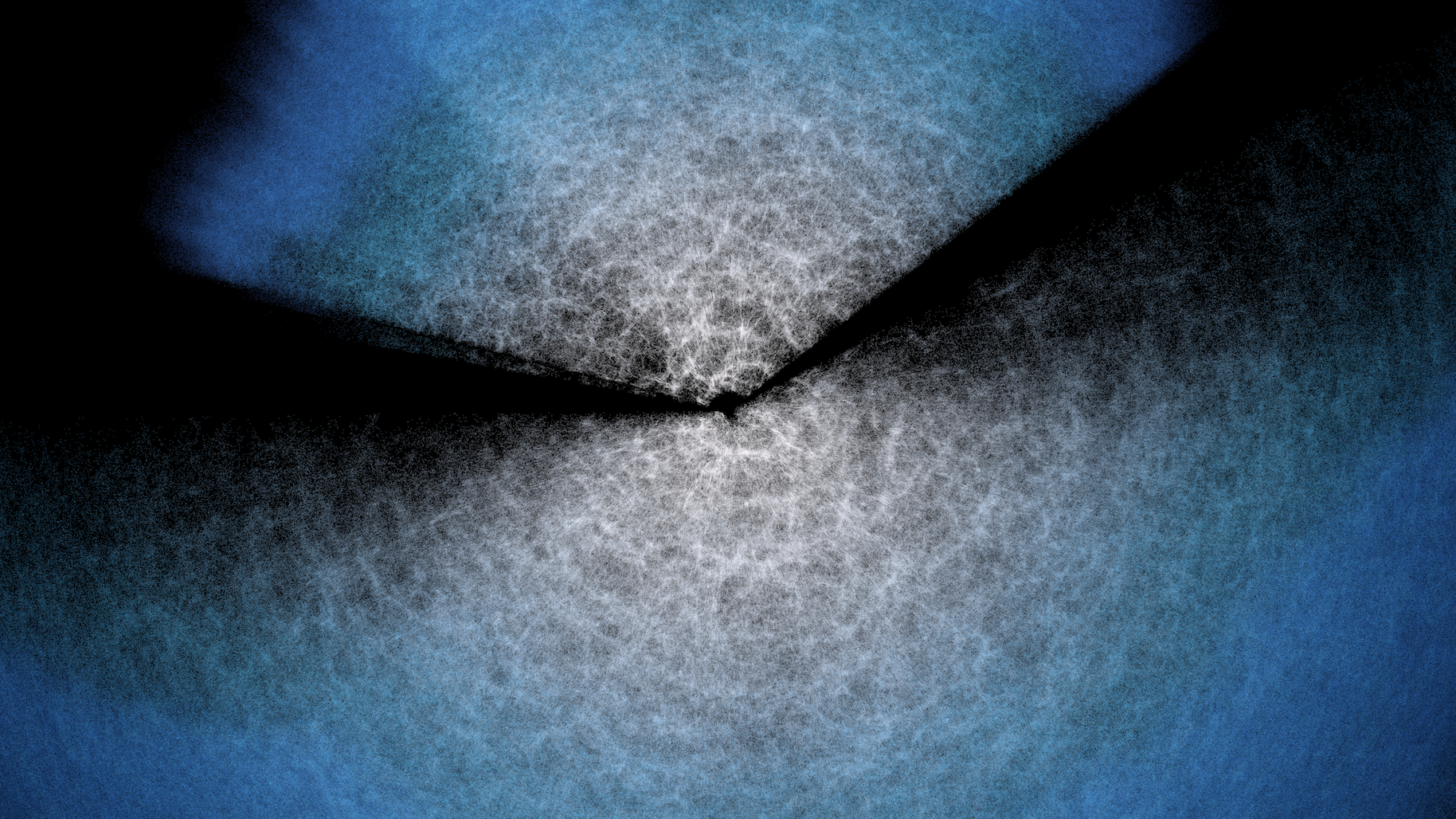
In March 2025, one of cosmology’s most dependable assumptions began to look less dependable. The Dark Energy Spectroscopic Instrument collaboration used its first three years of observations, spanning nearly 15 million well-measured galaxies and quasars, to reconstruct the expansion of the universe across 11 billion years.
The resulting map was the largest three-dimensional view of the universe yet assembled at the time. When its measurements were combined with several other ways of reading cosmic history, a model in which dark energy changes with time fitted better than the standard model’s unchanging cosmological constant.
That is the unsettling part. The reassuring part is equally important: DESI alone did not overthrow standard cosmology, the combined preference did not meet physics’ usual discovery threshold, and a more precise DESI result released in July 2026 has since moved one piece of the evidence back toward the standard model.
The story is therefore not that dark energy has been proved to be dying away. It is that measurements good enough to test the universe’s simplest working description have stopped lining up quite as comfortably as cosmologists would like.
DESI turns a flat sky into cosmic depth
DESI is mounted on the Nicholas U. Mayall 4-metre Telescope at Kitt Peak National Observatory in Arizona. Its focal plane contains 5,000 robotic fibre positioners. In one exposure, each fibre gathers the light of a selected galaxy or quasar and sends it to spectrographs that separate the light into its component wavelengths.
Those spectra contain redshifts. As the universe expands, light travelling through it is stretched toward longer, redder wavelengths. The greater the redshift, broadly speaking, the farther away the source and the earlier the cosmic era being observed. An angular position supplies two coordinates; the redshift supplies depth.
Night after night, that process builds a map made from points rather than photographs. SpaceDaily’s March 2025 report on DESI’s public data release described 18.7 million released objects, including 13.1 million galaxies, 1.6 million quasars and roughly four million Milky Way stars.
That public catalogue and the cosmology sample in the headline are related but not identical counts. The published DESI DR2 cosmology paper analysed more than 14 million selected galaxies and quasars from three years of operations, conventionally described in the collaboration’s public material as nearly 15 million. Stars in the data release were not part of that extragalactic BAO count.
A fossil sound wave became a standard ruler
DESI does not detect dark energy as a substance. It measures geometry. The key is a faint statistical pattern called baryon acoustic oscillations, or BAO, left behind when the young universe was a hot plasma of light and charged particles.
Gravity pulled matter inward while radiation pressure pushed outward, sending sound waves through that plasma. When the universe cooled enough for electrons and nuclei to combine into neutral atoms, light decoupled from matter and the travelling waves effectively froze. They left a small excess probability of finding pairs of galaxies at a characteristic separation, now about 150 megaparsecs, or roughly 490 million light-years.
That preferred separation is not visible between any chosen pair of galaxies. It emerges statistically from millions of them. Because its original physical scale can be calibrated against the early universe, its apparent size across and along the line of sight works as a standard ruler.
At lower redshifts, galaxies trace the pattern. Farther back, DESI also uses the Lyman-alpha forest: absorption marks made by intervening hydrogen in the spectra of brilliant distant quasars. Measuring the ruler at successive redshifts reveals distances and expansion rates at different cosmic times.
The Berkeley Lab release accompanying the March 2025 result called this the most precise BAO approach then available. The three-year dataset more than doubled the cosmology sample used in DESI’s first analysis.
The standard model makes dark energy deliberately simple
The prevailing cosmological model is Lambda cold dark matter, written as Lambda CDM. Cold dark matter supplies invisible gravitating mass that can clump and help build galaxies. Lambda represents the cosmological constant, the simplest mathematical description of the component associated with accelerated expansion.
As SpaceDaily’s earlier dark-energy primer explained, the name is a label for an observed gap in understanding, not an identified material. In the standard model, Lambda has a constant energy density even while space expands. Matter and radiation dilute; the cosmological constant does not.
Cosmologists describe the pressure-to-density relationship of dark energy with an equation-of-state parameter called w. A cosmological constant has w equal to minus one. A widely used extension, w0waCDM, gives that behaviour two adjustable parameters so it can vary with cosmic time.
That flexibility comes at a price. A model with extra parameters can fit data better simply because it has more room to move. The improvement must be large and consistent enough to justify replacing the simpler explanation.
In the 2025 analysis, the preferred region had w0 greater than minus one and wa below zero. Interpreted within that particular parameterisation, dark energy behaved as though it had a greater effective influence in the past and had weakened toward the present. A later SpaceDaily article followed that inferred history, including the proposed turn toward weakening several billion years ago.
The challenge appeared only when measurements were combined
This distinction is the centre of the result: the DESI BAO measurements by themselves were well described by a flat Lambda CDM model. DESI did not independently observe a changing dark-energy field.
The tension emerged when the BAO distances were combined with the cosmic microwave background, the ancient light measured especially precisely by the Planck satellite. Under Lambda CDM, the parameters preferred by DESI BAO were in mild 2.3-sigma tension with the CMB result. Allowing w to evolve relieved that mismatch, and the combined DESI-plus-CMB analysis preferred w0waCDM over Lambda CDM at 3.1 sigma.
Type Ia supernovae add a second kind of distance history. These stellar explosions can be standardised by their light curves, allowing their apparent brightness to indicate distance. When the researchers included different supernova compilations, the preference for dynamical dark energy ranged from 2.8 to 4.2 sigma.
The range is not bookkeeping trivia. PantheonPlus, Union3 and the Dark Energy Survey’s five-year supernova sample are built from different observations, calibrations and treatments of uncertainty. If the evidence changes when the supernova catalogue changes, the dark-energy interpretation is promising but not dataset-independent.
Weak gravitational lensing, which measures subtle distortions of background galaxies by foreground matter, supplied another comparison. The DESI collaboration’s own announcement described the result as stronger hints, not a detection.
Four sigma can be serious without being final
A sigma value expresses how unusual a result would be under a statistical model, given its assumptions. It is not the probability that the cosmological constant is wrong, and it does not automatically include every possible systematic error or every way analysts might have searched the data.
Physics commonly reserves discovery language for five sigma. Even that convention is not a substitute for independent confirmation. Three-sigma effects have often disappeared when samples grew, calibrations changed or an unrecognised bias was found.
DESI’s 2.8-to-4.2-sigma range was large enough to demand attention and small enough to demand patience. The collaboration used blinded analysis, hiding key results from its researchers while choices were being finalised to reduce unconscious tuning. Extensive tests found no simple failure in the BAO measurement. Yet a clean instrument does not remove every possible disagreement among CMB, BAO, lensing and supernova datasets.
The exact phrasing matters. The observations strengthened a possibility that contradicts an assumption of Lambda CDM. They did not falsify the entire model, and they did not reveal what a dynamical replacement would physically be.
“Weakening” is useful shorthand, not a direct reading
Dark energy is often called the force accelerating the universe, but force is a journalistic convenience here. In general relativity, accelerated expansion follows from the energy and pressure content of spacetime. DESI measures an expansion history, then asks which mathematical description can reproduce it.
Likewise, weakening does not mean an instrument watched a field’s strength fall. It describes how an inferred dark-energy density or equation of state changes inside a fitted model. Other explanations could include an incomplete treatment of gravity, an interaction in the dark sector, an unrecognised offset between datasets, or a parameterisation that is flexible but not fundamental.
The result also did not show that the universe had stopped accelerating. A component can evolve while acceleration continues. It did not establish a Big Crunch or any other particular cosmic ending. Extrapolating a tentative recent trend trillions of years forward would add assumptions far beyond the data.
If evolution is confirmed, however, the consequences would be profound. A true cosmological constant is built into the simplest form of Lambda CDM. Replacing it could require a new field, new interactions or a revision of gravity on the largest scales. It would also turn cosmic fate from a straightforward extrapolation into a problem requiring the dynamics of whatever replaced Lambda.
The 2026 Lyman-alpha result pulled the story back
By August 2026, the evidence was already more complicated than the March 2025 headline alone suggests. On 30 July, DESI reported a full-shape analysis of the Lyman-alpha forest, using information from the entire hydrogen correlation pattern rather than only the BAO peak.
The new measurement was the tightest from that probe to date. Its uncertainty shrank substantially, and its central value shifted toward Lambda CDM. DESI said this could mean the hints of evolving dark energy will fade, or that a more complicated model is needed to explain all measurements together.
A separate 2026 joint analysis combining DESI’s first-year full clustering shape with its three-year BAO measurements also reduced the discrepancy with Lambda CDM to 1.4 sigma when compared with BAO-only analyses. Other combinations still produce stronger preferences. The direction of the conclusion depends on what information is included and how correlated datasets are combined.
That is not an embarrassment for cosmology. It is what a live question looks like before convergence. The map has become precise enough that different slices and statistical summaries can expose tensions which less capable surveys would have blurred away.
The decisive test will use far more than 15 million objects
DESI finished the area planned for its original five-year survey in April 2026. According to the collaboration’s survey milestone report, it had mapped more than 47 million galaxies and quasars, plus 20 million stars, exceeding its design goal and completing the observations ahead of schedule.
The first dark-energy analysis of that full five-year dataset is expected in 2027. DESI is continuing through 2028 over a larger area, while other projects will attack the same problem differently. SpaceDaily has also followed the Nancy Grace Roman Space Telescope’s planned dark-energy surveys, which will bring wide-field imaging, supernovae and weak-lensing measurements to the comparison.
For now, the March 2025 result occupies an unusually productive middle ground. It was not a discovery, but it was not statistical decoration either. Nearly 15 million galaxies and quasars revealed that the simplest cosmological model had difficulty satisfying several of the best measurements at once.
The next map may restore Lambda CDM, deepen the mismatch or show that the two-parameter evolving model was only a convenient approximation. Any of those outcomes would teach cosmologists something important. DESI has not yet shown that dark energy weakens. It has shown exactly where the assumption that it never changes can be tested hard enough to fail.