
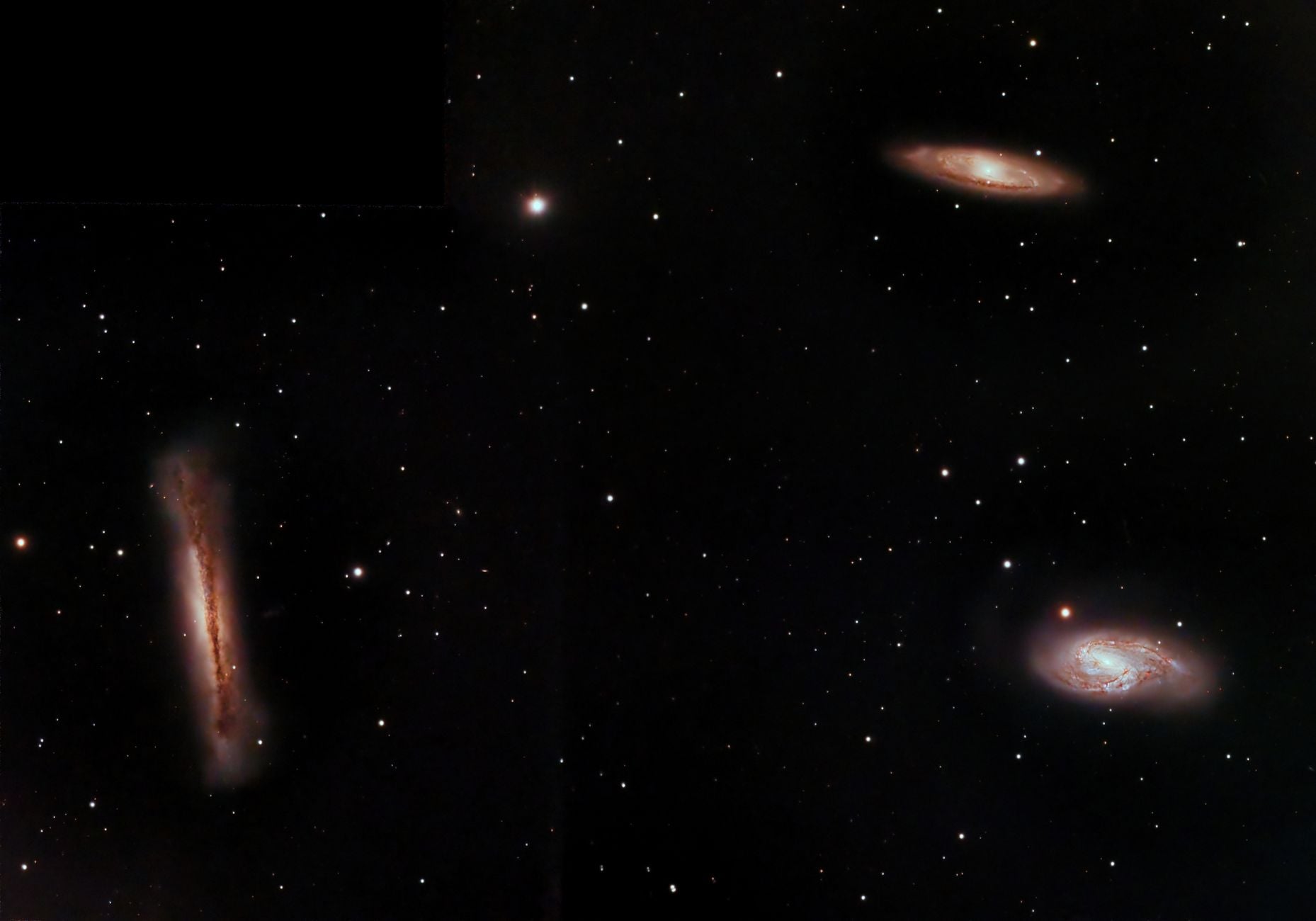
That the universe is expanding has been known for nearly a century. Galaxies are flying apart, and the more distant ones recede faster, as Edwin Hubble worked out in the 1920s. The shock came in 1998, when two teams measuring exploding stars found that the expansion is not slowing under gravity, as almost everyone expected, but speeding up.
Something is pushing the universe apart, and pushing harder as time goes on. After more than a quarter of a century of work, no one knows what it is. The name physicists gave it, dark energy, is not an answer. It is a label for the size of the gap.
How we know it is accelerating
The 1998 result came from Type Ia supernovae, exploding stars that flare with a known brightness and so can serve as distance markers. Two groups, one led by Saul Perlmutter and the other by Brian Schmidt and Adam Riess, found that the most distant of these supernovae were fainter, and so farther away, than a steadily slowing universe would allow. The expansion had been gaining pace. The discovery won the 2011 Nobel Prize in Physics, and independent measurements, from the leftover light of the Big Bang to the spacing of galaxies, have agreed ever since.
The finding has held up under pressure. When an analysis of supernova data appeared to question it, the result was traced to errors and corrected, leaving the acceleration itself untouched.
That the universe is accelerating is not in doubt.
The name is a placeholder
What is in doubt is almost everything about the cause. Dark energy is reckoned to make up around 68 per cent of all the energy in the universe, and yet the term describes only what it does. It behaves like a uniform push, spread evenly through space, driving everything apart. It says nothing about what that push actually is.
In that sense the name works like dark matter, its better-known cousin. It marks a place where the measurements are clear and the explanation is missing.
The leading guess, and its embarrassment
The simplest candidate is the oldest.
Einstein introduced a cosmological constant into his equations, a fixed energy belonging to empty space itself, and a constant of exactly that kind fits the data well. Empty space, on this picture, is not empty: it carries an energy that pushes outward.
The trouble is that when physicists try to calculate that vacuum energy from quantum theory, the answer comes out too large by something like 120 orders of magnitude, a one followed by 120 zeros. It is often called the worst prediction in physics. The best-fitting explanation for dark energy is also one that nobody can derive from first principles, which is not a comfortable place for a theory to sit.
The current crack in the picture
Lately the constant has looked less secure. The Dark Energy Spectroscopic Instrument, or DESI, has been mapping millions of galaxies to reconstruct how the expansion has changed over time. In results released in 2024 and 2025, combining DESI’s map with the Big Bang’s afterglow, supernovae and the bending of light by gravity, several teams found a hint that dark energy may not be constant at all, but weakening as the universe ages.
If that holds, the simple cosmological constant is wrong, and dark energy is something dynamic. But it is a hint, not a finding. The signal has not reached the five-sigma level of confidence that physicists treat as the threshold for a discovery, and it could still fade as more data arrive. For now it is a crack worth watching, not a conclusion.
What to watch
The question is about to have far more data thrown at it. DESI is still observing, and it will be joined by Europe’s Euclid space telescope, the Vera Rubin Observatory’s long survey of the southern sky, and NASA’s Roman Space Telescope, all designed in part to measure the expansion history precisely enough to tell a constant dark energy from an evolving one.
Within a few years the hint will most likely either harden into a discovery or wash out. Either way, the gap that the words dark energy have been holding open for a quarter of a century is finally being probed at the level where it might begin to close.
