

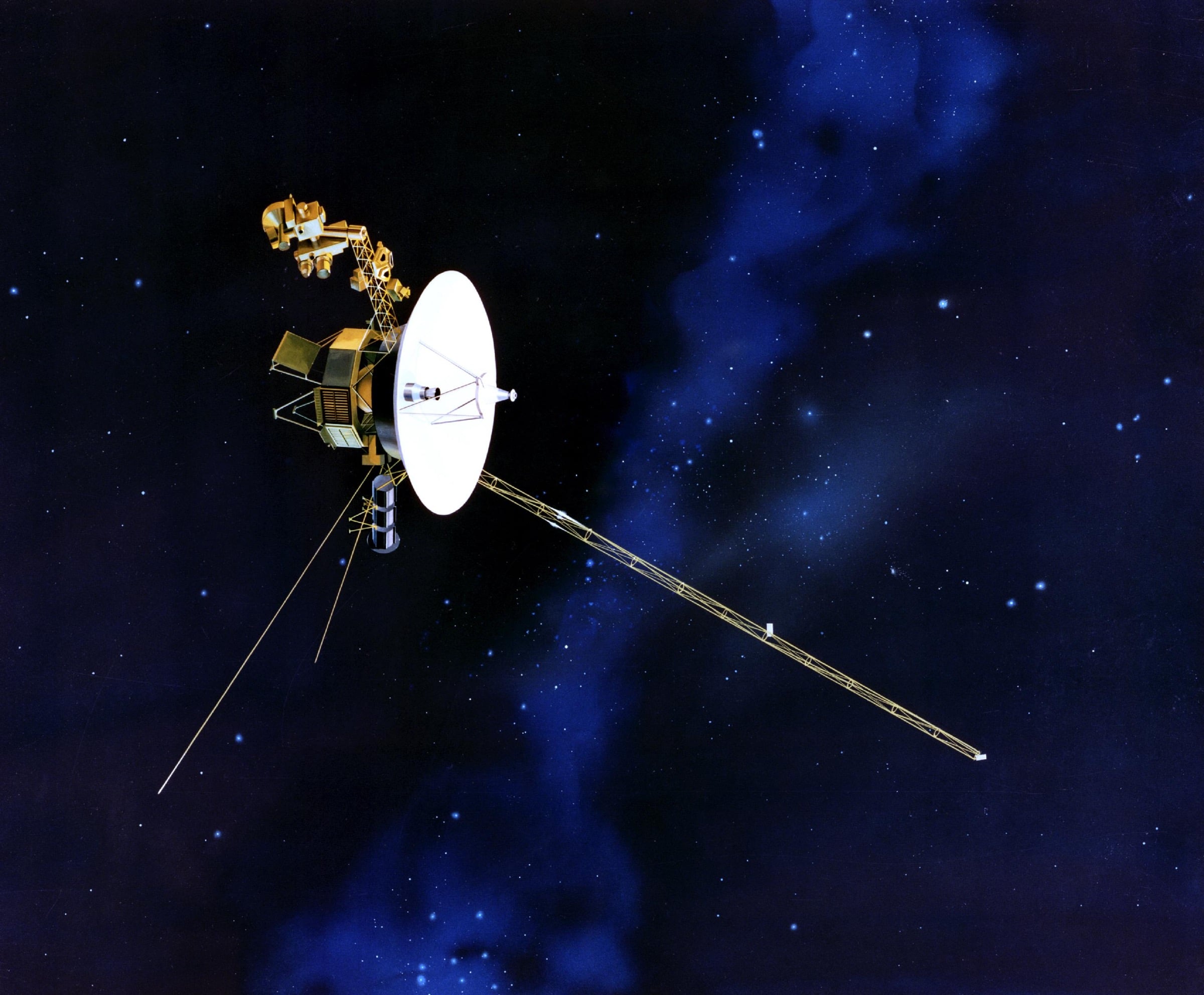
Voyager 2 has no repair port that anyone can reach, no spare spacecraft waiting nearby and no possibility of a technician opening its 1970s hardware. Nearly 49 years after launch, every intervention begins as a command transmitted across more than 20 billion kilometres and ends with a wait of almost two days to learn whether the spacecraft accepted it.
This July, engineers at NASA’s Jet Propulsion Laboratory used that narrow connection to rearrange Voyager 2’s power and thermal systems. The coordinated procedure, nicknamed the “Big Bang,” freed almost 10 watts and postponed the need to shut down another science instrument. NASA says the saving should keep the probe’s three remaining instruments operating for at least an extra year.
Four watts a year is now mission-scale
Voyager 2 launched on 20 August 1977 with three radioisotope thermoelectric generators, or RTGs. These are not nuclear reactors and they do not use a chain reaction. Heat from the natural decay of plutonium-238 crosses thermoelectric materials that convert part of the temperature difference into electricity. The source works without sunlight or moving parts, which is why it could support a journey past all four giant planets and into interstellar space.
It also weakens continuously. NASA says each Voyager loses about four watts of available electrical power every year. Plutonium decay gradually reduces the heat supply, while ageing thermoelectric converters also become less efficient. A four-watt loss was manageable when the probes had hundreds of watts to distribute. With almost half a century of decline behind them, a few watts can now decide whether an instrument survives.
Mission controllers have spent years shedding loads. Cameras and other instruments needed only for planetary encounters were retired. Heaters were turned off, sometimes allowing equipment to run far below the temperature at which it had been tested. A 2025 JPL power plan switched off another instrument on each probe and warned that another decision would arrive after about a year. Before the new operation, Voyager 2 was expected to lose one of its three remaining science instruments by the end of 2026.
The Big Bang was a thermal rewrite
The name sounds dramatic, but the operation did not increase RTG output. It changed which onboard devices consumed the shrinking supply. NASA’s 4 August mission update describes powered devices being switched off while lower-power alternatives were substituted simultaneously. The aim was to reduce demand without letting critical parts of the spacecraft become too cold.
That second requirement turns a power-saving exercise into a thermal puzzle. Almost every active electrical device produces waste heat. A recorder, sensor or propulsion component can warm the compartment around it regardless of what it was designed to do. Turning off a load may save electricity yet remove warmth from a propellant line several centimetres away.
Voyager’s attitude-control thrusters use hydrazine. They keep the high-gain antenna pointed at Earth so controllers can send commands and receive telemetry and science data. If the fuel lines freeze or a thruster branch becomes unusable, the spacecraft can lose its ability to point home. NASA has managed this balance before, including a 2024 Voyager 1 thruster swap that briefly borrowed power from a main heater to warm a dormant branch. The Big Bang applied the same underlying lesson on a larger scale: watts and heat cannot be budgeted separately.
Three devices off, three different devices on
According to a detailed Scientific American account, engineers turned off an old digital tape recorder and two heaters. They simultaneously powered two different heaters and a propulsion instrument. The new combination uses nearly 10 watts less while moving useful warmth toward the places that still need it.
The tape recorder is a particularly Voyager-like trade. During the planetary tour, it stored high-rate observations for later transmission. In the interstellar mission, most science can be returned at lower rates through the Deep Space Network, while the recorder’s electrical demand and heat output became part of a much narrower survival calculation. NASA’s Voyager science plan had long identified eventual retirement of the recorder as one of the remaining power-saving steps.
“All at once” therefore describes a coordinated substitution, not a single magical switch or an instantaneous repair. Removing the old loads without adding the replacements could have produced dangerous cold spots. Adding the replacements first could have pushed the power bus below its margin. The sequence had to move from one stable thermal and electrical state to another without lingering in an unsafe condition.
Testing took months because failure could be final
Engineers developed the plan while Voyager 2’s only command-capable ground antenna, the 70-metre dish at Canberra, was unavailable for upgrades. They then conducted separate power and thermal tests in May and June 2026. The final reconfiguration took place in July and was complete by the middle of the month.
Those tests could not eliminate every risk. Sensors do not measure the coldest points in the thruster lines because the original mission did not expect operators to worry about frozen plumbing almost five decades later. Engineers instead rely on old documentation, thermal models and the behaviour of neighbouring components. The models themselves were built long after launch and must represent a spacecraft whose materials and electronics have aged in deep space.
Distance makes every decision slower. Voyager 2 is roughly 143 astronomical units from Earth, so radio commands take about 19 hours to arrive and telemetry needs about the same time to come back. A troubleshooting exchange occupies the better part of two days before analysis begins. There is no physical inspection if a relay sticks, no replacement heater if one fails and no quick undo if the spacecraft loses its Earth-pointing attitude.
That is the “razor-thin” margin in NASA’s wording. It refers not only to the number of available watts, but to how few safe alternatives remain. The mission has already used backup circuits, colder-than-certified instruments and restored thruster branches. Each new move has fewer systems available to sacrifice.
What the saved watts keep measuring
The operation preserved all three of Voyager 2’s active science instruments: its magnetometer, plasma wave subsystem and cosmic ray subsystem. Together they measure the local magnetic field, infer plasma density from oscillations and track energetic particles originating in the galaxy and the solar system.
Voyager 2 crossed the heliopause in 2018, entering the interstellar medium six years after Voyager 1. It travels in a different direction, so the two probes sample different parts of the boundary between the Sun’s protective bubble and surrounding galactic space. No other working spacecraft has crossed that boundary. Losing one instrument means ending a measurement stream that cannot be replaced by an observatory near Earth.
The result also updates the picture described in SpaceDaily’s earlier account of the Big Bang plan. NASA has now confirmed the Voyager 2 swap succeeded. The team intends to complete the same reconfiguration on the more distant Voyager 1 in the coming months, but success on one probe is not proof that its sibling will respond identically after decades of slightly different thermal and operational histories.
At least one year is a floor, not a warranty
Nearly 10 watts appears to equal two and a half years of a four-watt annual decline. Scientific American reported that the team hopes for about two additional years of operation, while NASA’s formal statement makes the more conservative promise that Voyager 2’s three instruments can remain on for at least an extra year. Both can be true.
The power decline is only one variable. Heater duty cycles change, components age, thermal conditions shift as devices are retired and an unrelated fault could end the mission before electricity does. The saving delays the next instrument shutdown; it does not guarantee that the entire spacecraft will work for a fixed number of additional months.
Nor will the next shutdown necessarily mean silence. Voyager 2 could continue returning data with two instruments, then one, as long as it can power its radio, computers and attitude control. NASA has said the Voyagers may operate at least one science instrument into the 2030s if the spacecraft remain healthy. That is a possibility rather than a scheduled expiry date.
The Big Bang did not refill a nuclear battery, reverse radioactive decay or repair the spacecraft. It found a lower-power route through a heat map that nobody expected engineers to manage in 2026. On a probe too distant to touch and old enough that some critical temperatures were never instrumented, postponing the next irreversible choice by at least a year is the result.