

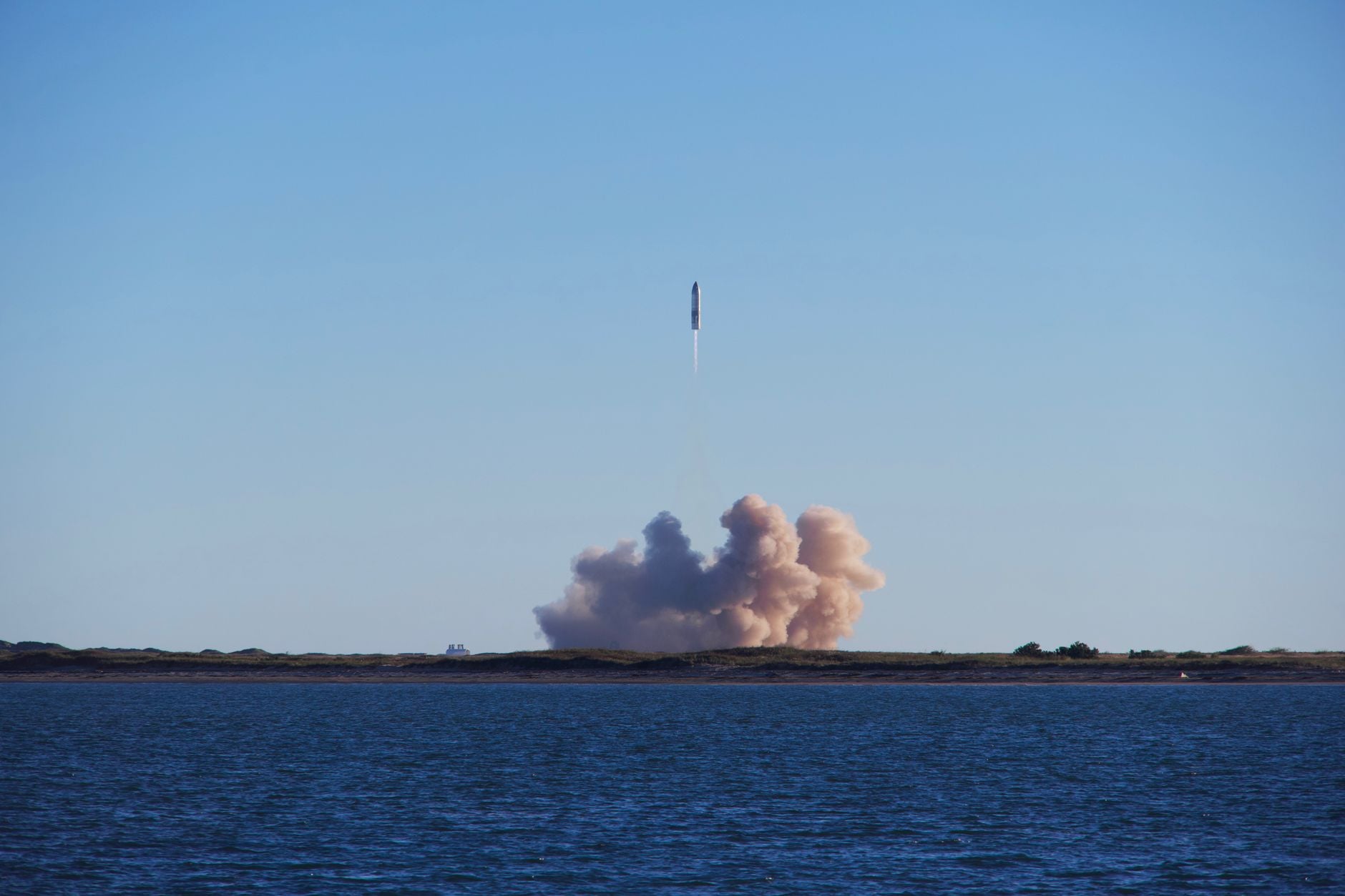
SpaceX’s Starship V3 leaves its launch pad with roughly 18 million pounds of thrust. NASA credits the Saturn V with 7.6 million pounds at liftoff, meaning the current Starship stack produces well over twice the force of the rocket that dispatched Apollo astronauts towards the Moon.
That comparison establishes Starship’s scale, not its readiness for Mars. SpaceX completed the vehicle’s 13th integrated test flight on 24 July 2026, but no two Starships have yet met in orbit, docked and passed propellant between them. That operation is central to the architecture because an upper stage consumes most of its launch load climbing away from Earth.
One Starship did transfer liquid oxygen between two of its own tanks during Flight 3 in March 2024. NASA subsequently judged that experiment successful. It was an important fluid-management test, but it did not involve a tanker, a second ship, rendezvous hardware or a connection made in orbit.
The distinction explains the apparent mismatch between the most powerful rocket ever flown and a fundamental capability that remains on its development list. Thrust gets a vehicle off the ground. A Mars campaign requires an entire transport system to work repeatedly after it gets there.
Starship has more than twice Saturn V’s liftoff thrust
NASA gives Saturn V’s launch thrust as 34.5 million newtons, equivalent to 7.6 million pounds-force. Five kerosene-burning F-1 engines powered its first stage. The rocket stood 111 metres tall and could place about 118 tonnes into Earth orbit.
The Starship V3 flown on Flights 12 and 13 is about 124 metres tall. Its Super Heavy booster uses 33 methane-burning Raptor 3 engines, which together can generate approximately 18 million pounds-force at liftoff. Dividing 18 million by 7.6 million gives a ratio near 2.4.
Thrust is force, however, not payload, reliability, efficiency or mission completion. It must exceed the vehicle’s weight to begin accelerating upwards, and extra thrust can lift a larger vehicle. It says nothing by itself about whether an upper stage can survive re-entry, fly again, support a crew for months or depart Earth orbit with enough propellant to reach another planet.
Saturn V and Starship also embody different trades. Saturn V discarded three stages in sequence and sent only a relatively small spacecraft stack onwards to the Moon. Starship is designed to recover and rapidly reuse both its booster and upper stage. The reusable ship carries tanks, heat shielding, flaps and landing systems that an expendable lunar rocket did not have to bring home.
What the first 13 integrated flights have proved
The flight count begins with the first full Starship and Super Heavy launch in April 2023. It excludes earlier high-altitude ship prototypes, short hops, static firings and other ground tests. SpaceX’s launch listings identify Flight 13 on 24 July 2026 as the latest integrated test.
Across that campaign, SpaceX has demonstrated hot-stage separation, controlled atmospheric entry, planned ocean splashdowns, in-space engine relights, payload deployment and catches of Super Heavy boosters with the launch tower. It has also lost vehicles, investigated failures and changed the design between generations.
Flight 13 mattered because it gave the new V3 vehicle a substantially cleaner mission after Flight 12’s booster anomaly. The upper stage deployed 20 next-generation Starlink satellites, relit a Raptor engine in space and reached its planned Indian Ocean splashdown. Neither its flight plan nor any earlier one included rendezvous and transfer between two Starships.
SpaceDaily’s preview of Flight 13 examined why engine relight mattered to NASA’s Artemis schedule. The completed test reduced that particular uncertainty. It did not erase the separate refuelling milestone.
Flight 3 moved oxygen, but only within one ship
In March 2024, Starship Flight 3 carried an experiment backed by NASA’s Tipping Point programme. While coasting in space, the ship transferred approximately five tonnes of liquid oxygen from a smaller header tank into its main oxygen tank. The operation was designed to study large-scale cryogenic fluid behaviour in low gravity.
NASA’s current TechPort record marks the project complete and says the demonstration achieved its milestone. That result matters because liquid does not simply remain pooled at the bottom of a tank in free fall. Before a transfer or engine burn, thrusters may need to settle it so pumps and lines receive liquid rather than vapour.
The experiment also provided data about pressure control, subcooled oxygen and the conditions required to move cryogenic propellant. Yet the source tank, receiving tank and connecting plumbing were installed inside the same vehicle before launch. Nothing had to rendezvous or dock, and no coupling had to join two independently moving spacecraft.
Ship-to-ship transfer adds a chain of new failure points
A full demonstration begins with two successful launches. A target Starship and a tanker must enter compatible orbits, navigate relative to each other, approach without collision and dock through a structural interface that can carry forces and fluids.
Transfer lines exposed to space must be connected and chilled before extremely cold liquid methane and oxygen can flow through them. Both vehicles must control their orientation, settle propellant near tank outlets and maintain the pressure difference that drives transfer. Engineers must limit boil-off, avoid unstable two-phase flow and measure how much liquid actually reaches the receiving tanks.
Doing this once is the first threshold. An operational mission would need the process to be routine and repeatable across several tanker launches on a tight schedule. A delay can leave stored propellant absorbing heat while the depot or mission ship waits in orbit.
A March 2026 NASA Office of Inspector General report called large-scale vehicle-to-vehicle cryogenic transfer one of the most significant technical challenges facing SpaceX’s Human Landing System. It said a test once planned for March 2025 had slipped by a year and highlighted the additional risk of achieving the launch-pad turnaround needed for a refuelling campaign. The demonstration still had not occurred by the end of Flight 13.
Why a Mars-bound Starship cannot simply launch full
A rocket pays an enormous energy cost to reach low Earth orbit. Starship must lift its upper stage, payload, recovery equipment and propellant through the atmosphere and accelerate them to orbital speed. By the time the ship arrives, much of the propellant loaded on the ground has already been burned.
For a high-capacity trip beyond Earth, SpaceX proposes launching tanker variants separately. They would deliver methane and oxygen to a depot or directly to the mission ship, allowing it to leave low Earth orbit with replenished tanks. The exact number of tanker launches depends on the evolving vehicle, payload, destination and how much propellant each flight can deliver.
SpaceX’s published lunar architecture describes tanker Starships supplying an orbital depot before a lander fills up and continues to the Moon. Mars requires the same foundational capability to depart Earth with a large payload. A return mission introduces another challenge: producing methane and oxygen on Mars or delivering them in advance.
Refuelling is therefore more than a way to improve payload performance. It is the bridge between Starship as a reusable launcher to low Earth orbit and Starship as the interplanetary transport SpaceX proposes.
The matching flight counts obscure different programmes
Saturn V happened to launch 13 times between 1967 and 1973. Its first two flights were uncrewed, its third carried Apollo 8 around the Moon, and later vehicles supported six lunar landings before the final Saturn V launched Skylab. The numerical symmetry with Starship’s 13 integrated flights is striking, but it is not a fair schedule comparison.
Apollo’s rocket emerged from a vast government programme with extensive component, engine, stage and ground testing beyond the flights themselves. Saturn V was also designed for an expendable architecture whose stages did not have to return, dock with tankers or fly again. Starship’s test campaign is simultaneously developing propulsion, atmospheric return, tower recovery, payload operations and rapid reuse.
SpaceX’s own 2026 prospectus names in-orbit propellant transfer and catching the upper stage among the key milestones still to be demonstrated. It also describes refuelling as the capability that would extend the upper stage into deep-space missions.
Orbital transfer is not the only unfinished requirement for Mars. Starship still needs genuinely rapid reuse, a durable heat shield, high launch cadence, long-duration power and life support, radiation protection, reliable landing with heavy cargo and a credible path to return propellant. The Flight 13 result advances several nearer-term pieces without resolving that larger chain.
Starship’s thrust advantage over Saturn V is real. So is the progress represented by 13 flights. The next transformation will not be another record at liftoff, but proving that separate reusable ships can repeatedly meet, dock and turn low Earth orbit into a filling station.